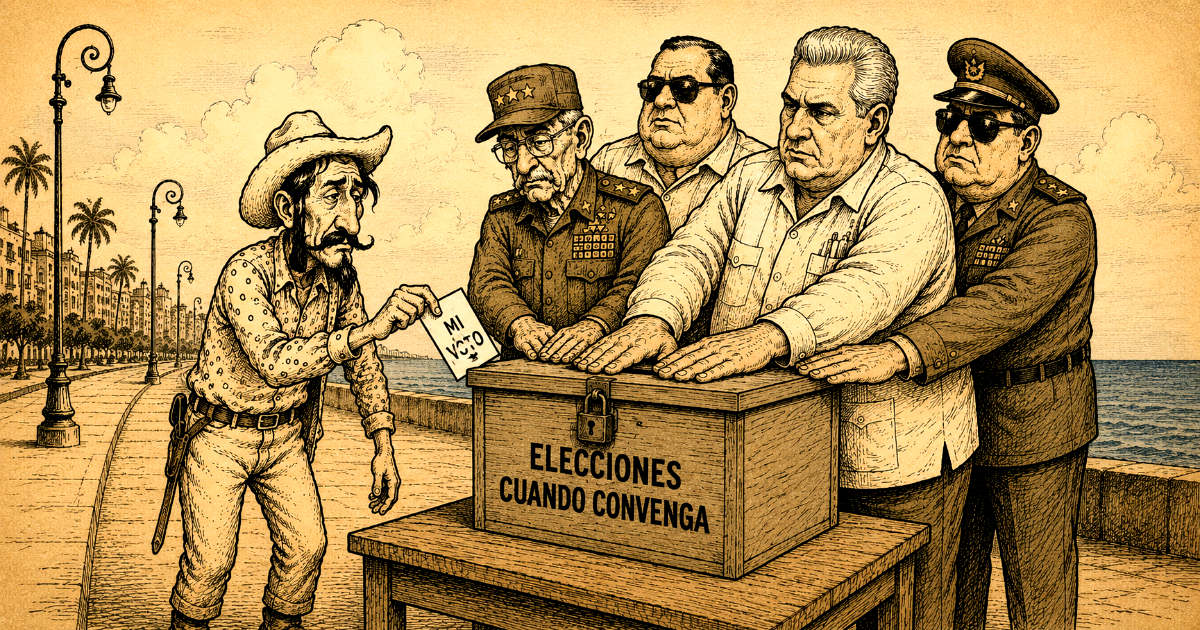
In any democratic society, elections serve as a means for citizens to reward or penalize their leaders' performance.
However, in Cuba, where the Communist Party holds a monopoly on power and candidates for the National Assembly of People's Power (ANPP) do not compete on equal footing with independent candidates nor represent alternative political projects, the scope for decision-making is practically non-existent.
Ironically, the only electoral process that retains a minimal potential for citizens to express their dissatisfaction is the election of local district delegates.
These are elections devoid of political parties and campaigns, and they face significant limitations. Yet, they still represent the sole opportunity for residents to voice their discontent and directly challenge the officials representing the state in their communities, refuse to re-elect them, or express, through voting or abstention, the erosion of the system.
Recently, this process has been postponed.
The secretary of the National Assembly, José Luis Toledo Santander, justified the repeal of Law 183—passed just seven months ago—by stating that "it is not appropriate to conduct an electoral process under the current circumstances," citing the complex economic and social situation facing the country.
The rationale is telling.
There's no assertion that the law was flawed or violated the Constitution. Nor are there insurmountable legal barriers. The real reason lies in the political and economic context, which suggests elections should not take place.
In other words, when the situation becomes inconvenient for those in power, the rules are altered.
Merely a few months ago, the Parliament itself approved an exceptional reduction in the municipal delegates' term from five to four years to separate local and national elections and streamline the electoral calendar.
Now, that very exceptionality is removed. The law is repealed, the term returns to five years, and municipal elections are postponed once again. This marks the fourth delay of municipal elections since 2017.
The official explanation attempts to portray the decision as an act of administrative responsibility. Toledo Santander mentioned the economic cost of the electoral process and the need to focus resources on "other vital processes for the defense and sustainability of the Revolution."
However, this justification raises an unavoidable question.
If the economic situation is too dire to allow citizens to vote, shouldn't that very crisis necessitate greater accountability from those in power?
In any system where elections serve as a mechanism for political control, a crisis of such magnitude would lead to increased democratic demand, not the suspension of participatory mechanisms.
In Cuba, the opposite happens. The crisis doesn't hasten elections; it delays them.
The implicit message is hard to ignore: the worse the system functions, the less convenient it is to consult the populace.
This paradox takes on even greater significance when considering the political context of this parliamentary session.
While the Assembly approves 176 economic measures aimed at correcting the collapse of its productive model, it simultaneously eliminates the only electoral process that could provide even an imperfect and heavily conditioned snapshot of the public mood.
It's no coincidence.
The Cuban regime needs to implement deep reforms amidst the most significant economic deterioration in decades while also minimizing any scenario that could translate that discontent into a politically uncomfortable outcome.
Municipal delegates don't decide national economic policy, don't control the government, and can't disrupt the Communist Party's monopoly. However, they do represent the only link in the system where citizens have direct contact with the nomination and voting process.
Even within the vast limitations of the Cuban totalitarian model, this space retains symbolic value. And it is precisely this space that has been postponed.
Perhaps the most unsettling aspect isn't the postponement itself. What is truly revealing is the ease with which the regime alters its own rules when they no longer serve its needs.
Law 183 was enacted in December 2025. Seven months later, it's deemed obsolete. Not because the Constitution changed. Not due to a technical error. Simply because the power considers that the current circumstances advise otherwise.
This reasoning reflects a fundamentally different conception of the rule of law.
In a constitutional democracy, laws serve to limit power. In Cuba, power dictates the lifespan of laws.
The law ceases to be a stable framework, becoming instead a temporary tool, useful as long as it serves the government's interests and dispensable when it no longer does.
Thus, the decision made this week extends beyond the electoral calendar. It speaks not just to when Cubans will vote but to who decides when they can. And the answer remains the same as ever.
Not the citizens. The power.
Understanding Cuba's Electoral Challenges
Why has Cuba postponed its municipal elections?
Cuba's municipal elections have been postponed due to the regime's assertion that the current economic and social circumstances make it inappropriate to conduct an electoral process. The decision reflects the government's desire to avoid potentially unfavorable outcomes during a time of crisis.
What role do municipal delegates play in Cuba's political system?
Municipal delegates in Cuba serve as the only direct link between citizens and the voting process within the Communist regime. While they don't influence national economic policy or government control, they hold symbolic significance as a point of contact for public expression and participation.
How does the postponement of elections reflect on Cuba's governance?
The postponement highlights the Cuban regime's tendency to alter laws and electoral processes to suit its needs, showcasing a departure from a stable rule of law. It underscores the government's control over when and how citizens can participate in elections.