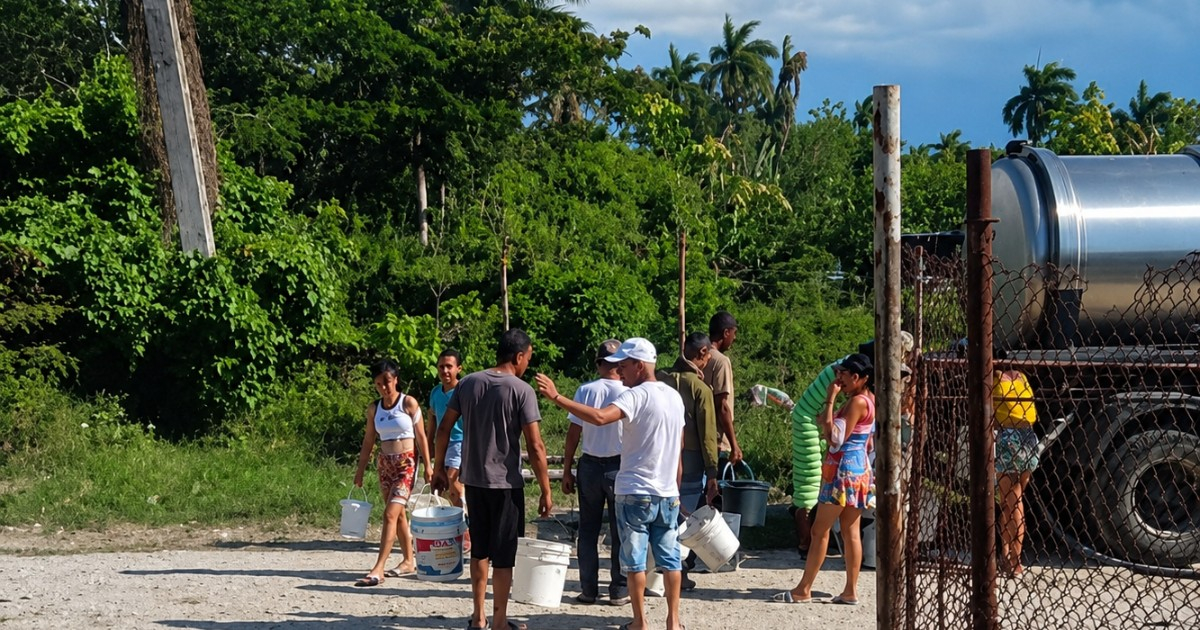
On Wednesday, a Cuban woman named Sisi Aguilera took to Facebook to share a video expressing her deep frustration over the worsening water crisis in Cuba, which she claims has added to the ongoing power outages, painting a grim picture of what she calls "genocide" and "miserable living conditions."
"It's not just the electricity, now it's water too," Aguilera emphasized in the brief video, which has garnered nearly 6,000 views and over 380 reactions.
Escalating Water Crisis in Cuba
Aguilera reported that the entire country is currently suffering from a lack of water, highlighting the exorbitant prices charged by the black market to fill the gap left by the government: "A truckload of water costs 60,000 pesos. A well ranges from 150,000 to 250,000 Cuban pesos, and no one here earns that kind of money in a year."
The stark reality is underscored by the fact that the official average salary in Cuba is approximately 7,074 Cuban pesos per month, equivalent to about 13 dollars on the informal market, according to data from the ONEI cited by Infobae in April 2026.
Fear and Silence Among the Population
Aguilera also pointed out that fear contributes to the silence: "Eighty percent of the population doesn't even speak out on social media because they're afraid, afraid to tell the truth, afraid to show the reality."
She ended her message with a statement that resonates with millions: "It's not just the electricity, it's not just that your food is spoiling, now you don't even have water to drink, and hygiene is a luxury in this country."
Widespread Impact and Infrastructure Issues
The crisis Aguilera describes is backed by statistics. Official Cuban figures released in May 2026 show that nearly three million Cubans regularly face water shortages, while about 10 million—virtually the entire population—receive water intermittently.
In Havana alone, more than half a million residents were affected by the water crisis in July 2026, compared to the 200,000 reported in April. According to The Guardian, up to 70% of the city's water supply is lost to leaks before reaching households.
The root of the problem lies in the infrastructure: Cuban aqueducts are heavily reliant on electric pumps, so every blackout—which in 2026 can last between 12 and 20 hours a day—automatically disrupts the water supply. In May 2026, the system was operating with just 37% of the necessary fuel, as reported by Infobae.
Growing Social Unrest
The mounting desperation has spilled over into both social media and the streets. The Cuban Conflict Observatory recorded 107 street protests in June 2026, marking an all-time high.
On Monday, four young people were arrested in Sibanicú after protesting the water shortage, and earlier in July, residents of Mantilla blocked traffic in response to the same issue.
Understanding Cuba's Water and Power Challenges
What is causing the water crisis in Cuba?
The water crisis in Cuba is largely due to the dependency on electric pumps for water supply. Frequent power outages, some lasting 12 to 20 hours, severely disrupt the system. Additionally, infrastructure issues such as leaks result in significant water loss before it reaches consumers.
How are Cubans coping with the water shortage?
Many Cubans are turning to the black market for water, where prices are exorbitantly high. A truckload of water can cost 60,000 pesos, while digging a well might cost between 150,000 to 250,000 pesos, amounts that are unaffordable for most given the average salary.
What has been the public reaction to the crisis?
The public's response has been one of growing frustration and anger, leading to an increase in street protests. In June 2026 alone, there were 107 demonstrations, the highest number recorded, as people demand solutions to the ongoing shortages.