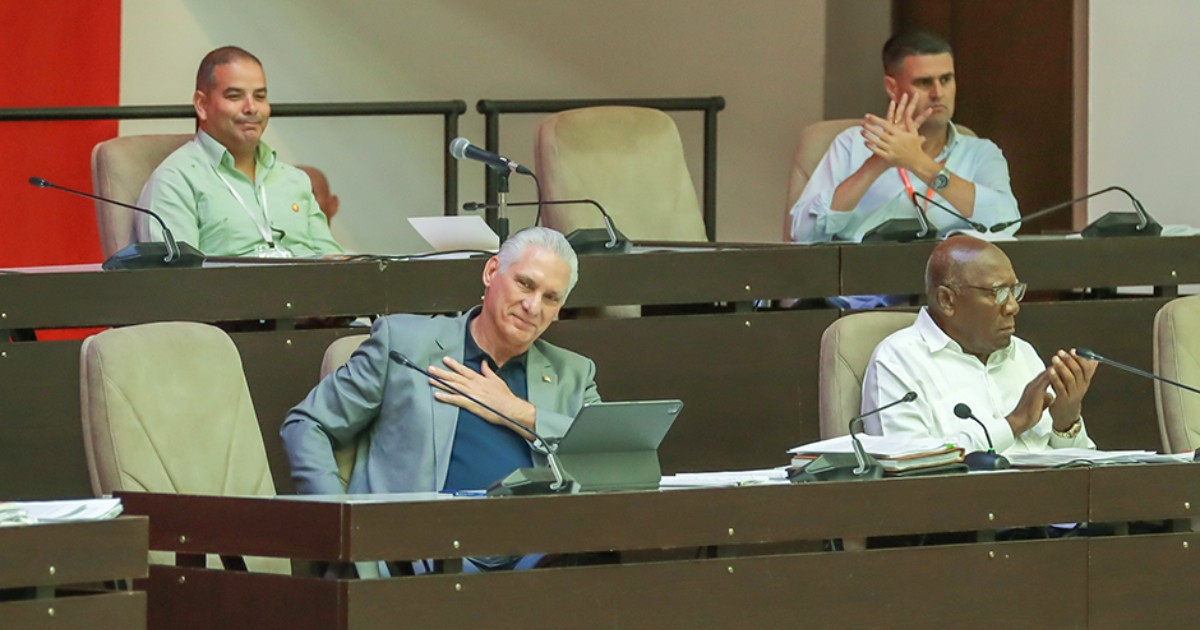
The National Assembly of People's Power commenced its seventh regular session of the tenth legislature on Wednesday at Havana's Palace of Conventions. Despite the addition of ten new deputies and an extensive legislative agenda, there appears to be a lack of tangible solutions to the pressing crisis faced by the Cuban population.
Raúl Castro participated via video link, while Miguel Díaz-Canel was present in person for the opening of the session, which exclusively gathers deputies from Havana physically; representatives from other areas of the country join remotely, as reported by the state media outlet Cubadebate.
The session began by confirming the election of ten parliamentarians—including government spokesperson Jorge Legañoa—to fill vacancies in an equal number of municipalities, in accordance with Cuba's Electoral Law, which mandates that municipal assemblies appoint replacements when a seat becomes permanently vacant.
The official agenda includes evaluating the so-called "economic and social transformations" implemented in 2026, reviewing the state budget's execution for the first half of the year, and finalizing the 2025 budget, which is projected to have a deficit of 74,500 million pesos.
Legislation up for approval includes the Agricultural and Forestry Land Law, the Law for Central State Administration Organization—which proposes reducing central agencies from 27 to 21—the Housing Law, the Labor Code, and the Personal Identity and Residence System Law.
Foreign Minister Bruno Rodríguez Parrilla will also present a report on Cuba's international situation, at a time when U.S. pressure on the regime remains high.
The session commenced with a moment of silence in memory of Ramiro Valdés Menéndez, who passed away on June 21, 2026, at the age of 94. Valdés was one of the last surviving figures from the revolutionary generation.
The context in which this parliament convenes—widely criticized as a rubber-stamp body lacking genuine debate—could not be more grim. According to Infobae, Cuba's GDP has shrunk by over 15% since 2020, with an estimated 5% contraction in 2025 and projections of up to 7.2% for 2026.
As deputies discuss laws, citizens endure power outages lasting up to 30 hours daily, shortages of food, medicine, and fuel, and persistent inflation that erodes the purchasing power of salaries, which as of July 1, have a minimum of 3,210 pesos, although actual payments were deferred to August.
In June, the regime announced a package of 176 economic transformation measures, including the introduction of private banking and currency exchange houses. Touted as the largest reform in decades, its actual impact on the daily lives of Cubans remains to be seen.
The new Housing Law being debated has raised concerns among analysts, who warn it reinforces state control over the sector rather than expanding citizens' rights.
With 470 deputies in its tenth legislature—now ten more than at the period's start—the National Assembly meets only twice a year to approve, in a matter of hours, an agenda pre-determined by the Communist Party and the Council of State.
Key Issues Facing Cuba's National Assembly
What is the current economic situation in Cuba?
Cuba's economy has faced significant challenges, with a GDP decline of over 15% since 2020. The economy is projected to contract further by 5% in 2025 and possibly up to 7.2% in 2026.
What new laws are being considered by the Cuban parliament?
The parliament is set to discuss several laws, including the Agricultural and Forestry Land Law, the Law for Central State Administration Organization, the Housing Law, the Labor Code, and the Personal Identity and Residence System Law.
How does the public view the new Housing Law?
Analysts have expressed concern that the new Housing Law may increase state control over the housing sector, rather than expanding rights for citizens.