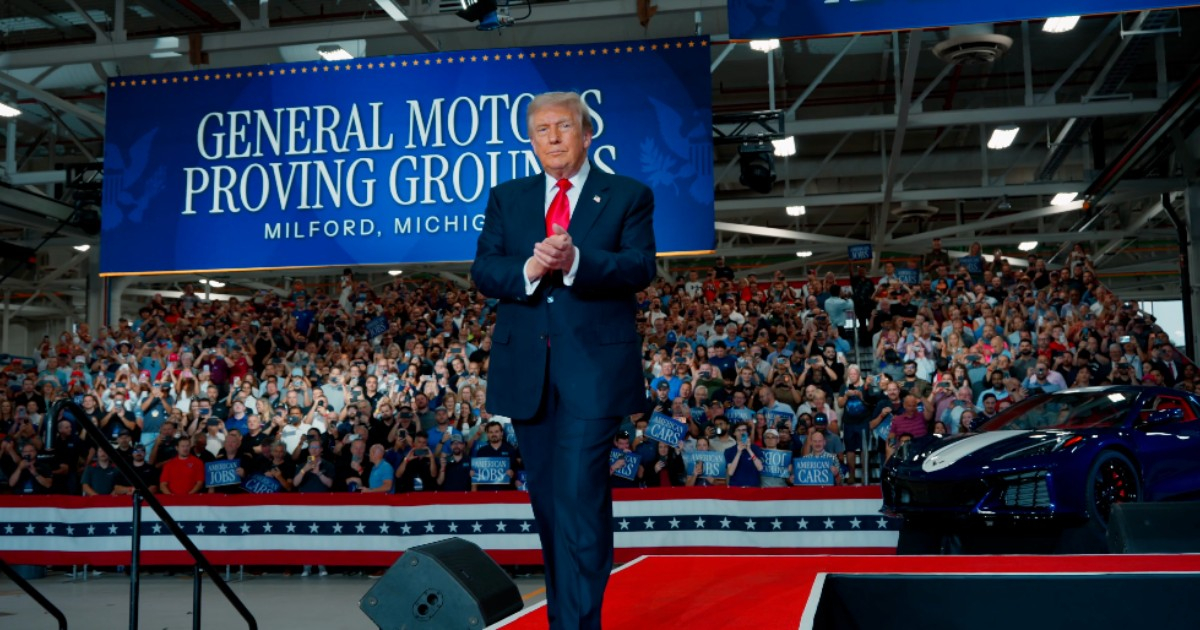
On Tuesday, President Donald Trump declared that the American auto industry is experiencing a revival directly due to his administration's tariff policies. This announcement came during his visit to General Motors' testing facility in Milford, Michigan, where he addressed both workers and company executives.
According to a report by La Jornada, Trump credited the shift of production lines from Mexico back to the United States to the 25% tariff his administration imposed on vehicles manufactured abroad, effective since April 2, 2025.
"For years, companies moved production from the United States to Mexico, but now they are coming back, and production is moving from Mexico," Trump stated to the audience gathered at the event.
Trump highlighted companies like Toyota, Hyundai, and Ford as examples of manufacturers relocating operations within the U.S. He noted that Ford is investing $3 billion to produce parts for a new truck in central Michigan.
General Motors' Expansion
Regarding General Motors, the president noted that the company increased its production of trucks and utility vehicles by 20% during 2026 and has allocated $9 billion over the past two years to expand operations on American soil.
The rationale behind his trade policy, as Trump explained, is straightforward: "If you manufacture your truck or car in a foreign country, you have to pay for the privilege of sending it to our market. But if you build in a factory in Michigan or somewhere else in our country, you pay zero tariffs."
The White House released a statement titled "Made in Michigan Again," which attributes these investments directly to the president’s trade agenda, indicating that GM is investing $6 billion in U.S. manufacturing, including the Orion Township plant.
Investment Plans and Controversies
However, specialized media pointed out that some of these investment plans were conceived before Trump returned to the White House, and the tariffs could cost GM up to $3.5 billion, while Ford and Stellantis anticipate costs exceeding $1 billion each.
During the same speech, Trump mocked Mexico with a tone of derision, mimicking President Claudia Sheinbaum's pronunciation of "Me-hee-ho" and threatening to halt all U.S. automotive investment in that country. Sheinbaum had previously stated on July 23 that no automaker had informed her of plans to exit Mexico.
Nonetheless, Toyota did announce in July a $3.6 billion investment to gradually shift part of the Tacoma production from Tijuana, Baja California, to San Antonio, Texas, in a process expected to continue until 2030. Mexican authorities clarified that the Guanajuato plant remains operational and that it does not signify a complete withdrawal from the country.
Impact of New Tariffs
Meanwhile, Trade Representative Jamieson Greer noted that the new 10% or 12.5% tariffs applied to 60 countries for alleged forced labor practices would have minimal economic impact, given that their rates are similar to tariff measures already adopted globally.
“Today, I am proud to say that the auto industry is back, and America is back,” concluded Trump in front of the GM workers in Michigan.
Understanding the Impact of Tariffs on the U.S. Auto Industry
How have tariffs affected the U.S. auto industry according to Trump?
Trump claims that the tariffs have encouraged auto manufacturers to relocate production back to the United States from countries like Mexico.
What companies were mentioned as moving operations back to the U.S.?
Toyota, Hyundai, and Ford were specifically mentioned as companies shifting operations back to the United States.
How significant are the investments by General Motors in the U.S.?
General Motors has increased production by 20% and invested $9 billion over the last two years to expand its operations in the U.S.