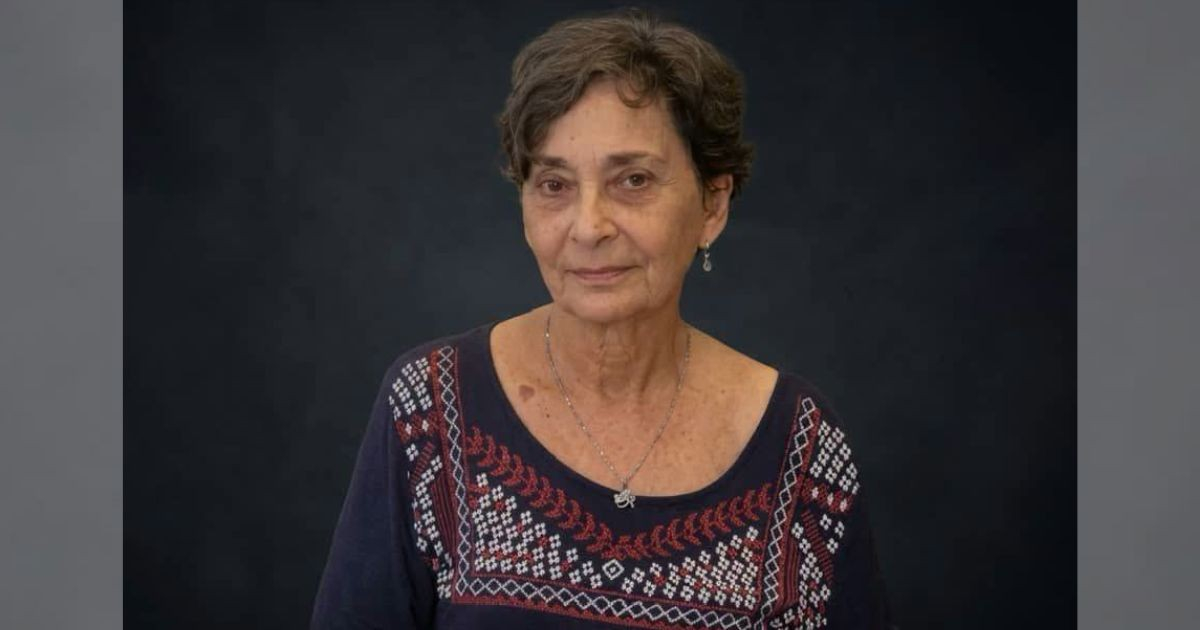
Concepción Valdés Castro, a revered Professor Emeritus from the University of Havana and the first Cuban woman to earn a Doctorate in Mathematical Sciences, has passed away, the university announced on Wednesday.
"The university community mourns deeply the loss of Dr. Concepción Valdés Castro, a pivotal figure in the teaching of Mathematics in Cuba," the institution shared on social media.
The university emphasized that her teaching was characterized by intellectual rigor, an enthusiasm for education, and a commitment to advancing higher education in Cuba.
"To her family, colleagues, students, and friends, we offer our heartfelt condolences, confident that her legacy will endure in every classroom, every book, and in every professional shaped by her guidance," concluded the University of Havana's statement.
Born in 1946, Valdés Castro passed away last Sunday during a flight from Panama to Havana, returning from the Latin American Meeting on Mathematics Education in Santo Domingo, Dominican Republic.
She completed her secondary education at the Institute of La Víbora and entered the University of Havana in the early 1960s.
Early Achievements and Academic Influence
Part of the second cohort of graduates following the University Reform, Valdés Castro began lecturing to junior students while still in her second year, due to a shortage of faculty.
In 1976, she earned a Doctorate in Mathematical Sciences from Moscow State University M. V. Lomonosov, marking her as the first Cuban woman to achieve this academic distinction in her field.
For over fifty years, she dedicated herself to teaching, research, and nurturing generations of mathematicians, primarily at the University of Havana.
Research and Literary Contributions
Her academic focus was primarily in Mathematical Analysis, though she also explored Queue Theory and Reliability. The University of Havana recognized her as a founder of the Mathematics program in Cuba.
Valdés Castro's career was closely tied to the early years of this specialization, where she began as a teaching assistant and later joined the faculty at what is now the Faculty of Mathematics and Computer Science.
Together with her husband, mathematician Carlos Sánchez Fernández, she produced extensive pedagogical work and writings on the history of mathematics.
She coauthored several books, including "The Bernoullis: Geometers and Travelers," "Functions: A Stroll Through Their History," "From the Bernoullis to the Bourbaki: A History of the Art and Science of Calculus," and "Kolmogorov: The Tsar of Chance."
Recognition and Legacy
Among her career accolades are the Sofia Kovalevskaya Award, for Lifetime Achievement, and the Raimundo Reguera Prize, which honors outstanding contributions to Mathematics.
Valdés Castro was awarded the Sofia Kovalevskaya Prize in March 2023 during a ceremony at the University of Havana's Aula Magna.
Her passing adds to a series of recent losses of esteemed Cuban academics that the university community continues to mourn.
Frequently Asked Questions About Concepción Valdés Castro
Who was Concepción Valdés Castro?
Concepción Valdés Castro was a prominent Cuban mathematician and the first Cuban woman to earn a Doctorate in Mathematical Sciences. She was a Professor Emeritus at the University of Havana.
What were Concepción Valdés Castro's academic contributions?
Her academic work focused on Mathematical Analysis, Queue Theory, and Reliability. She was instrumental in the establishment of the Mathematics program in Cuba and coauthored several influential books on mathematics history.
What awards did Concepción Valdés Castro receive?
She received the Sofia Kovalevskaya Award for Lifetime Achievement and the Raimundo Reguera Prize for her significant contributions to the field of Mathematics.