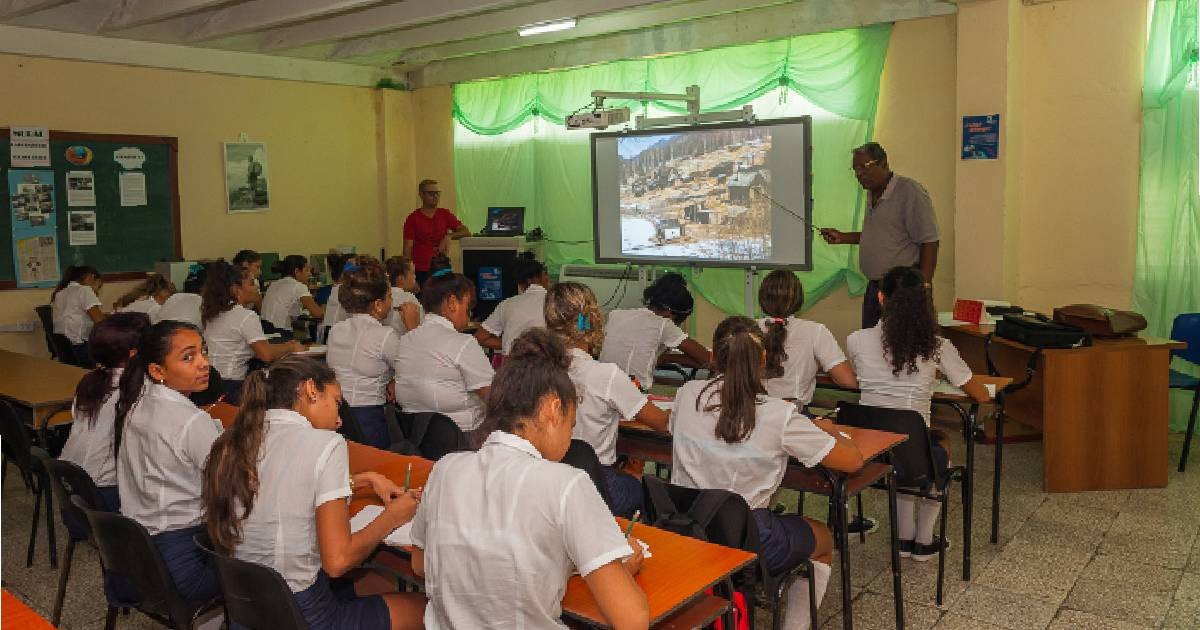
The Cuban regime announced a revamped pay scale for educators within the General and Secondary Education System this Tuesday. This update, articulated in the Ministry of Labor and Social Security's Resolution 18/2026, was officially released in the Official Gazette No. 8 Special Edition.
The regulation sets the base salary for teachers and professors with higher education degrees at 7,735 CUP per month (classified under Salary Group XIX). Those with a higher technical degree will earn 6,740 CUP (Group XVI), while teachers with a medium level will receive 6,130 CUP (Group XIV).
Effective from July 1, 2026, the new salary structure will reflect in the August payroll, as detailed in the Official Gazette.
Economic Overhaul and Teacher Compensation
This resolution is part of a broader set of 176 Economic and Social Transformations ratified by the National Assembly on June 19, 2026. Introduced by Prime Minister Manuel Marrero Cruz, the initiative also raises the state's minimum wage from 2,100 to 3,210 CUP monthly—a nominal increase of approximately 53%—benefiting over a million public sector employees in areas such as Health, Education, Culture, and Public Administration.
Resolution 18/2026's text justifies the change by stating, "The approved Economic and Social Transformations necessitate implementing a salary increase in the budgeted sector, which requires modifying the salary organization of the General and Secondary Education System to implement the approved increases."
Additional Incentives and Payments
Beyond the base salary, the regulation stipulates monthly additional payments based on teaching categories: 750 CUP for Expert Teachers, 500 CUP for Principal Specialist Teachers, and 250 CUP for Specialist Teachers.
Teachers also receive bonuses for years of service: 1,000 CUP after five years, 1,400 CUP after ten years, and 1,800 CUP after 15 years of service.
Educators serving as Guide Professors at the secondary and higher secondary levels will be classified under a higher complexity group than their current position, along with an extra 1,000 CUP for working in pre-university vocational institutes specializing in exact sciences.
Challenges Amid Economic Hardships
It is worth noting that Resolutions 15, 17, 18, and 23, all dated July 15, 2026, were initially published in the ordinary edition No. 60 on July 17 with inaccuracies. The Gazette clarified that "due to an error by the issuing body, inaccurate data were recorded and require correction for better understanding and application," which led to this special rectified edition.
The total cost of the salary reform for the state budget is estimated to be around 42,500 million pesos.
However, this pay increase comes against the backdrop of a severe educational and economic crisis. Cuba is grappling with a shortage of at least 24,000 teachers nationwide—equivalent to 12.5% of teaching positions—due to migration, the shift to the private sector, and historically low wages.
In Camagüey alone, over 2,000 teachers were missing for the 2025-2026 school year, directly affecting around 98,000 enrolled students.
Since the implementation of the "Ordering Task" in January 2021, inflation has surpassed 200%, with the estimated monthly basic basket costing between 25,000 and 50,000 CUP, far exceeding the new maximum teacher salary of 7,735 CUP. As of April 2026, a primary school teacher reported earning only 3,000 CUP monthly, equating to six to ten dollars at the informal exchange rate.
While the nominal increase appears significant on paper, it fails to address the real decline in the purchasing power of Cuban teachers, who will continue to earn wages far below the actual cost of living on the Island.
Impact of Salary Changes on Cuban Education
How will the new salary scale affect Cuban teachers?
The revised salary scale provides a nominal increase in earnings for Cuban teachers. However, due to high inflation and significant cost of living, the increase may not substantially improve their purchasing power.
What additional payments are available for teachers?
Teachers may receive additional monthly payments based on their category, as well as bonuses for years of service. There are also extra payments for those working in specific educational roles or institutions.
What challenges does the education sector face in Cuba?
Cuba's education sector is currently facing challenges like a severe teacher shortage, high inflation, and low wages, all of which are affecting the quality of education and teacher retention.