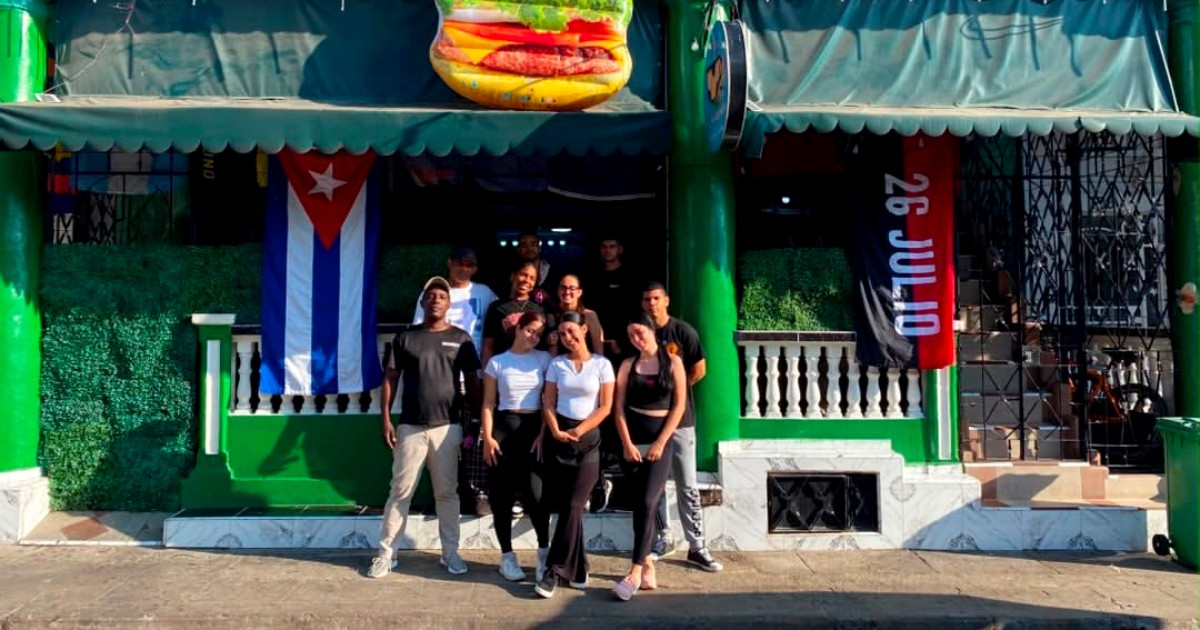
Fast-food restaurant La Masía 24H, situated in Pinar del Río, joined in the National Rebellion Day festivities this past Sunday by sharing a post on Instagram. The post showcased both the Cuban flag and the July 26th Movement flag displayed prominently on the building's exterior, expressing pride in both their team and their homeland.
“With the Cuban flag and the July 26th flag, we reaffirm our respect for our history and our commitment to providing the best service to our customers,” the restaurant stated in their message, which garnered 91 reactions.
The gesture by La Masía 24H—a 24-hour establishment serving burgers and pizza—mirrors a growing trend among private Cuban businesses publicly aligning themselves with the regime during politically significant dates.
This Sunday marked the 73rd anniversary of the attack on the Moncada Barracks, an event the regime regards as the beginning of the so-called "Cuban revolution," celebrated annually with political events, fairs, and mobilizations nationwide.
Growing Trend of Political Alignment in Business
In this context, private operators in Cienfuegos reopened iconic dining spots like Covadonga, Coppelia, and El Cairo ahead of the date, while in Havana, agricultural and commercial fairs were organized featuring participation from small and medium enterprises (SMEs) and cooperatives. In Granma, an agri-commercial fair offered prices aligned with wages for the July 26th celebrations.
The regime has adeptly leveraged these initiatives to portray a unified image between the private sector and the official political project.
The Strained Relationship Behind the Scenes
The most notable precedent for this instrumentalization dates back to 2023, when the SME Cubamodela funded the first commercial advertorial on Cubadebate, marking the beginning of private advertising in official media.
Between September and October of that year, Ideas Multimedio Group earned over 712,000 pesos from advertising paid by SMEs.
However, the relationship between the private sector and the government is far from harmonious.
The government implemented Resolution 225/2024, which established price ceilings for basic goods sold by SMEs, and began penalizing those who violated these limits, even shutting down 12 businesses in Las Tunas for price cap violations.
The regime later admitted that this policy led to a shortage of chicken in SMEs.
In June 2026, the regime approved 176 economic measures that require private actors to support elements of the state's social assistance, such as pensions and funeral services.
Weeks later, Prime Minister Manuel Marrero Cruz publicly called on “bold entrepreneurs” to join the regime's economic project.
Survival or Genuine Support?
Analysts suggest that private businesses publicly endorsing the official discourse do so out of survival in an environment where the state controls licenses, supplies, and regulations, rather than genuine ideological support. Others link these actions to corrupt practices and the proliferation of frontmen for public figures within the regime.
Nevertheless, the display of revolutionary symbols by SMEs creates a real propaganda effect that the regime exploits to project an image of popular support for its political project.
Understanding the Dynamics of Private Business and Political Alignment in Cuba
What is the significance of the July 26th Movement in Cuba?
The July 26th Movement marks the anniversary of the attack on the Moncada Barracks in 1953, which is considered the beginning of the Cuban revolution. The regime celebrates this day annually with political events and activities nationwide.
How do private businesses in Cuba align with the regime?
Private businesses in Cuba sometimes publicly display symbols or messages that align with the regime, especially during politically significant dates, as a means of survival in a state-controlled environment.
What challenges do private businesses face under Cuba’s regime?
Private businesses face challenges such as strict government regulations, price caps, and penalties for non-compliance, as well as the need to navigate a system where the state controls licenses and supplies.