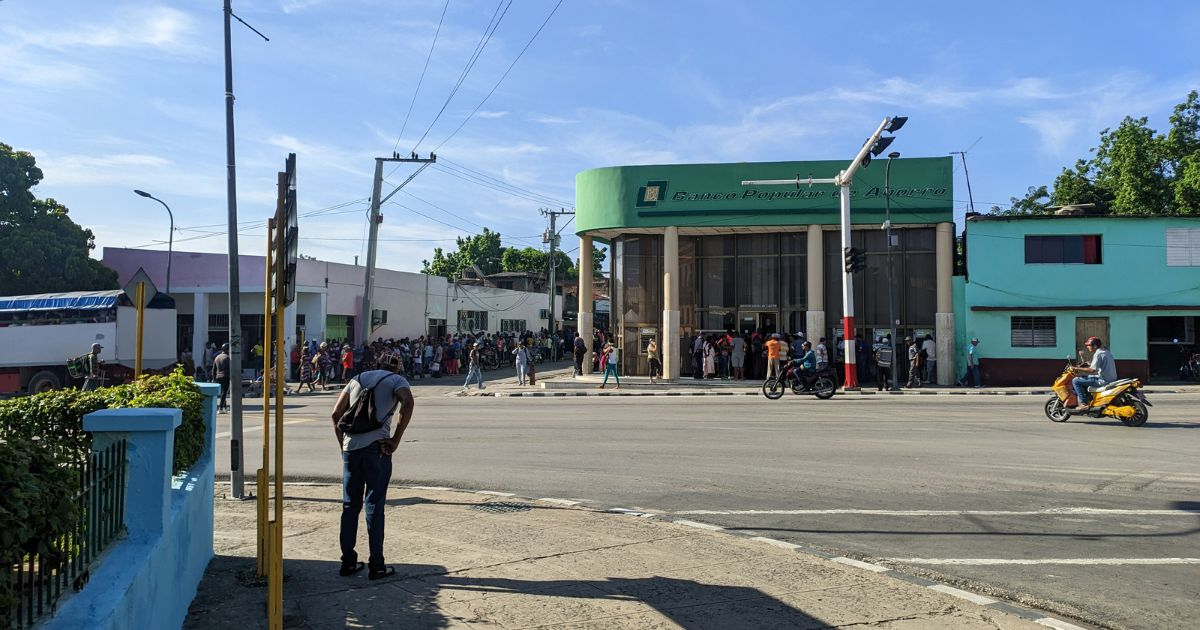
The Credit and Commerce Bank (Bandec) in Santiago de Cuba has openly acknowledged that retirees in Cuba face the challenge of waking up early to access their cash, describing the situation as a "challenge," while proposing the "extra cash" service as a remedy for bank branches operating without power.
An article, attributed to "Bandec Santiago Communicators," concedes that "rising early in the morning to conduct any transaction at a service entity presents a challenge given the socio-economic conditions the country is experiencing."
Additionally, the article outlines the "extra cash" scheme as "a solution that is currently benefiting primarily those in need; individuals who rise early and require cash to purchase essential goods, only to find bank offices without electricity."
This mechanism shifts the responsibility of physically distributing pensions to private businesses and small enterprises. These establishments receive a list containing the name, identity card, and exact amount for each retiree, dispense the cash, and have up to 72 hours to submit the documentation to the bank, which reimburses them automatically.
However, delegating pension payments to private entities highlights the State's failure to fulfill a constitutional duty.
The scheme was initially launched as a pilot in April 2026 in four Havana municipalities and expanded in May to Holguín, where approximately 20 small enterprises disbursed pensions to nearly 5,000 retirees, accounting for 9.6% of the municipality's total.
Subsequently, the Central Bank announced its rollout nationwide as part of a package of 176 economic measures.
The bank's publication comes on the heels of reports of large queues of elderly people forming in Santiago de Cuba outside the Banco Popular de Ahorro in Plaza de Dolores, seeking to cash pensions ranging from 4,000 to 5,000 Cuban pesos.
The branch can only serve about 50 retirees daily with priority service, forcing individuals as old as 80 to start queuing from 6 PM the previous day, enduring waits on the sidewalks for four to eight hours.
Additionally, in Santiago de Cuba, a black market was documented where up to a 40% commission is charged to convert electronic transfers into cash: a transfer of 1,000 pesos only yields 600 pesos in cash.
Challenges for Cuban Retirees Accessing Cash
Why do Cuban retirees need to wake up early to get cash?
Retirees in Cuba must rise early due to limited banking hours and the lack of electricity in some branches, which restricts the number of customers served each day.
What is the "extra cash" scheme proposed by Bandec?
The "extra cash" scheme involves private businesses and small enterprises handling the distribution of pensions, receiving lists of retirees and dispensing the cash, with the bank reimbursing them later.
How does the black market affect cash access for retirees in Santiago de Cuba?
In Santiago de Cuba, a black market charges up to 40% commission to convert electronic transfers into cash, significantly reducing the amount retirees receive in bills.