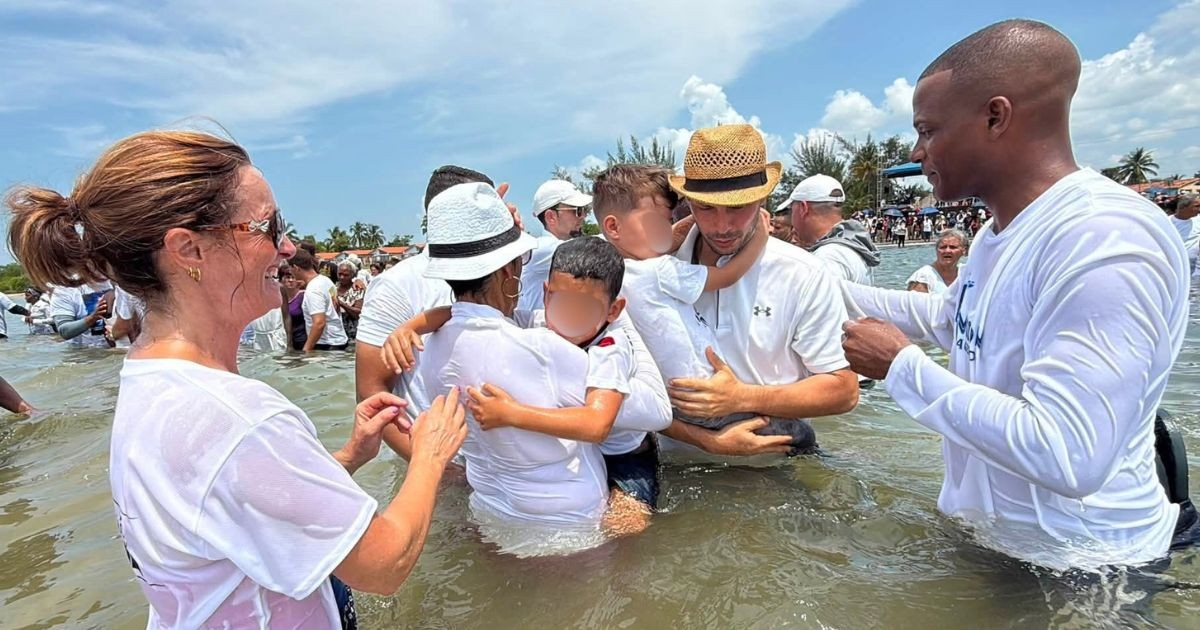
In an extraordinary display of faith, hundreds of families, adults, youths, and children, many clad in white, gathered on a beach in Pinar del Río last Saturday. The event was a massive baptism organized by the Methodist Church in Cuba, with approximately 450 individuals stepping into the sea during what the institution dubbed their "Year of Multiplied Blessings."
Norberto Pedrero, the Superintendent of the Pinar del Río District, led the significant event alongside several local pastors.
Images shared by the church on social media capture a vibrant crowd along the shoreline, with colorful umbrellas and a festive, communal atmosphere. Aerial shots further emphasize the scale of the gathering.
As part of the celebration, each baptized individual received a Bible. The church proudly announced on its official page, "Bibles for the baptized!"
"Together with pastors from the Pinar del Río District. A day of multiplied blessings," summarized the church in one of their social media posts about the eventful Saturday.
Symbolic and Growing Practices
Water baptism is a fundamental rite of initiation in Protestant and Evangelical Christianity. It symbolizes dying to one's past life and being spiritually reborn, serving as a public declaration of faith before the community.
Conducting the baptism in the sea, rather than within a church, adds a symbolic layer and transforms the act into a visible, collective celebration—a practice that has gained momentum in Cuba in recent years.
Faith Amid Crisis
This event takes place as Cuba faces one of its deepest crises, marked by widespread shortages, prolonged blackouts, and rapidly deteriorating social conditions.
Research indicates that in times of extreme hardship, people's turn towards faith tends to increase, and Cuba is no exception. Evangelical and Protestant churches have seen sustained growth over the past decades, offering community, support, and a sense of belonging amidst adversity.
In 2025, the Christian Alliance of Cuba reported that more than 80% of local churches lacked legal recognition, yet this has not hindered the expansion of religious activities.
Expanding Influence of the Methodist Church
The Methodist Church has established a significant presence across Cuba. In 2017, UM News reported over 400 churches and activity in 80% of Cuban municipalities, along with approximately 1,000 mission centers and thousands of prayer groups.
By 2019, the Florida Conference of the United Methodist Church noted that the denomination had reached 99.4% of municipalities, with membership skyrocketing from 12,622 in 2003 to 51,266, a growth of around 306% over 16 years.
A 2025 analysis by the Caribbean Basin Research Institute estimated that regular attendance at Sunday services in Cuban Protestant churches exceeded 600,000 individuals. The study also highlighted that the Methodist Church now has five times more congregants than it did in 1959.
Frequently Asked Questions about the Religious Landscape in Cuba
Why is there an increase in religious activities in Cuba?
In times of severe crisis, such as the current economic and social turmoil in Cuba, people often turn to faith for community support and spiritual solace. This has led to a notable rise in religious activities.
How significant is the presence of the Methodist Church in Cuba?
The Methodist Church is highly influential in Cuba, with a presence in nearly all municipalities and a rapidly growing membership, reflecting its expanding role in Cuban society.
What does the baptism in water symbolize for Protestants and Evangelicals?
For Protestants and Evangelicals, water baptism symbolizes the renunciation of one's past life and a spiritual rebirth, serving as a public commitment to their faith within the community.