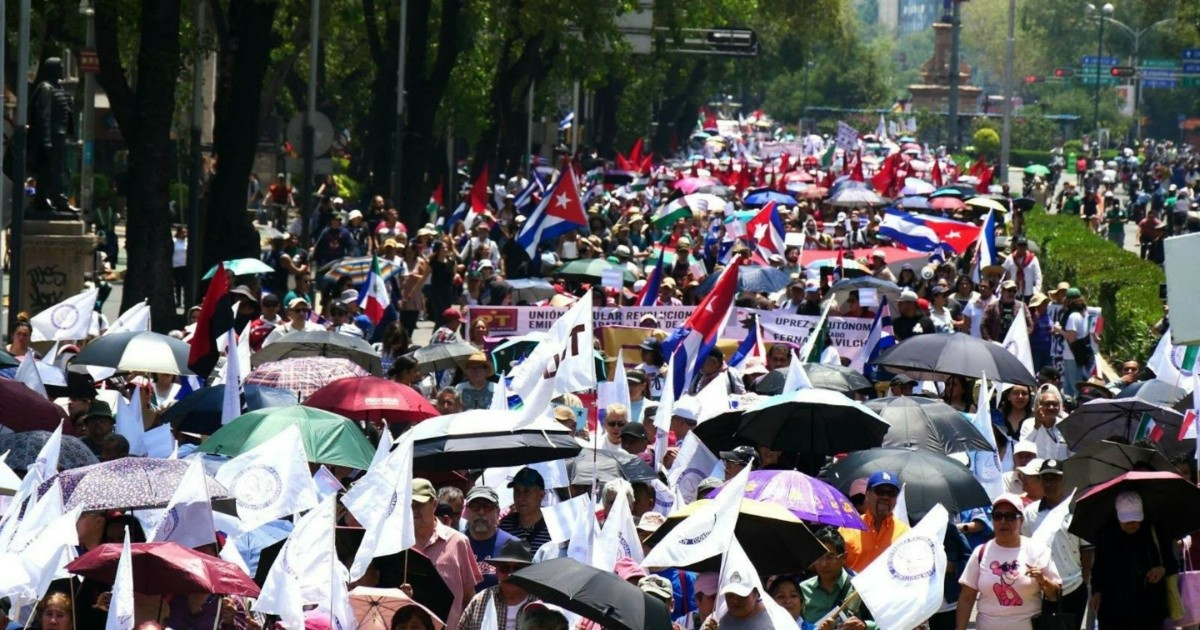
As over a thousand regime supporters paraded down Paseo de la Reforma in Mexico City this past Sunday to commemorate the 73rd anniversary of the Moncada Barracks assault, Cubans both on the island and abroad took to social media to share stark accounts of their daily struggles. This was a direct response to Miguel Díaz-Canel's public thanks for the demonstration.
The Cuban leader expressed his gratitude online, saying, "Thank you, Mexico. Once again at the forefront of the dignity of Our America. To everyone who marched for Cuba on July 26, a grateful embrace from a people who always found solidarity in the noble and generous Aztec land. #CubaIsNotAlone." Instead of support, his post sparked a wave of criticism.
The pro-Cuba protest in Mexico also stirred controversy for another reason: some participants vandalized the Cuauhtémoc Mayor's Office, an act publicly condemned by Mayor Alessandra Rojo de la Vega.
While Mexican Eugenio Martínez celebrated in Díaz-Canel's thread, noting that "several thousand for Cuba in Mexico" was "very exciting and encouraging," Cuban Reinier Álvarez bluntly replied, "Eugenio Martínez, many Cubans in Cuba have no power or water."
One of the most poignant remarks came from Ileidys Del Monte Sánchez: "In Mexico, they can't imagine how the people live. My son's siblings are malnourished children. They've had dengue five times since birth and often go without food. The children are weak, and one is hospitalized with pneumonia. This isn't life; they've forgotten the people, forgotten the most vulnerable."
Another Cuban, Cary Rivero, offered an ironic invitation to the Mexican demonstrators: "Come to Cuba, join us, and I'll even have a room in my house for you. Help me cook with charcoal and give me a hand in buying food because my pension isn't enough." When a Mexican commented that "the people of Mexico support and back the Cuban government," Rivero sarcastically replied, "Well said, to the Cuban government."
Communicator Magdiel Jorge Castro highlighted the lack of mobilization on the island itself: "There were more people in Mexico than in Pinar del Río... it's clear none of them know what communism does to people. Poor ignorant souls."
User Jorge Ramírez drew a geopolitical comparison: "They no longer talk about Venezuela; now the cash cow is Mexico," alluding to Mexico's role as the regime's main external ally in 2026 after Venezuela's shift. Manuel Antonio Ricardo was more direct: "If they come to live here, they'll face a wave of hatred."
The stark contrast between the regime's image of international solidarity and the harsh reality faced by Cubans is striking. Over half a million Havana residents endure a water crisis, while 2.7 million Cubans nationwide lack a regular supply, compounded by an electrical crisis that hit a historic deficit of 2,341 MW on July 10.
This pattern of reactions is not new. Every time Díaz-Canel thanks Mexico for its assistance, Cubans on social media respond with the same implicit question: who really benefits from this solidarity?
Questions About Cuba's Current Situation
Why did the pro-Cuba march in Mexico City face criticism?
The march faced criticism because it was seen as out of touch with the struggles that Cubans face daily. Many Cubans voiced that the support for the regime did not align with their harsh realities.
What did the Cuban leader say in response to the march in Mexico?
Cuban leader Miguel Díaz-Canel thanked Mexico, expressing that the march was a symbol of dignity and solidarity with Cuba. However, his comments led to significant backlash from Cubans.
How did Cubans react to the vandalism at the Cuauhtémoc Mayor's Office?
The vandalism was condemned publicly by officials, including Mayor Alessandra Rojo de la Vega, and added to the controversy surrounding the pro-Cuba march.