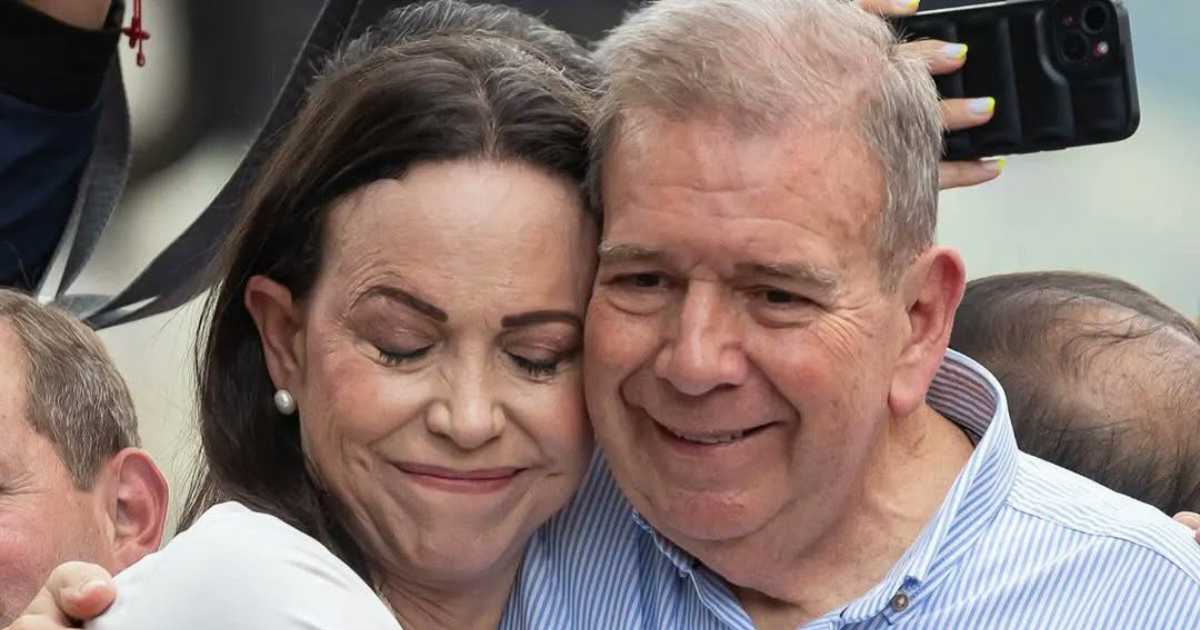
On Sunday, María Corina Machado and Edmundo González Urrutia released a joint statement expressing their conditional support for the dialogue process set to begin formally on Saturday, August 1, between the Chavismo regime and a faction of the opposition.
The opposition leaders made it clear they had no part in the "design, construction, and operation" of this negotiation path, which is led by the Chavista National Assembly President, Jorge Rodríguez, and former opposition deputy Dinorah Figuera.
In their statement, Machado and González emphasized they would evaluate the process "based on concrete and verifiable achievements: the restoration of democratic institutions, the release of all political prisoners, real guarantees for all actors without exclusions, a timely presidential election schedule, and full respect for popular sovereignty."
Demands for Transparency and Accountability
Both leaders also demanded that Figuera and Rodríguez inform the nation about "their objectives, their method, and their schedule." They stressed, "This is what our people demand, and we will remain vigilant about it," adding that they would not "stand in the way of any initiative that results in real progress."
The initial contact between Figuera and Rodríguez—brother of the interim Venezuelan president, Delcy Rodríguez—occurred on June 18 at the Federal Legislative Palace in Caracas, shortly before the devastating earthquakes that struck Venezuela.
Impact of Natural Disasters on Dialogue
The process was temporarily halted due to the earthquakes on June 24, 2026, which measured 7.2 and 7.5 magnitudes. These disasters resulted in over 5,398 deaths, at least 16,740 injuries, and left nearly 18,000 people homeless, according to last week's cumulative report.
Regarding the tragedy, Machado and González accused authorities in their statement of attempting to "block, divert, and control aid organized by the people to prevent it from reaching those most in need," and called for "a new government with moral authority and managerial capacity" to tackle the reconstruction.
International Involvement and Future Plans
U.S. Secretary of State Marco Rubio confirmed on July 20 that the 2015 National Assembly and the interim Venezuelan government had agreed to establish a joint forum to formally initiate the political transition process, with initial talks scheduled for the first week of August.
Rubio described the agreement as a "very significant proposal" and assured that Washington would "actively participate" in the process.
Figuera, who returned to Venezuela after eight years in exile in Spain at the invitation of the State Department, stated last Thursday that Machado plays a "very important role in this process."
Machado, the 2025 Nobel Peace Prize laureate, is currently outside Venezuela and has reported obstacles to re-entering the country. She has asserted her "responsibility to lead" negotiations with Delcy Rodríguez's government.
In Sunday's statement, the opposition leader and González also announced their intention to return to Venezuela to "support the people, travel across the country, and build" a national agreement for reconstruction, although they did not specify dates or details on how this return will take place.
Key Questions About the Venezuelan Dialogue Process
What are the main conditions set by Machado and González for supporting the dialogue?
They require concrete achievements such as restoring democratic institutions, freeing political prisoners, ensuring real guarantees for all actors, establishing a timely presidential election schedule, and respecting popular sovereignty.
How did natural disasters affect the dialogue process in Venezuela?
The earthquakes on June 24, 2026, temporarily interrupted the dialogue process due to their devastating impact, which included significant loss of life and displacement of people.
What role does the U.S. plan to play in the Venezuelan dialogue?
The U.S. intends to actively participate in the political transition process, as confirmed by Secretary of State Marco Rubio.