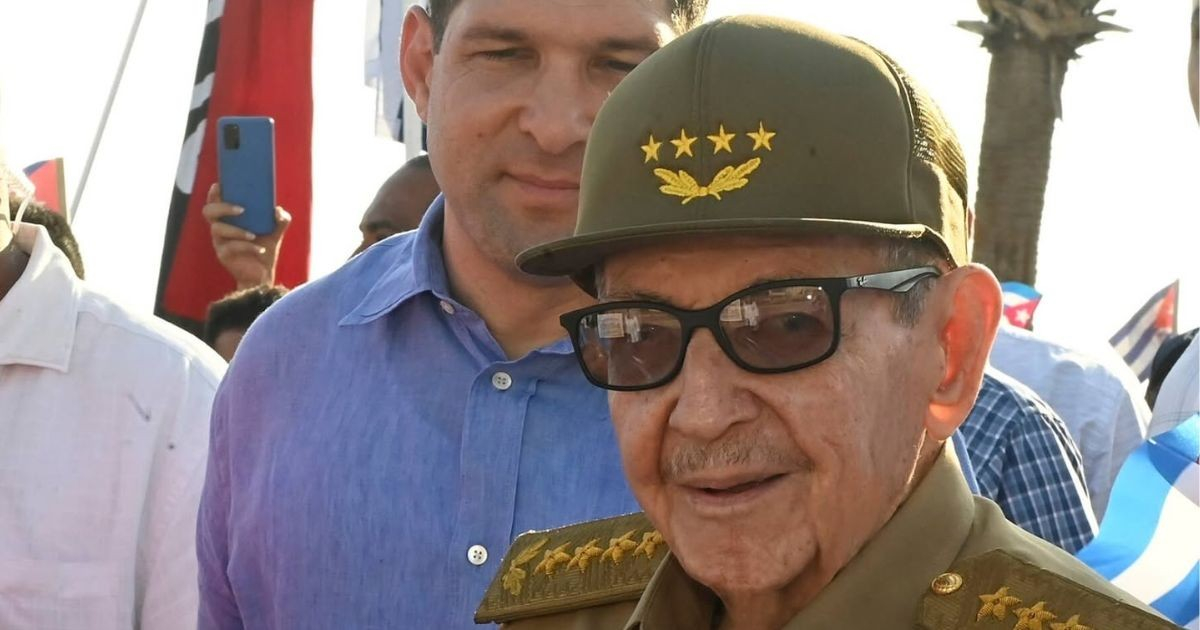
A handwritten note from Raúl Castro addressed to the residents of Pinar del Río went viral on social media after being shared on the Presidency of Cuba's Facebook page this Sunday. The message, commemorating the 73rd anniversary of the assaults on the Moncada and Carlos Manuel de Céspedes barracks, highlighted the stark contrast between official rhetoric and the actual hardships faced by the people of Pinar del Río and Cubans nationwide.
The letter, read aloud by Miguel Díaz-Canel during the event, stated: “Dear residents of Pinar del Río: On this July 26th, receive my affection and acknowledgment for having earned, through your dedication to the revolutionary cause and creative work, the great honor of hosting the central act for the 73rd anniversary of the assaults on the Moncada and Carlos Manuel de Céspedes barracks, National Day of Rebellion. A big hug to all, Raúl Castro Ruz, 26-7-2026.”
Absence of Raúl Castro Raises Questions
The notable absence of the 95-year-old former president in Pinar del Río did not go unnoticed. According to the Associated Press, this might have been his first missed appearance at a central July 26th event in three decades, with no explanation provided by the regime.
Cubans promptly took to social media to express their frustrations and sarcasm. A viral comment summed up the collective sentiment: “And as a gift, here are 48 hours without electricity. Thank you, revolutionary people.” Another user mockingly referenced a long-standing promise from Castro: “Soon you'll get your glass of milk... promised since 2007. Signed: Raúl Castro.” Yet another comment was even more blunt: “Keep resisting, Pinar del Río, while we continue to grow richer; this is the true message.”
Electricity Crisis Fuels Sarcasm
The sarcasm found a basis in the dire reality of the province's ongoing power crisis. In March 2026, a transmission line failure left Pinar del Río completely in the dark, and in July, the National Electric System experienced three total collapses—on July 6th, 10th, and 14th—leaving millions without power each time.
Leading up to the July 26th event, Cuba was grappling with widespread blackouts, affecting up to 2,315 MW, with outages lasting as long as 24 hours in every province. On the day of the event, the National Electric System had only 1,150 MW available against a demand of 3,200 MW, while the Antonio Guiteras thermoelectric plant went offline due to a technical failure—the 17th such incident that year.
Criticism Over Resource Allocation
Critics were particularly incensed by the regime's ability to secure fuel and resources for the political spectacle in Pinar del Río. Since the announcement of the event's location and preparations, Cubans had been responding with statements like “We are suffocating, stop the rhetoric,” “Cuba is not celebrating, you're killing the country,” and “There is fuel for that.”
This marked the fourth occasion that Pinar del Río hosted the central July 26th event, following previous years in 1976, 2000, and 2017. It was the first time Raúl Castro—who led Cuba from 2008 to 2018 and still holds symbolic and seemingly military leadership—chose to send a signed note instead of attending, while the province and nation struggle with ongoing blackouts, water shortages, and a lack of food and medicine.
Understanding the Power Crisis in Cuba
What triggered the power outages in Pinar del Río?
The power outages in Pinar del Río were caused by a failure in the Mariel-Pinar del Río transmission line and subsequent collapses in the National Electric System, leading to widespread blackouts.
How did Cubans react to Raúl Castro's message?
Cubans reacted with sarcasm and criticism, highlighting the disparity between the government's message and the harsh realities they face, such as ongoing power outages and resource shortages.