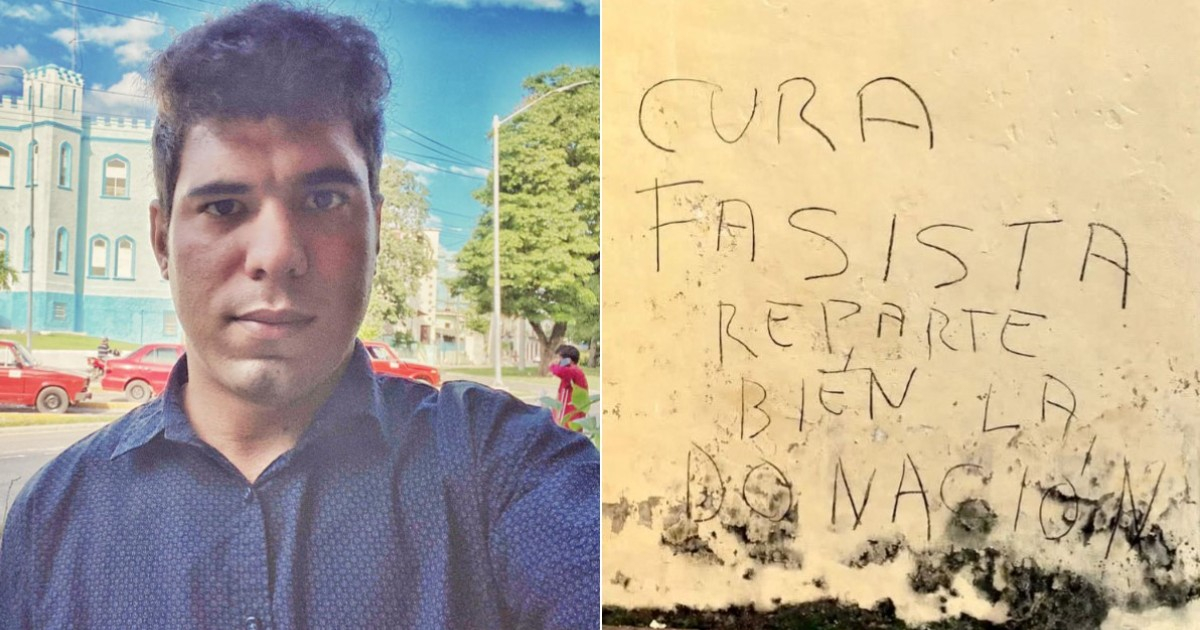
A graffiti message scrawled on the front of a Cuban church accusing the priest of improperly distributing donations sparked a strong reaction from independent journalist Adrián Martínez Cádiz. Martínez, a correspondent for the Catholic media outlet EWTN in Havana, shared his thoughts in a Facebook post titled "The Wrong Wall."
The graffiti, painted with a misspelling, declared: "FASCIST PRIEST DISTRIBUTE DONATION PROPERLY" on the church's exterior.
This incident unfolded amidst the distribution of U.S.-funded humanitarian aid, which began reaching families on July 22 in Bejucal and Alquízar, Matabeque.
Martínez Cádiz firmly condemned both the act of vandalism and the allegation against the priest, emphasizing that the anger of those not chosen as beneficiaries was being directed at the wrong target.
"We've been living in an upside-down world for so long that some dare to criticize those distributing aid while remaining silent about the power that has left an entire nation in need of such help," he wrote.
The correspondent explained that Caritas Cuba uses objective vulnerability criteria set by the donor: elderly living alone, pregnant or nursing mothers, individuals with disabilities or bedridden, and families with young children at risk, identified through home visits.
"They don't ask who attends mass," nor did the priests "create a list of friends and acquaintances," Martinez asserted.
He also highlighted a crucial distinction from the regime's mechanisms: "At least the aid packages aren't being sold in foreign currency stores."
The social tension has a clear backdrop: Caritas Cuba publicly acknowledged that the aid wouldn't reach everyone in a nation of over 11 million. The program aims to assist between 100,000 and 120,000 families.
Addressing those who channel their frustration toward the Church, Martínez Cádiz posed a question many prefer to avoid: "Shouldn't we be more outraged that millions of Cubans rely on foreign donations for essentials like rice, beans, soap, toothpaste, or a lamp to deal with blackouts?"
He emphasized: "The Church didn't create this misery (...) The culprit is a system that, after more than six decades of dictatorship, has made daily survival a race to secure food, medicine, and electricity."
The journalist also recalled the church organization's history: "Caritas Cuba didn't appear this week with the arrival of these packages. It has been working across the island for over three decades, often with minimal resources."
Martínez Cádiz, fined by the regime in 2022 for his social media posts, clarified that those who attack the helpers while remaining silent about those who impoverish are not defending the people but cowardly misidentifying the enemy.
He concluded his commentary with a sentence that encapsulates his main argument: "Don't defile the church wall; if you dare, write on the walls of the dictatorship that turned Cuba into a nation in need."
The first shipment of U.S. humanitarian aid—18 tons arriving on a flight from Miami—landed last Tuesday at the José Martí International Airport.
The total aid package amounts to $100 million: $60 million managed by the Catholic Church—through Caritas Cuba and Catholic Relief Services—and $40 million by independent non-governmental organizations, specifically designed to exclude the Cuban regime from any involvement.
On Saturday, Mike Hammer, head of mission at the U.S. Embassy in Cuba, visited beneficiary families in Bejucal to verify the arrival of the aid packages.
Understanding the Impact of U.S. Aid in Cuba
What sparked Adrián Martínez Cádiz's response?
A graffiti message on a church accusing a priest of not distributing donations properly prompted his reaction, as he defended the rightful distribution and criticized the misplaced frustration.
How does Caritas Cuba determine who receives aid?
Caritas Cuba uses objective vulnerability criteria set by the donors, focusing on elderly individuals living alone, pregnant or nursing mothers, people with disabilities, and families with young children at risk.
What is the social context surrounding the aid distribution?
The aid distribution occurs against the background of widespread need in Cuba, where millions rely on foreign aid for basic necessities. Caritas Cuba acknowledged that the aid won't reach everyone.