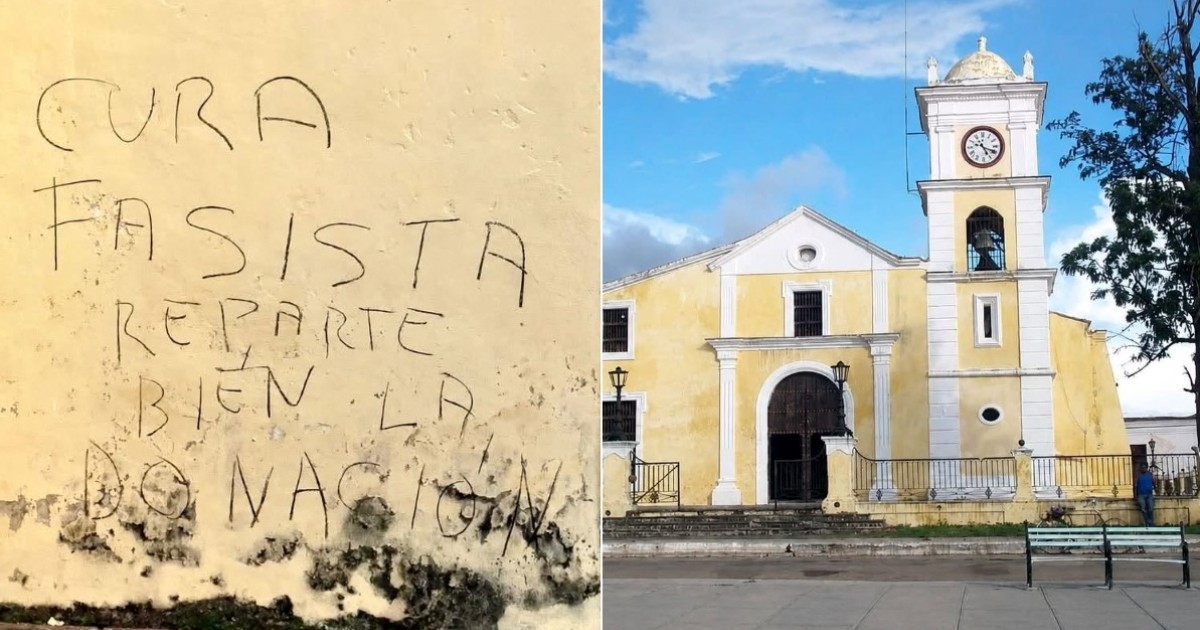
A graffiti message, misspelled as "FASIST PRIEST DISTRIBUTE DONATION BETTER," was discovered on the wall of the church in Bejucal, Mayabeque. This act of vandalism occurred following the Catholic Church's distribution of humanitarian aid from the United States to vulnerable individuals.
Father Jorge Luis Pérez Soto, from the Archdiocese of Havana, took to Facebook to address the situation with a post titled "Fascist is Spelled with a C," where he defended the charitable work of the Church and dismissed accusations of improper distribution of aid.
Defending the Distribution Process
Father Pérez Soto emphasized the overwhelming demand for aid, explaining that with finite resources, it is impossible to assist everyone equally. "We have never imposed conditions on this aid. Not based on religious beliefs, political affiliations, or personal biases. The only criterion is the genuine need of the individuals," he stated.
He clarified that the distribution would be gradual due to logistical constraints, and limited, since resources are insufficient to meet the vast needs. However, he assured that the process would be managed with responsibility, seriousness, and a commitment to truth and justice.
Reflecting on the scale of the aid, he remarked, "60 million sounds significant... but in Cuba's current situation, where the majority of the population lives in extreme need, it becomes like five loaves and two fishes."
Addressing Attempts to Discredit the Effort
Father Pérez Soto was firm in dismissing attempts to undermine the effort: "Ask those who have received the aid if it's beneficial or harmful. At least with these donations, we know whose hands they go into, and we know they receive them for free."
He also pointed out that efforts to defame the initiative are not restricted to social media: "We've seen attempts from within the country's institutions to diminish this act which, while not resolving the situation, provides relief to those who receive it."
He criticized certain evangelical ministers for demanding lists of beneficiaries to exclude those sympathetic to the regime, and questioned why independent civic volunteers would join denigration campaigns when they themselves "know the complexities of organizing any kind of humanitarian aid in Cuba."
Concerns Over Political Manipulation
Father Pérez Soto warned against the potential use of donations for political purposes by the government: "Let the humanitarian aid not become a smokescreen used by cyber troops and others to divert attention from our serious and urgent national problems that require immediate resolution."
He concluded by emphasizing that while humanitarian aid is a temporary relief, what Cuba truly needs are political, economic, and social changes that enable the people to live with dignity. "Let us not have to beg as if we were starving or a people incapable of working and sustaining ourselves," he expressed.
Visit by U.S. Embassy Official
The graffiti incident in Bejucal coincided with a visit by Mike Hammer, the head of the U.S. Embassy mission in Cuba, who inspected firsthand how the humanitarian aid sent by his government was being distributed to local families.
Hammer visited the homes of several beneficiaries, stating, "We’re here on behalf of the U.S. government, President Trump, and Secretary Marco Rubio, to see how the aid we've sent is impacting the situation and to assess how things are progressing."
In addition to food, the rechargeable lamps included in the aid packages were particularly valued amid the island's energy crisis. "Everyone is telling me the lamps are working well," Hammer noted.
Breakdown of the Aid Program
The aid distributed in Bejucal comprised basic food items such as rice, beans, oil, sugar, pasta, sardines, and tuna, alongside hygiene and household products like soap, toothpaste, toothbrushes, water purification tablets, a plastic bucket, a 20-liter container, and a rechargeable lamp.
The Catholic Church began distributing the humanitarian aid on July 22 in the municipalities of Bejucal and Alquízar, following the arrival of the first shipment—18 tons flown in from Miami—at the José Martí International Airport.
The U.S. government’s aid program totals $100 million: $60 million managed by the Catholic Church and Caritas, and $40 million by independent non-governmental organizations, with the explicit condition that resources do not pass through the Cuban state.
Caritas Cuba has publicly acknowledged that the aid will not reach all Cubans in need, with selection criteria prioritizing elderly individuals living alone, pregnant or nursing women, people with disabilities, and families with children under five.
The program aims to benefit between 100,000 and 200,000 households.
Pattern of Harassment Against the Catholic Church
This incident is part of a documented pattern of harassment against the Catholic Church in Cuba. From January 2025 to June 2026, CSW recorded 667 violations of religious freedom on the island, including the confiscation of humanitarian aid distributed by churches and 94 warning acts against religious leaders.
The Cuban Observatory of Human Rights reported 873 violations during 2025, and the U.S. Commission on International Religious Freedom included Cuba in its 2026 annual report as a country with severe and systematic violations.
Understanding the Humanitarian Aid Efforts in Cuba
What triggered the graffiti incident at the church in Bejucal?
The graffiti appeared after the Catholic Church began distributing humanitarian aid from the U.S. to vulnerable people, amidst accusations of unfair distribution by certain individuals.
What was Father Jorge Luis Pérez Soto's response to the graffiti?
Father Pérez Soto defended the Church’s charitable work, rejected the accusations of improper aid distribution, and emphasized the genuine need and fair criteria used in the distribution process.
How is the humanitarian aid being distributed in Cuba?
The aid is distributed based on genuine need, with priority given to the elderly, pregnant or nursing women, people with disabilities, and families with young children. It is managed by the Catholic Church, Caritas, and independent NGOs, avoiding state involvement.