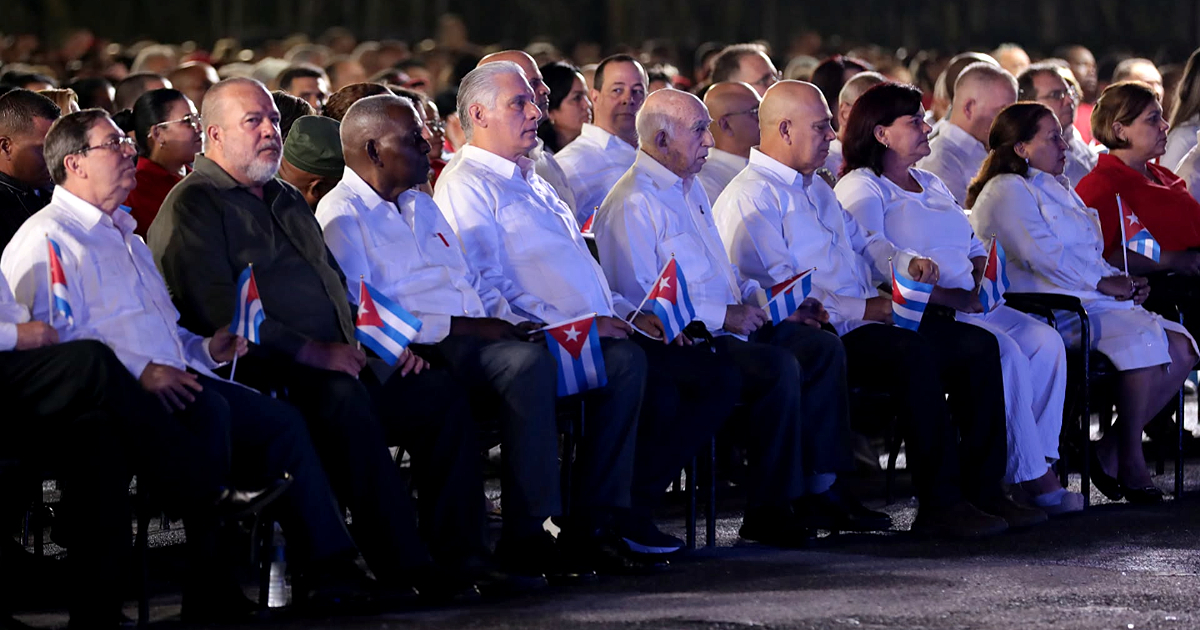
On Sunday, Miguel Díaz-Canel once again took aim at "the elites who grow obscenely rich" during his speech commemorating July 26th. His remarks were intended to criticize the inequalities inherent in capitalism but ended up highlighting one of the most glaring contradictions in Cuba's official narrative: the widening social gap within the island itself.
"The elites enrich themselves obscenely," the Cuban leader declared, targeting foreign nations. However, this characterization, as reported by Cubadebate, increasingly mirrors the reality on the island, where a small group tied to political, military, and business circles enjoys a level of affluence out of reach for most Cubans.
While Díaz-Canel called for collective sacrifice and resilience against the U.S. embargo, millions of Cubans continue to grapple with daily power outages, food and medicine shortages, rampant inflation, inadequate salaries, and an unprecedented wave of emigration.
The Emergence of a Cuban Socialist Elite
For decades, the official narrative has maintained that the so-called "revolution" eradicated the deep-seated inequalities that existed before 1959. Yet, contemporary Cuba presents a starkly different picture.
Exclusive restaurants, luxury bars, high-end cars, renovated mansions, and private businesses catering to a wealthy clientele are proliferating in Havana and other cities. Meanwhile, the majority endure long lines for basic goods, live on state salaries amounting to mere dollars per month, and suffer through extended power outages.
Social media has further exposed this divide. Entrepreneurs with government ties, officials, sympathetic artists, and new economic actors flaunt their travels, luxury watches, exclusive dinners, and properties, starkly contrasting with the everyday lives of most Cubans.
One recent example of this disconnect was Raúl Guillermo Rodríguez Castro, known as "El Cangrejo" and grandson of Raúl Castro, who in a recent interview with USA Today defended his lifestyle, admitting, "It pains me that many people can't live like I do. I feel the struggle people face. I work every day to change that situation."
In the same conversation, he envisioned a Cuba where any citizen could enter a supermarket and buy products like foie gras, a vision many interpreted as a reflection of the vast gap between the privileged class and a populace spending hours securing basic foodstuffs.
Economic Reforms and Shifting Ownership
The contradiction becomes even more apparent as Díaz-Canel's government promotes a broad package of 176 Economic and Social Transformations, presented as the most significant update to the economic model in decades.
Though officially framed as a modernization of socialism, many economists argue that these measures are laying the groundwork for a profound redistribution of property.
The concern isn't just about economic opening but about who will be in a position to acquire companies, state assets, participate in future privatizations, or capitalize on new investment opportunities. In a country where access to credit, foreign currency, licenses, and much of the economic activity still hinges on political decisions, analysts warn that the primary beneficiaries will likely be those close to power structures, high-ranking officials, state enterprise directors, military personnel, and entrepreneurs with privileged connections.
In essence, while the regime has long battled private property in the name of equality, it now risks facilitating wealth concentration in the hands of an elite closely tied to the political system itself.
The Paradox of Privileged Capitalism
The irony is hard to overlook. For years, the Cuban regime justified economic restrictions by claiming to prevent the rise of vast private fortunes. However, today's reality points towards a model where opportunities depend less on the market and more on access to power.
Without independent institutions, full legal security, and equal competition conditions, economic openness may ultimately cement a "privileged capitalism" rather than an open and competitive economy.
The contrasts are increasingly visible between those who frequent luxury hotels, exclusive restaurants, or privileged neighborhoods, and those surviving on meager pensions or salaries that barely cover a few days of food.
A Phrase That Resonates Within Cuba
Thus, when Díaz-Canel declared that "the elites grow obscenely rich," many Cubans didn't think of other countries. They thought of those driving luxury cars while public transport collapses; those enjoying exclusive dinners while millions struggle to put food on the table; those accumulating wealth while hundreds of thousands of Cubans emigrate in search of opportunities they can't find at home.
The statement was meant to critique capitalism. Yet, it inadvertently became an all-too-familiar description of the Cuba emerging under the very model Díaz-Canel defends: a society where inequality is no longer an exception but a growing reality fueled by a new economic elite closely linked to power.
Understanding Cuba's Social Divide
What are the contradictions in Díaz-Canel's speech?
Díaz-Canel's speech criticized capitalist inequalities, but ironically highlighted Cuba's own growing social divide, where a small elite enjoys privileges out of reach for the majority.
How are recent economic reforms affecting Cuba?
Recent reforms, though framed as modernizing socialism, are believed to be setting the stage for a redistribution of property, potentially concentrating wealth among those with political connections.
What is "privileged capitalism" in Cuba?
Privileged capitalism refers to a model where economic opportunities are dictated by political access and connections, rather than open market competition, leading to wealth concentration among an elite.