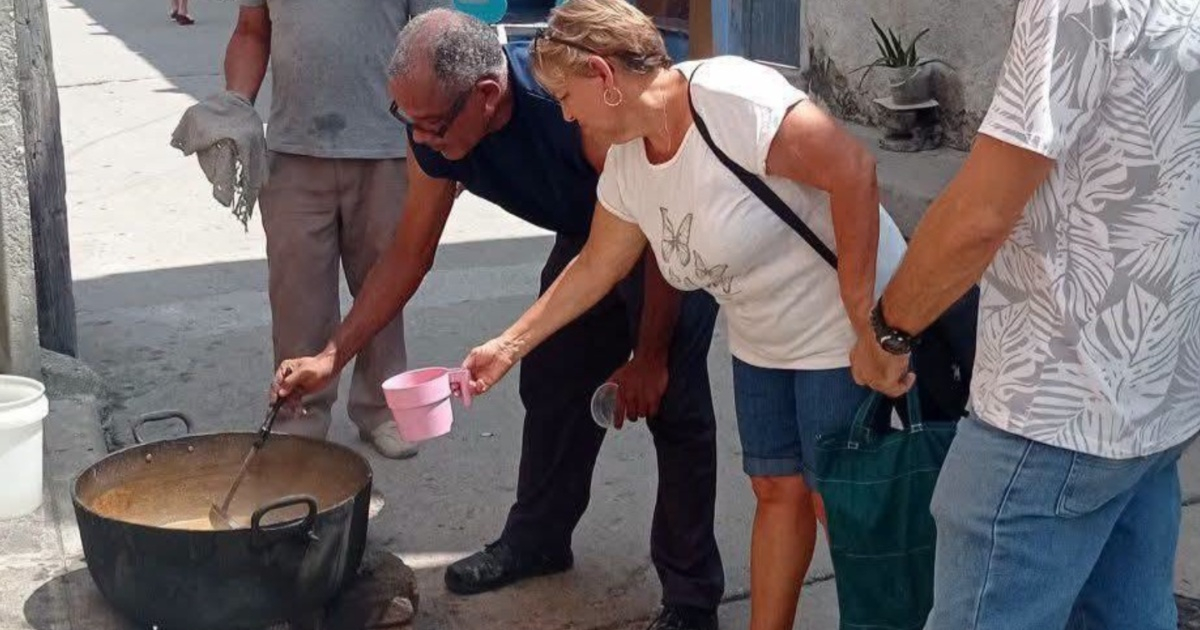
On the eve of the 73rd anniversary of the Moncada Barracks attack, the Provincial Company of Technical Services of Villa Clara (EPSTAC) orchestrated a community caldosa event right on the streets of Santa Clara's Centro neighborhood. This gathering was portrayed by authorities as an act of solidarity under the governmental program "My Neighborhood for the Homeland."
Images shared on the official Facebook page "Soy Villa Clara" depicted workers cooking over wood fires with large black cauldrons on the pavement, surrounded by buildings with visibly damaged facades.
The official post described the event as a "solidarity activity" in celebration of July 26th. However, the scene drew mostly critical responses on social media. "As usual, romanticizing poverty," one user commented.
Another sarcastically noted, "Is that really the solution? How depressing is Cuba! We keep heading toward the horizon." A third echoed the sentiment of many: "God, what era are they in? How sad."
Not all feedback was negative. One user defended the initiative, stating, "It's good, this way they help those in need. A good initiative."
Contradictions Between Official Rhetoric and Reality
Yet, the majority highlighted the discrepancy between official rhetoric and the harsh everyday reality. "The people suffer without water, and when the electricity comes, the voltage is terrible," another person remarked.
A Cuban, reflecting the sentiment of many, commented, "If I didn't drink it when there was something to add, imagine that broth now," encapsulating the bitter feelings toward a celebration that, for many, underscores the decline in living standards on the island.
A Broader Context of Crisis
Street cooking events like this are not new in Villa Clara. In June, stores in the Manicaragua municipality were already selling caldosa as a "nutritious and traditional option" amid a shortage of basic foodstuffs. By July, other stores in the province began selling rice, elbow pasta, and caldosa, with rice portions priced at 45 pesos and pasta at 60 pesos.
This celebration occurs within a context of severe crisis. In 2026, the Food Monitor Program reported that 96.91% of the Cuban population lacked sufficient food access, and 33.9% of households experienced hunger in the 30 days prior to the study.
Adding to the food crisis is the energy collapse: blackouts have exceeded 20 hours a day in many areas, explaining why cooking with wood on the street has become a norm, rather than a festive tradition.
Despite these challenges, the regime hailed Villa Clara as the winning province in the Moncada competition, with Caibarién hosting the provincial event.
The national main event on July 26th was held this Saturday in Pinar del Río, a day the regime marked with significant symbolic weight as it coincided with the centennial of Fidel Castro's birth.
Understanding the Caldosa Event in Santa Clara
What is the significance of the caldosa event in Santa Clara?
The caldosa event in Santa Clara was organized as a community gathering to commemorate the 73rd anniversary of the Moncada Barracks attack. It was intended to promote solidarity within the community as part of the "My Neighborhood for the Homeland" program.
How did the public react to the caldosa event?
The event received mostly critical feedback on social media, with many users criticizing it as a romanticization of poverty. However, some defended the initiative as a means to support those in need.
What broader issues does the caldosa event highlight?
The caldosa event underscores Cuba's ongoing food and energy crises. With widespread food shortages and prolonged power outages, such events reflect the declining living standards and daily challenges faced by the population.