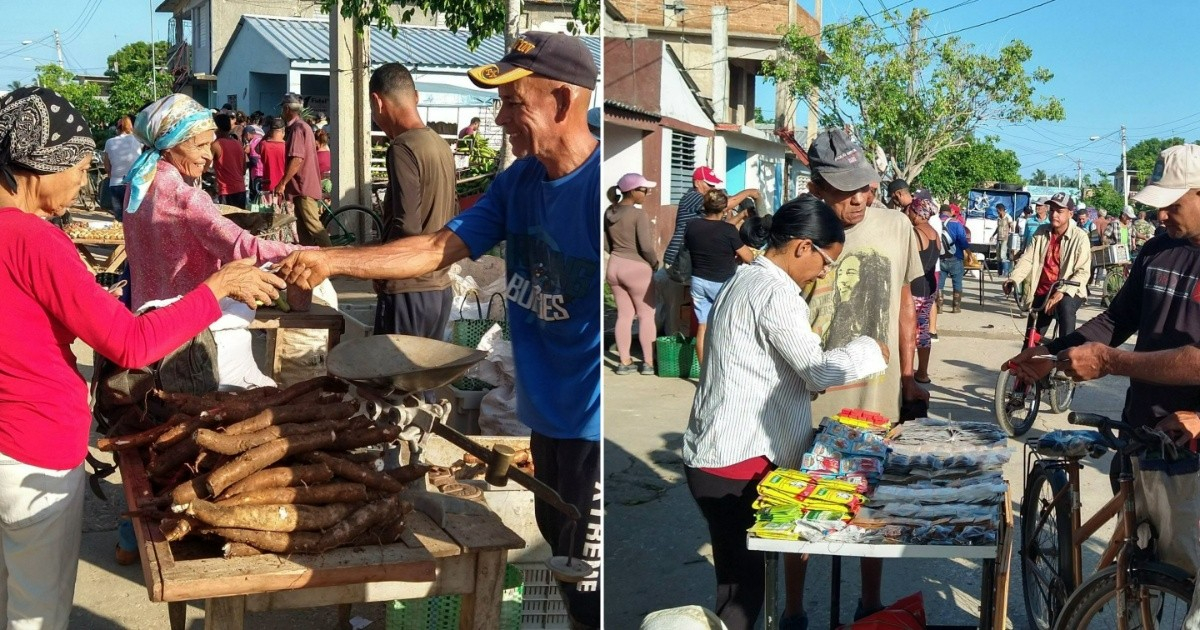
This past Saturday, the Cuban government hosted a series of fairs featuring agricultural, commercial, and cultural activities in the towns of Bayamo and Manzanillo, located in Granma province. These events marked the 73rd anniversary of the assaults on the Moncada and Carlos Manuel de Céspedes barracks.
While the state-run Radio Bayamo hailed the occasion as "a tangible example of how integrating the economy, culture, and society can enhance local identity," Cubans who attended or followed the event on social media painted a starkly different picture.
A Tale of Two Perspectives
In Bayamo, the event was held along Felino Figueredo Avenue, featuring both state-run agricultural enterprises and private ventures. High-demand items included root vegetables, greens, grains, fruits, consumer rice, roasted pork, and household goods. Over in Manzanillo, the fair took place on Primero de Mayo Avenue, where images shared by Radio Granma Manzanillo highlighted products like air fresheners priced at 625 Cuban pesos (CUP) each.
The Wage-Price Disparity
A pressing question loomed large: "Did the prices align with the average Cuban's salary?" This inquiry was posed by user Andy Luis Torres Rivera in a comment on Radio Bayamo's official post. The stark reality of Cuba's economy provides an answer. As of July 1, 2026, the minimum wage stands at 3,210 CUP per month, roughly equivalent to less than five dollars on the informal exchange market. Official figures place the average monthly salary at approximately 7,074 CUP, whereas estimates from June 2026 suggest that meeting basic family needs costs between 50,000 and 96,000 CUP monthly.
Public Outcry and Unmet Expectations
Social media reactions were even more blistering. "Stop spreading so many lies, please. The Cuban people are dying of hunger and misery, and you're publishing lies. Enough already," declared Reinier Rodriguez Vega. Carlos Hechavarria criticized the high prices and fees associated with payment transfers, remarking that appearances can be deceiving: "Looks nice in photos. Nothing more. Prices are high, expensive, with fees for transferring payment."
Nieves Báez Reyna directly challenged the official narrative, stating, "I'm sorry, but it wasn't like that. There was no such comprehensive fair in Río Cauto."
A Pattern of Political Showmanship
This isn't an isolated incident. Similar events have unfolded elsewhere. In Las Tunas, a fair on July 5 was portrayed by state media as "a challenge to resistance," but locals dubbed it "the fair of misery" and "a theater." On July 14, in Trinidad, a woman battled a crowd to purchase meat at 800 CUP per pound. Back in June, a basic neighborhood fair purchase cost 21,060 CUP—more than triple the average monthly wage.
The Cuban regime frequently uses the July 26 fairs as a political showcase, projecting an image of normalcy and abundance that starkly contrasts with the ongoing food crisis affecting the populace. In Granma, government-organized food fairs in 2025 followed protests in Bayamo, highlighting how these events are strategically employed to quell social unrest.
Despite official media's depiction of a "dynamic evolution of the local economic sector," ordinary Cubans continue to grapple with soaring food prices and a minimum wage that barely covers a few days' worth of basic necessities.
Understanding Cuba's Economic Challenges
What is the minimum wage in Cuba?
As of July 1, 2026, the minimum wage in Cuba is 3,210 CUP per month, which is less than five dollars on the informal exchange market.
How do current salaries compare to the cost of living in Cuba?
The average monthly salary in Cuba is approximately 7,074 CUP, while estimates suggest that meeting basic family needs costs between 50,000 and 96,000 CUP monthly.
How do Cubans perceive the government-organized fairs?
Many Cubans view these fairs as political showcases that do not reflect the reality of their economic struggles, as prices remain high and beyond the reach of average citizens.
What role do these fairs play in Cuban politics?
The Cuban regime uses these fairs as a tool to project an image of stability and abundance, attempting to counteract the growing social discontent and economic crisis.