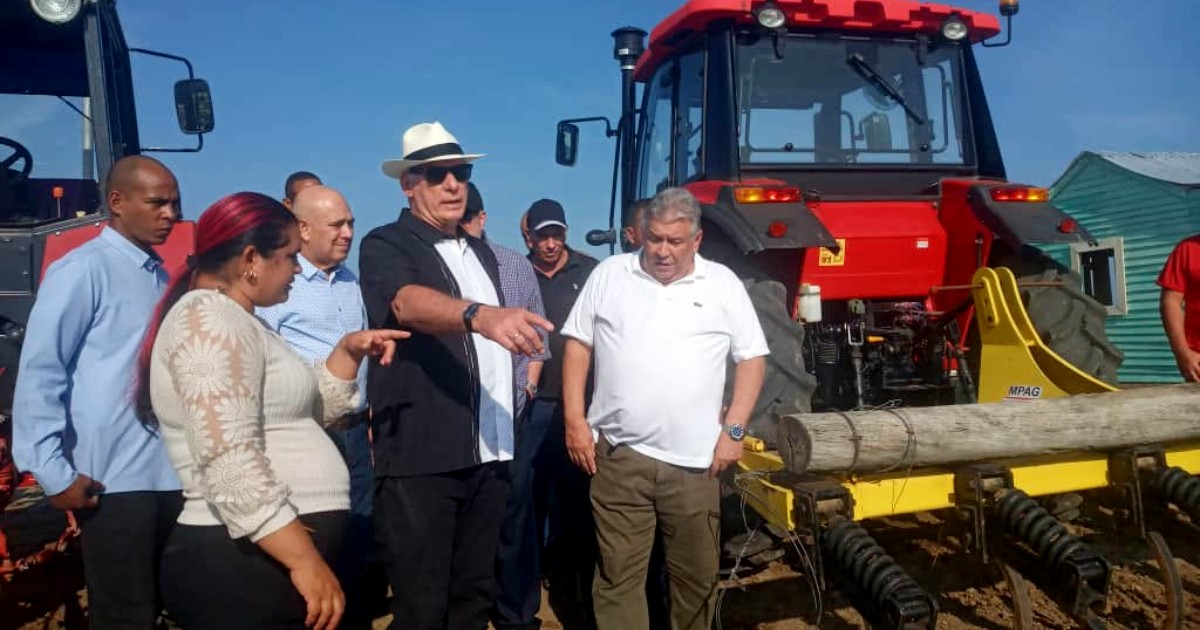
Sporting a white Panama hat, dark sunglasses, and a black shirt with a white guayabera-style stripe, Miguel Díaz-Canel spent Saturday visiting tobacco farms in Pinar del Río.
The state-run Periódico Guerrillero shared photos of what was described as a work visit ahead of the central event marking the anniversary of the Moncada Barracks assault. From the images, it appears the appointed leader did not step onto the ground, instead choosing to listen to explanations and point his index finger towards horizons filled with utopian visions.
His attire, more suited for a tourist at the Tobacco Fair than a leader in action, stood out: while Cuba faces its worst economic crisis, the first secretary of the Communist Party of Cuba (PCC) posed cheerfully among tractors, alongside Prime Minister Manuel Marrero Cruz and PCC Central Committee Organization Secretary Roberto Morales Ojeda.
The highlight of the tour was a visit to the farm of Isabel Cristina Barbosa Díaz, a producer of covered tobacco in La Ceniza, the main municipality of Pinar del Río. This operation boasts drip irrigation plans, photovoltaic panels, and controlled curing houses.
Díaz-Canel, sticking to his script, was generous with his praise: "It's a place where you can feel work and prosperity in the air," he stated to state media cameramen.
Such statements are hard to swallow for those who recall that just four days earlier, the regime permanently canceled the Habano Festival, the most prestigious event in Cuba's tobacco sector, without setting a new date. This marked the second historic cancellation of the festival, following those in 2020 and 2021 due to the pandemic.
The event was initially postponed in February 2026, when it was set to occur from the 23rd to the 27th, citing the energy and fuel crisis. The final cancellation occurred without any resolution to these issues.
The tobacco sector is led by Marino Murillo Jorge, the architect of the failed economic reform guidelines and the 2021 monetary reform known as the "Ordering Task," which triggered inflation. He became president of Tabacuba in November 2021.
Under his leadership, the sector has faced production delays, cuts in payments in freely convertible currency to farmers, and the loss of hundreds of tobacco hectares due to blackouts.
In June 2025, the energy crisis devastated over 385 hectares of tobacco in Consolación del Sur, with only 1,301 tons harvested out of a planned 1,778 tons.
This Saturday's visit is part of a well-documented pattern: since 2022, Díaz-Canel has repeatedly appeared at farms and fields in various provinces, always surrounded by state photographers.
In April 2026, he was criticized for appearing in agricultural work photos while food was scarce; in November 2025, he posed with a hoe during voluntary work; and in June 2025, it was reported that Guáimaro municipality was given a facelift to hide the real poverty before his arrival.
Pinar del Río is hosting the central July 26 event for the third time since 1959 — the last was in 2001 — which the regime presents as recognition of the province's "fulfillment." The plaza in Pinar del Río is ready for the event, while, as even regime-friendly media admit, the country is "falling apart."
Understanding Cuba's Tobacco Industry Crisis
What is the significance of the Habano Festival in Cuba?
The Habano Festival is the most important luxury event in Cuba's tobacco sector, attracting international attention and boosting the country's tobacco industry.
Who is Marino Murillo Jorge and what role does he play in Cuba's tobacco sector?
Marino Murillo Jorge is the president of Tabacuba and is known for his role in implementing the failed economic reform guidelines and the 2021 monetary reform that led to inflation.