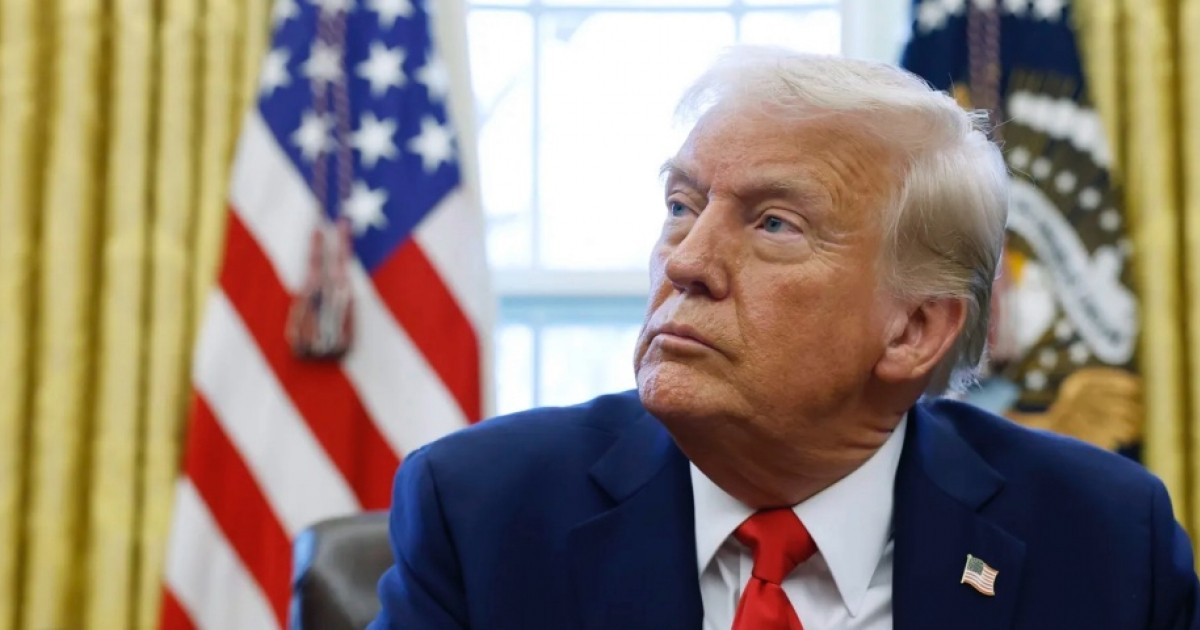
Donald Trump issued a stern warning to the European Union this Friday following news of a hefty fine levied against Google, amounting to approximately $1 billion.
The former president declared the immediate commencement of a federal investigation into European practices and threatened to impose additional tariffs "as swiftly as possible."
Trump took to his platform, Truth Social, to accuse Brussels of systematically targeting major American tech companies. "The European Union is back to its old tricks, and as always, it's targeting BIG American companies," he wrote, listing the sanctions he deems unjustified.
According to Trump, the EU fined Apple $15 billion, Meta $3 billion, and Amazon $2.5 billion, adding a new $1 billion sanction against Google "without any explanation," bringing Google's total fines to over $18 billion.
The fine that sparked Trump's reaction was imposed by the European Commission on Thursday, under the Digital Markets Act: €890 million divided into two parts: €460 million for preferential treatment of its own services in Google Search, and €430 million for restrictions placed on app developers in Google Play. Google has announced plans to appeal the penalty.
Just three weeks earlier, the EU's Court of Justice had also confirmed a €4.1 billion fine against Google in the Android case, rejecting the company's appeal.
Trump described these practices as "illegal and highly discriminatory," asserting they began "at such high levels during the first year of the Biden administration," but promised they would not persist under his leadership. "The United States is not a 'PIGGY BANK' for Europe, and we won't allow it," he warned.
The former president announced the immediate launch of a Section 301 Investigation, a tool under the Trade Act of 1974, allowing Washington to impose tariffs or other measures against countries with unfair or discriminatory trade practices.
"The European Union will pay a very high price for this illegal and highly unethical conduct," he wrote, adding that he expects the fines to be reversed and that a "substantial tariff" would be imposed promptly.
The announcement came a day after Trump signed an executive order imposing tariffs ranging from 10% to 12.5% on 60 countries, including the EU, also under Section 301, effective from midnight this Friday. These goods account for 99.4% of total U.S. imports, according to the Office of the Trade Representative.
The European Commission responded with a "cautious welcome" to the new trade tariffs, noting they align with the joint agreement framework between both parties. Its spokesperson downplayed the threat related to the Google fine, asserting that Brussels is "not worried" about possible U.S. retaliation.
Trump's move also has legislative backing: a group of 25 U.S. congressmen urged the former president last week to act against European tech regulations, explicitly suggesting the use of Section 301 if diplomatic efforts failed.
Understanding the Impact of U.S. Tariffs on the European Union
What prompted Trump's tariff threat against the European Union?
Trump's tariff threat against the EU was prompted by a $1 billion fine imposed on Google by the European Commission, which he perceives as part of a pattern of unfair targeting of American tech companies by Europe.
How does Section 301 of the Trade Act of 1974 relate to Trump's actions?
Section 301 of the Trade Act of 1974 allows the U.S. to impose tariffs or take other actions against countries with unfair trade practices. Trump invoked this section to justify tariffs against the EU in response to what he considers discriminatory actions against U.S. companies.
What has been the European Union's reaction to the U.S. tariffs?
The European Commission has expressed a "cautious welcome" to the new U.S. tariffs, indicating they adhere to the joint agreement framework between the two regions. The EU appears unconcerned about potential U.S. retaliatory measures.