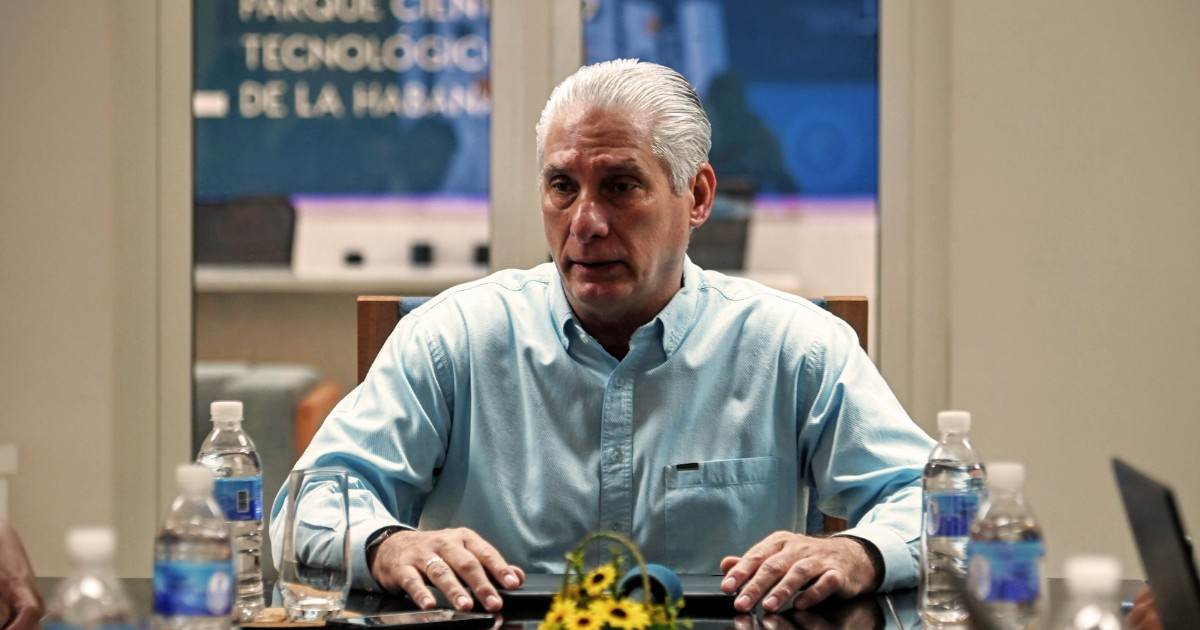
On Thursday, Miguel Díaz-Canel made his third visit to Havana's Science and Technology Park since its inception in 2020.
The Cuban leader met with executives and representatives from small and medium-sized tech-based enterprises to commend their supposed progress and to call for increased synergy between state-run and private sectors.
The Cuban Presidency stated that Díaz-Canel "underscored the leadership achieved" by the park and advocated for its role as a hub for research, development, and innovation projects.
He also urged the full exploitation of the new economic and social reforms approved in the country, particularly in the information and communication technology sectors, which currently hold significant potential.
This visit comes amid Cuba's most severe economic crisis in decades, with the Economic Commission for Latin America and the Caribbean (CEPAL) projecting a GDP contraction of 6.5% by 2026 and an accumulated decline of nearly 26% since 2020.
During the tour, Díaz-Canel was briefed on two startups nurtured within the park. The first, Laberinto Tech, led by Yunior Almaguer, a University of Information Sciences graduate, develops fleet management solutions for tourism entities like Transtur and Ecotur.
The second company, Gemellux, led by Tatiana Delgado Fernández, transforms scattered data into managed assets for institutions such as the National Institute of Hydraulic Resources, the tourism sector, and environmental agencies.
The park currently hosts 40 ventures at various incubation stages. Its president, Rafael Torralbas Ezpeleta, acknowledged that the challenging economic environment hampers the growth of new businesses.
"All the support that the park can offer to new ventures is indeed a significant aid to sustain their growth," he stated.
The visit is part of Díaz-Canel's extensive tour across Havana's 15 municipalities, initiated on June 30, under the so-called "Year of Preparation for Defense 2026."
The crisis in Cuba has had a devastating impact on the private sector. According to February 2026 data, 96.4% of Cuban micro, small, and medium enterprises (MSMEs)—8,904 out of 9,236 registered—are severely or critically affected by energy and fuel shortages.
In June, the government announced a package of 176 economic reform measures, including lifting the cap on the number of workers for MSMEs from 100.
Despite these presidential tours yielding new analyses and speeches about "potentials," the Cuban population continues to face a harsh reality that no meeting at a technology park has yet managed to change.
The Economic Impact of Cuba's Current Crisis
What is the current economic situation in Cuba?
Cuba is experiencing its worst economic crisis in decades, with a projected GDP contraction of 6.5% by 2026 and an accumulated decline of nearly 26% since 2020.
How are Cuban MSMEs affected by the crisis?
Nearly 96.4% of MSMEs in Cuba are suffering severe or critical impacts due to energy and fuel shortages, as of February 2026.
What reforms has the Cuban government announced to address economic issues?
In June, the Cuban government announced 176 economic reform measures, including the removal of the 100-worker limit for MSMEs.