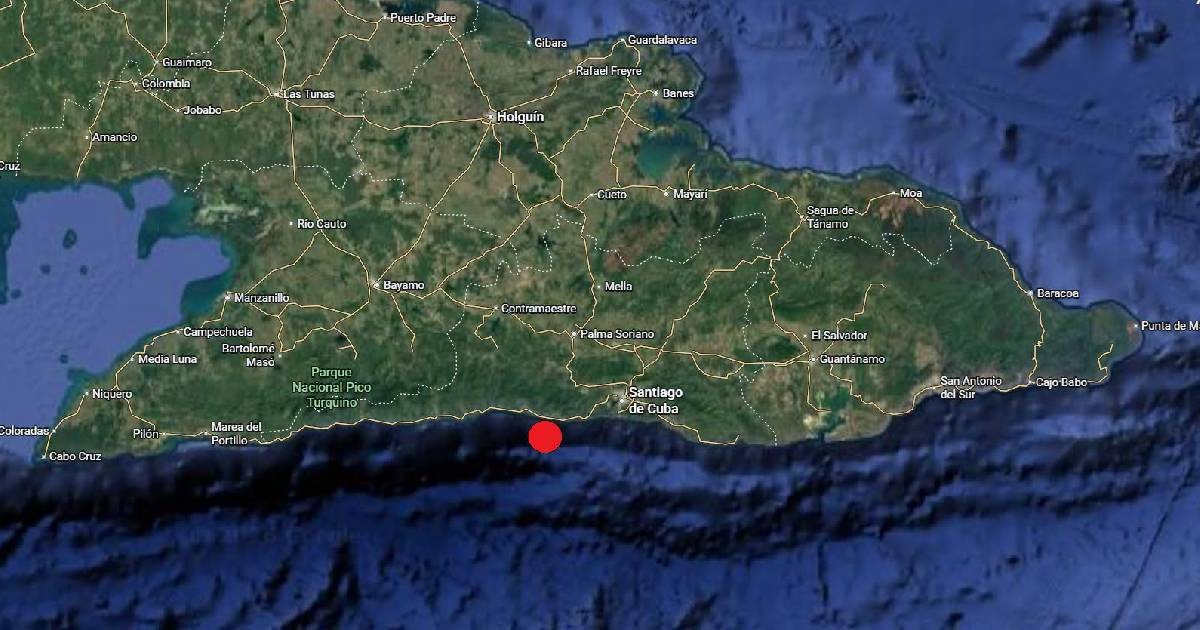
A minor earthquake with a magnitude of 3.1 shook Santiago de Cuba on Thursday night at 10:13 PM, as reported by the Cuban National Seismological Service.
The quake's epicenter was pinpointed 26 kilometers southwest of the city, beneath the Caribbean Sea, at a depth of 8.5 kilometers.
Seismologist Enrique Diego Arango Arias shared details of the quake on his public Facebook profile, specifying the event's coordinates at 19.90 degrees north latitude and -76.06 degrees west longitude.
As of 10:25 PM, the report's cut-off time, multiple perceptibility reports had been received from various city locations, but thankfully, there were no reports of damage or injuries.
Arango Arias noted that this is the "ninth perceptible quake of 2026," placing this event within a pattern of sustained seismic activity that has been affecting eastern Cuba in recent months.
The year 2026 has seen heightened seismic activity in the region. On March 17, the strongest quake of the year, with a magnitude of 6.0, struck, resulting in over 160 aftershocks and was felt in Santiago de Cuba, Guantánamo, and Granma.
Earlier, on February 8, a 5.6 magnitude quake hit southeast of Imías, followed by another 5.3 magnitude tremor on March 6 in the same area. On July 1, a 3.9 magnitude quake was recorded southeast of Imías, also felt in Santiago de Cuba.
Just weeks before Thursday's tremor, Arango Arias had warned of unusual activity in Manzanillo, Granma. "The seismic activity recorded since yesterday in Manzanillo is very interesting, so we must remain vigilant," he wrote on June 29, when the National Center for Seismological Research (CENAIS) logged 23 quakes between June 27 and 28 in eastern Cuba.
Eastern Cuba is responsible for approximately 70% of the country's seismic activity, due to its proximity to the Oriente fault, the boundary between the Caribbean and North American tectonic plates. Santiago de Cuba experiences the highest frequency of perceptible quakes in the nation, ranging from 10 to 15 annually, according to CENAIS.
This sequence of activity began with particular intensity on November 10, 2024, when two quakes measuring 6.7 and 5.8 shook the Pilón-Uvero area in Santiago de Cuba, causing material damage and triggering thousands of aftershocks over the following weeks.
Thursday's tremor, which fortunately resulted in no damage, marks the ninth recorded perceptible seismic event in Cuba for 2026, contributing to a year already notable for several of the most significant tremors in the island's recent history.
Understanding Seismic Activity in Eastern Cuba
Why is eastern Cuba prone to frequent seismic activity?
Eastern Cuba is susceptible to frequent seismic activity due to its proximity to the Oriente fault, which is the boundary between the Caribbean and North American tectonic plates.
How does the Oriente fault affect Santiago de Cuba?
The Oriente fault's location near Santiago de Cuba leads to a higher frequency of earthquakes in the area, making it the most seismically active province in the country.
What has been the impact of seismic activity in 2026?
In 2026, the region has experienced several significant earthquakes, including a magnitude 6.0 quake in March, contributing to a year of notable seismic events in Cuba.