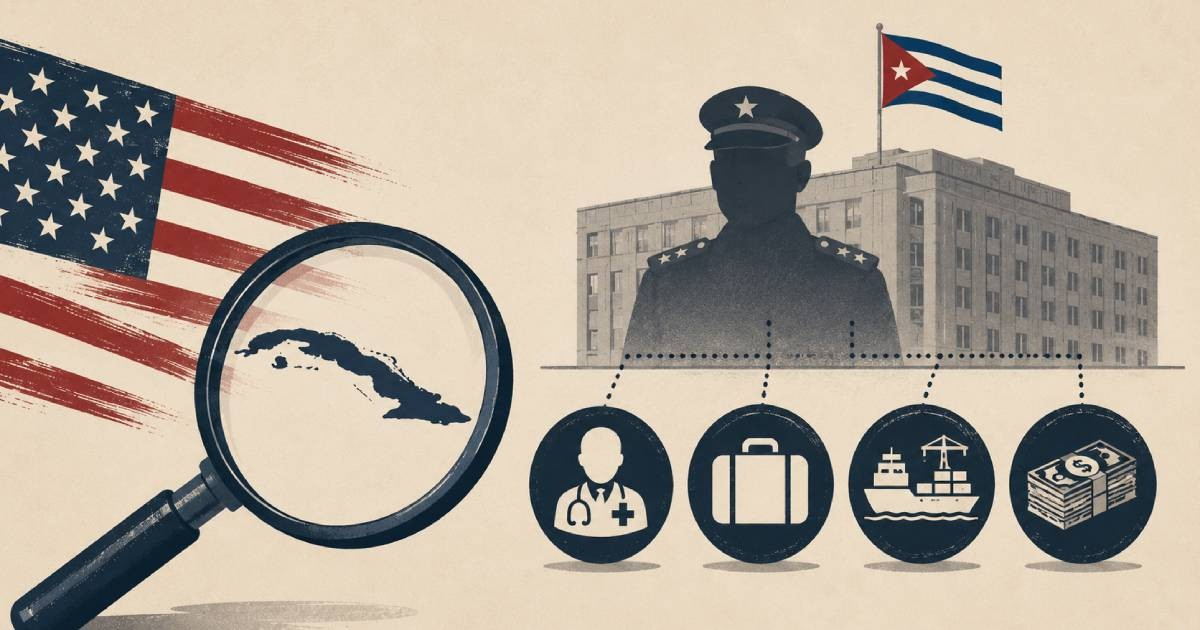
The United States escalated its economic offensive against the Cuban regime on Thursday by unveiling a fresh set of sanctions targeting nine entities and two senior officials. This move aims directly at undermining three of Havana's primary cash flows: the military conglomerate GAESA, the energy sector, and the export of medical services.
Announced by the State Department under Executive Order 14404, signed by President Donald Trump on May 1, 2026, these measures are part of Washington's broader strategy to cripple the financial capacity of the regime and diminish the resources that support its political, military, and oppressive structures.
Targeting the Military's Economic Powerhouse
A significant portion of the new sanctions focuses on GAESA, the business empire controlled by the Revolutionary Armed Forces and deemed by the U.S. as the principal economic stronghold of the regime.
The State Department accuses GAESA of trying to shield its assets through corporate reorganizations and using intermediary companies to circumvent existing sanctions. For example, Washington highlighted the transfer of the Mariel Port management to Coral Marítima S.A. in mid-June, labeling it as an attempt to dodge restrictions placed on the military conglomerate.
Consequently, sanctions were imposed on Terminal de Contenedores de Mariel S.A., Coral Marítima S.A., CEIBA Investments Limited—a Guernsey-based firm whose Panamanian subsidiary took over a former joint venture of GAESA—and ORBIT S.A., a remittance processing company that the State Department firmly believes is controlled by this economic group.
Increasing Pressure on the Energy Sector
The U.S. has also extended sanctions to the energy sector, another cornerstone of the Cuban state's economy. The new list includes the Centro de Investigaciones del Petróleo S.A. (CEINPET), the research arm of the already-sanctioned Unión Cuba-Petróleo (CUPET), as well as ENERSA S.A. and EINARBO S.A., companies responsible for importing gas, liquefied gas, and lubricants from Mexico and India.
With these designations, the U.S. continues to tighten its grip on an industry it views as vital for the regime's financial sustainability.
Medical Missions Under Scrutiny
The third prong of the action targets the international medical missions program, described by the State Department as Cuba's foremost source of foreign currency.
Sanctions were announced against Comercializadora de Servicios Médicos Cubanos S.A. (CSMC), the Unidad Central de Cooperación Médica (UCCM), and two key figures: Public Health Minister José Ángel Portal Miranda and UCCM Director Gretza Sánchez Padrón.
The U.S. government claims that the regime withholds between 50% and 95% of the wages paid by receiving countries for Cuban medical services. This exploitation affects tens of thousands of professionals deployed in over 50 countries and is considered by Washington as a form of forced labor and human trafficking.
A Broad Strategy to Cut Off Financial Lifelines
The new sanctions represent another step in the Trump administration's strategy to economically pressure the Cuban regime. Since May, sanctions have impacted GAESA, CUPET, the Banco Financiero Internacional (BFI), mining companies, the Ministry of Tourism, Rapid Response Brigades, Territorial Troop Militias, and other entities deemed essential to the state apparatus.
These measures come shortly after the release of the State Department's report "Cuba: The Capital of 21st Century Communism," which identifies the economic and political structures that Washington believes enable the regime to maintain its grip on power.
In announcing the new sanctions, Secretary of State Marco Rubio warned that pressure would persist and issued a caution to foreign companies and financial institutions. "Anyone supporting, sponsoring, or providing services to these sanctioned actors risks being sanctioned themselves. Foreign banks and other businesses providing services or holding funds for these entities must cease these activities immediately," he stated.
Frequently Asked Questions about U.S. Sanctions on Cuba
What are the main targets of the new U.S. sanctions on Cuba?
The new sanctions primarily target GAESA, the energy sector, and the international medical missions program, which are key revenue sources for the Cuban regime.
How does the U.S. justify these new sanctions?
The U.S. justifies these sanctions as a strategy to weaken the financial capabilities of the Cuban regime, reducing resources that support its political and military structures.
What could be the impact on foreign companies dealing with these sanctioned entities?
Foreign companies and financial institutions risk facing U.S. sanctions themselves if they continue to support or provide services to the sanctioned Cuban entities.
Why is the U.S. focusing on the Cuban medical missions?
The U.S. views the medical missions as a significant revenue source for Cuba and criticizes it as a form of forced labor, with the regime retaining a large portion of the salaries paid to Cuban doctors abroad.