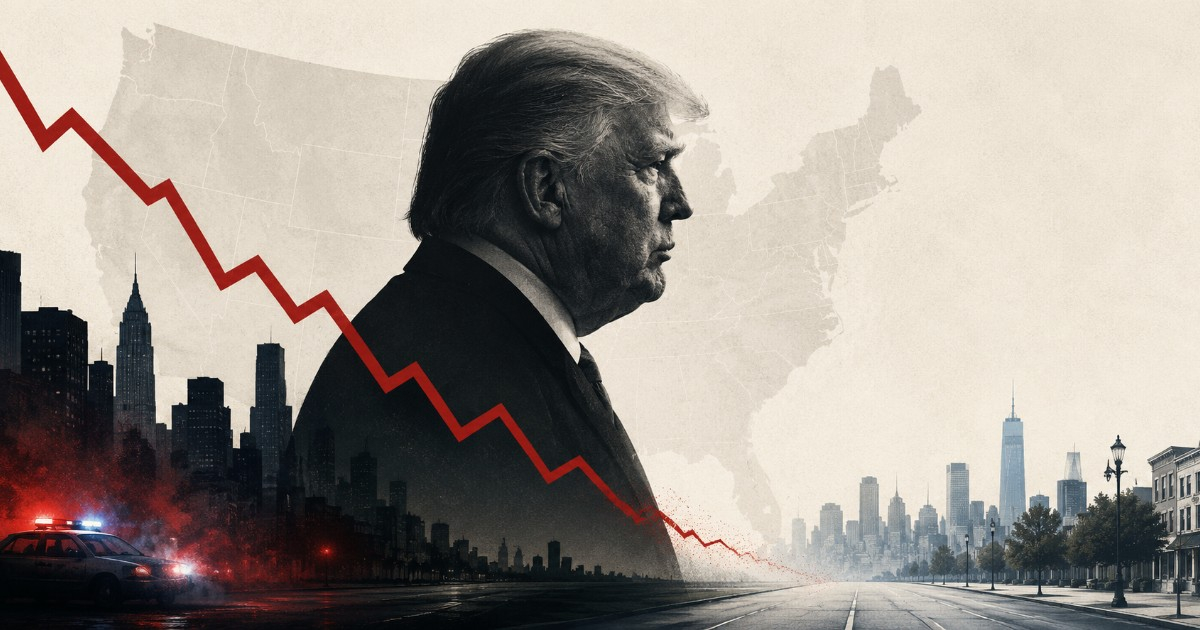
By the end of 2026, the United States might witness its lowest homicide rate in over a century, as suggested by a recent report from the Council on Criminal Justice released this Thursday. The report highlights an 18% drop in homicides during the first half of the year compared to the same period in 2025. This decline coincides with the months when President Donald Trump implemented stringent immigration policies.
The Council on Criminal Justice, an independent and nonpartisan body, compiled data from 30 American cities. Their analysis indicates that this reduction translates to roughly 215 fewer homicides.
If this downward trend continues through December, the nation could achieve homicide levels unseen in over a hundred years. However, the final numbers will only be available at the year's end.
Crime Rate Trends Across the Nation
The report examined 13 crime categories and noted decreases in nine, including carjackings, residential burglaries, and aggravated assaults. A notable finding was a 23% reduction in the lethality of violent crimes, indicating not only fewer crimes but also less deadly incidents.
Residential burglaries decreased by 13% compared to the previous year and by 50% from pre-pandemic levels in 2019.
Not all statistics were positive. Shoplifting rose by 5%, and there were slight increases in domestic violence, sexual assaults, and drug-related offenses.
Factors Influencing Crime Reduction
Adam Gelb, the President and CEO of the Council, emphasized that the improvements are being observed in cities with diverse political leadership, economic conditions, and security strategies.
“Crime rates are declining across the board, in cities with varying political leadership, different housing and economic conditions, diverse policing, prosecutorial strategies, and varying levels of federal enforcement activity,” Gelb noted.
“This represents one of the most significant advancements in public safety in decades. It means lives are being saved, families spared from trauma, and communities regaining stability,” he concluded.
Political Implications Amidst the Decline
With midterm elections on the horizon, both Democrats and Republicans are attempting to leverage the positive trend.
According to John Roman of the University of Chicago’s Center for Public Safety and Justice, conservatives allied with President Trump might credit the toughened immigration policies and National Guard deployments in cities like Los Angeles and Memphis. On the other hand, liberals may point to public safety legislation enacted during Joe Biden's administration.
However, Roman suggests that factors beyond any single administration play a role, such as decreased drug consumption, which reduces violence linked to illegal markets, and the federal post-pandemic funding for social programs.
These funds, Roman explained, supported jobs like teachers and social workers who engage with “youth most at risk of violence and victimization.”
Variations in Homicide Rates Across Cities
The overall landscape wasn’t uniform. Approximately one-third of the analyzed cities experienced homicide increases.
Norfolk, Virginia, saw a 64% rise, while San Francisco recorded a 55% increase. In contrast, Lincoln, Nebraska, achieved a 100% reduction in homicides during the first six months of 2026 compared to the same period in 2025.
This positive trajectory is part of a continued decline since the pandemic peak: homicides had already dropped 21% in 2025 from 2024, representing 922 fewer lethal crimes in 35 cities, and a cumulative decline of 44% since the 2021 peak.
Understanding the U.S. Homicide Rate Decline
What factors have contributed to the decline in U.S. homicide rates?
The decline is attributed to a reduction in drug consumption, federal funding for social programs, and varying local policing and prosecution strategies.
How have political policies impacted crime rates?
Policies such as stricter immigration enforcement and public safety legislation have been credited by different political factions for influencing crime reduction.
Are all cities experiencing a decline in crime rates?
No, while many cities have seen declines, about one-third reported increases in homicides.