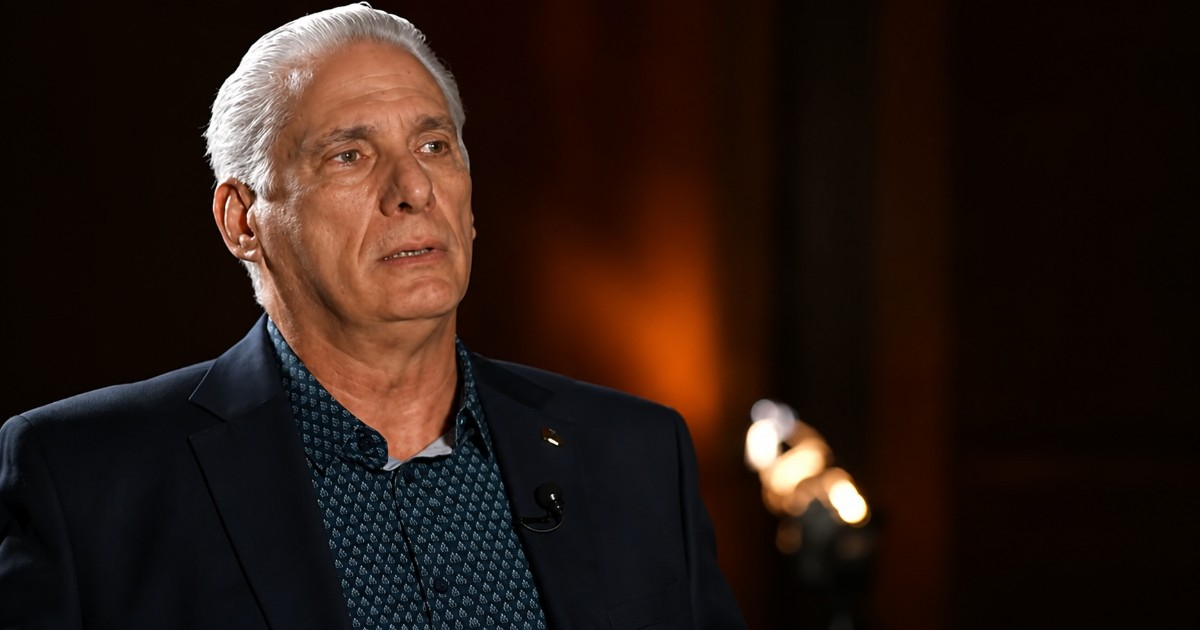
On Wednesday, Miguel Díaz-Canel hosted George Katrougalos, an independent expert from the UN Human Rights Council on promoting a fair and democratic international order, at the Palace of the Revolution. During their meeting, Díaz-Canel reiterated what he portrayed as Cuba's dedication to human rights, according to the official site of the Cuban Presidency.
The Cuban leader expressed gratitude for the Human Rights Council's statements in favor of Cuba and confirmed that the nation would "continue cooperating with UN mechanisms on this sensitive matter."
Bruno Rodríguez Parrilla, Cuba's Foreign Minister and a member of the Communist Party's Political Bureau, also attended the meeting.
Cuban Narrative vs. Ground Reality
Díaz-Canel's speech avoided addressing internal repression, instead focusing on the U.S. embargo, which he described as "the longest in human history; an economic, financial, commercial, and now energy blockade, imposed by the world's most powerful nation."
He declared that Cuba's stance in this situation is "to not surrender and resist, while also moving forward," emphasizing the need to "overcome the most adverse conditions through our own efforts and talent."
However, the official narrative starkly contrasts with realities documented by independent organizations. According to Prisoners Defenders, by June 2026, Cuba had 1,306 political prisoners, including 40 minors, 16 of whom are held in adult prisons.
In April 2026, Amnesty International demanded the release of all prisoners of conscience, highlighting that none identified by the organization had been freed, and excarceration announcements lacked transparency.
International Observations and Internal Suppression
The Cuban Human Rights Observatory recorded 332 repressive actions in May 2026, while Cubalex noted 319 incidents in June.
Katrougalos, a Greek jurist and former foreign minister, visited Cuba on an academic trip. During his stay, he gave a lecture organized by the Union of Cuban Jurists and the universities of Havana and International Relations, met with the Ministry of Foreign Affairs, and visited the Latin American School of Medicine and the Quisicuaba Assisted Living Center.
The Cuban Foreign Ministry described the visit as "a new expression of the cooperation Cuba maintains with the universal and non-discriminatory human rights mechanisms of the United Nations."
Diplomatic Strategy and Ongoing Repression
This scene is part of a systematic diplomatic strategy by the regime: utilizing multilateral forums to portray the embargo as the sole human rights violation in the nation while avoiding any mention of internal repression.
Back in April, Díaz-Canel had participated through a recorded message in a UN-sponsored conference in Geneva to accuse Washington of "flagrantly, deliberately, and unjustifiably violating the human rights" of Cubans.
Justice 11J reported in April 2026 that 338 individuals remain imprisoned for the July 11, 2021 protests, five years after these events.
Questions on Cuba's Human Rights Situation
What is the current status of political prisoners in Cuba?
As of June 2026, there were reported to be 1,306 political prisoners in Cuba, including 40 minors, with 16 held in adult facilities.
How is the Cuban government addressing the U.S. embargo?
The Cuban government continues to portray the U.S. embargo as the most significant human rights violation, framing it as an economic, financial, commercial, and energy blockade by the world's most powerful country.