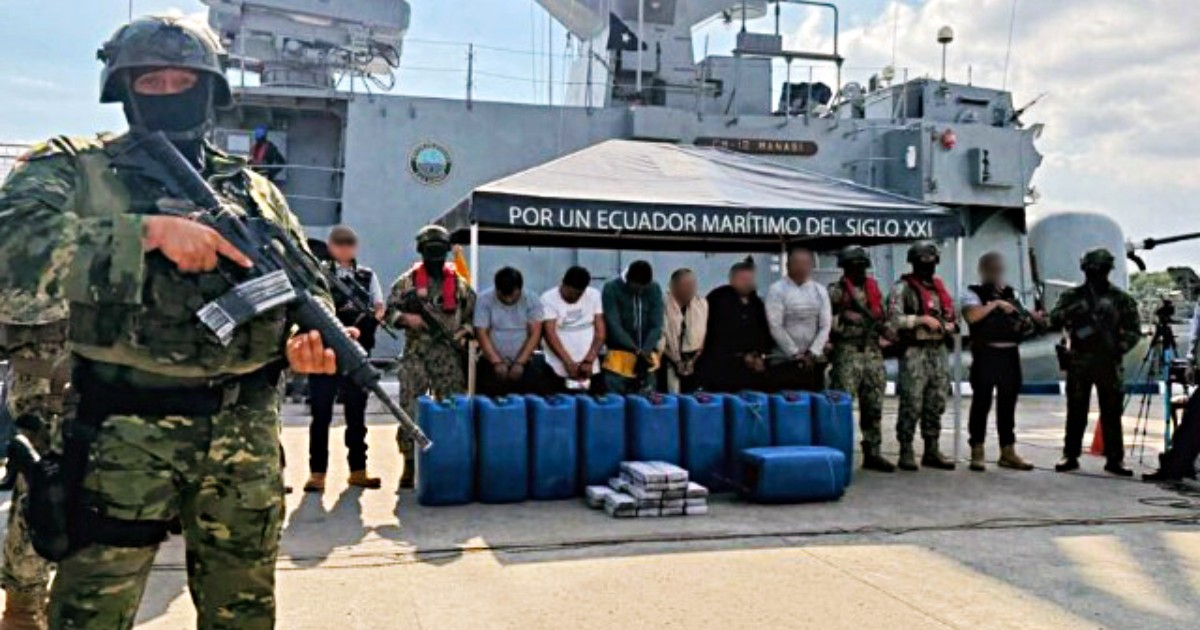
An international coalition, including the Joint Interagency Task Force South (JIATF-S), the Ecuadorian Navy, the Colombian Navy, and the DEA, confiscated 2,728 kilograms of cocaine in the Eastern Pacific this Wednesday. This operation, hailed by JIATF-S as the most significant maritime drug bust in Ecuador in 2026, underscores the ongoing battle against drug trafficking.
The operation was initiated when a maritime patrol aircraft from the United States Southern Command (SOUTHCOM) spotted two speedboats traveling in tandem south of Colombia, with routes originating in Ecuador and destined for Mexico.
Six traffickers, all Ecuadorian nationals, were apprehended during the mission.
The aircraft crew tracked the vessels overnight, coordinating in real-time with JIATF-S. This coordination enabled the Ecuadorian Navy's surface ships to intercept the speedboats precisely.
During the pursuit, the traffickers encountered a fishing vessel to swap crew members and refuel, a common tactic on these Pacific routes.
Upon boarding the vessels, authorities found 73 modified fuel barrels with false bottoms designed to conceal the drugs, showcasing an increasingly sophisticated method of smuggling.
JIATF-S lauded the operation as a testament to regional cooperation: "JIATF-S, Ecuador, Colombia, and the DEA joined forces to intercept a massive cocaine shipment in the Eastern Pacific, delivering the hardest blow to maritime drug trafficking in Ecuador this year."
The agency also emphasized that these efforts, led by the U.S. Department of Defense, "disrupt the funding of transnational crime, bolster regional security, and protect our homeland."
This operation is part of an Ecuador-U.S. cooperation phase described as "total offensive," with numerous maritime interdictions across the Pacific and Caribbean throughout 2026.
The 2026 World Drug Report by the UNODC, released in late June, identified Ecuador as a key logistical hub in the global cocaine trafficking network. It highlighted how criminal organizations exploit the extensive Pacific coastline, port infrastructure, and legitimate maritime trade—including banana exports—to disguise illegal shipments.
In March, Ecuadorian Armed Forces, backed by U.S. support, bombed a drug camp in the Amazon under "Operation Total Extermination" targeting the Border Commandos in Sucumbíos.
On the maritime front, a joint operation in June led to the detection of an Ecuadorian drug-running boat in the Caribbean, resulting in the seizure of over 3,900 pounds of marijuana and the arrest of two Ecuadorian citizens.
In July, Ecuador's Ministry of the Interior reported joint operations with the DEA on the high seas, which led to the seizure of over three tons of drugs and 11 arrests. These interdictions, conducted 180 nautical miles west of Manta, had an estimated economic impact of over $80 million on criminal networks.
Key Insights into Ecuador's Maritime Drug Bust
What was the size of the cocaine seizure in Ecuador's largest maritime bust of 2026?
The operation resulted in the seizure of 2,728 kilograms of cocaine, marking it as the largest maritime drug bust in Ecuador for the year 2026.
Which organizations were involved in the international coalition for this drug bust?
The coalition included the Joint Interagency Task Force South (JIATF-S), the Ecuadorian Navy, the Colombian Navy, and the DEA, with coordination from the United States Southern Command (SOUTHCOM).
How did traffickers attempt to conceal drugs during the operation?
Traffickers used modified fuel barrels with false bottoms to hide the cocaine, demonstrating a sophisticated technique for drug smuggling.