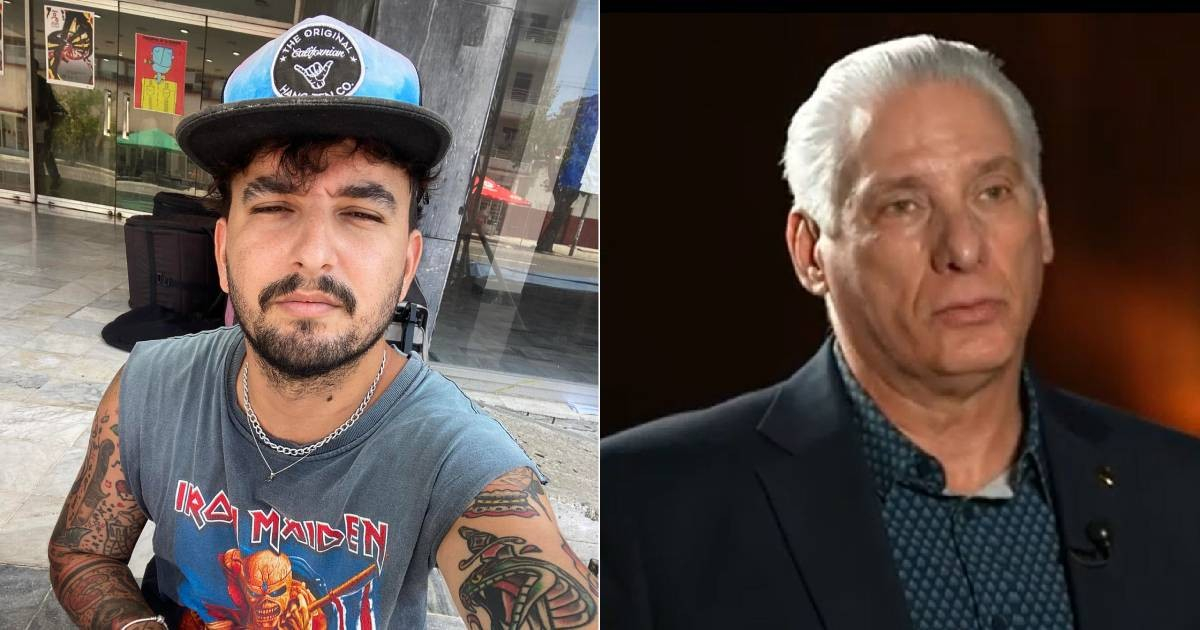
The Cuban rapper and songwriter, Jotabarrioz, voiced a sharp criticism on Facebook this Wednesday against the response given by Miguel Díaz-Canel when questioned about Cuba's potential to emerge from its crisis. He labeled the response as "vague and inaccurate," emphasizing that the true issue lies not in the crisis itself but in the glaring absence of solutions from those in power.
The catalyst for this outcry was an interview Díaz-Canel granted to RT en Español on July 20. When asked about resolving the crisis, he quoted writer Eduardo Galeano: "Utopia is on the horizon... What is the purpose of utopia? To keep us walking. I would say hope works the same way." This answer triggered a wave of criticism across social media and among Cuban public figures.
Jotabarrioz's Critique of Official Rhetoric
Jotabarrioz, the stage name of Jesús Andrés Barrios Sánchez, responded with a Facebook post highlighting how the term "utopia" reveals the underlying message: "Be aware that 'utopia' signifies a 'dream very difficult or almost impossible to achieve.' Faced with such an essential question posed to Miguel Díaz-Canel, his reply was vague and inaccurate."
For the artist, the presidential metaphor points to a deeper, more painful truth: "The issue is not the crisis itself; it is the lack of answers and solutions from those who manage the country. While the scarcity of nearly everything is distressing, the total hopelessness we are engulfed in is even more so."
Jotabarrioz rejected the official discourse, which he believes distorts reality with euphemisms: "These are not times for poetic phrases, ideological stances, or romanticizing the profound misery we are entrenched in. These are not times to confuse resistance with stagnation, sovereignty with stubbornness, or resilience with mere survival."
A Call for Basic Rights and Real Change
The musician, who has hosted the program Cuerda Viva on Cuban state television, was candid in demanding basic rights: "I don't want a utopia. I want the achievable dream of living up to my potential. I want a country where food, water, and electricity are not luxuries nor define my social class."
He depicted Cuban daily life with stark imagery that captures the degradation of everyday existence: "I want a country that allows me to design my projects without my worries being limited to finding daily food like a cave-dwelling hunter, or deciphering codes to figure out when I'll have two hours of light."
Backdrop of a Severe Energy Crisis
This statement comes amidst the worst energy crisis Cuba has faced in decades. In May 2026, the country recorded a record electrical deficit of 2,174 MW, leaving up to 70% of the territory without power simultaneously. By July, 106 distributed generation plants remained idle due to fuel shortages.
In the same interview, Díaz-Canel admitted that no fuel shipments arrived in Cuba for six months, except for one from Russia, and that the island produces only 40,000 barrels of oil per day while needing between 90,000 and 110,000 to sustain its economy.
Jotabarrioz's voice joins others who have harshly critiqued the presidential metaphor. Intellectual Alina Bárbara López—under house arrest since June 2024—remarked that "no one like the Cuban president can utter foolishness with such grandiosity." Actor Luis Alberto García Novoa demanded "actions, not promises" after hearing Díaz-Canel's response.
"It breaks my heart to wake up every day living the same day. It twists my soul to see colleagues, friends, people on the street with dim homes and eyes," Jotabarrioz wrote, closing his post with an image that encapsulates the mood of a generation: walking a thousand steps with worn-out shoes and seeing nothing on the horizon, "just a dystopia of garbage dumps and shadows."
Understanding the Cuban Crisis Response
What prompted Jotabarrioz to criticize Díaz-Canel's response?
Jotabarrioz criticized Díaz-Canel's response after he used a metaphor involving utopia to answer a question about Cuba's crisis, which the musician found vague and lacking concrete solutions.
How has the energy crisis affected Cuba recently?
Cuba is experiencing its worst energy crisis in decades, with a record electrical deficit and widespread power outages affecting up to 70% of the country simultaneously.
What message does Jotabarrioz convey about daily life in Cuba?
Jotabarrioz describes the daily struggles in Cuba as a hunt for basic necessities, likening it to a primitive existence and condemning the lack of reliable access to essentials like food and electricity.