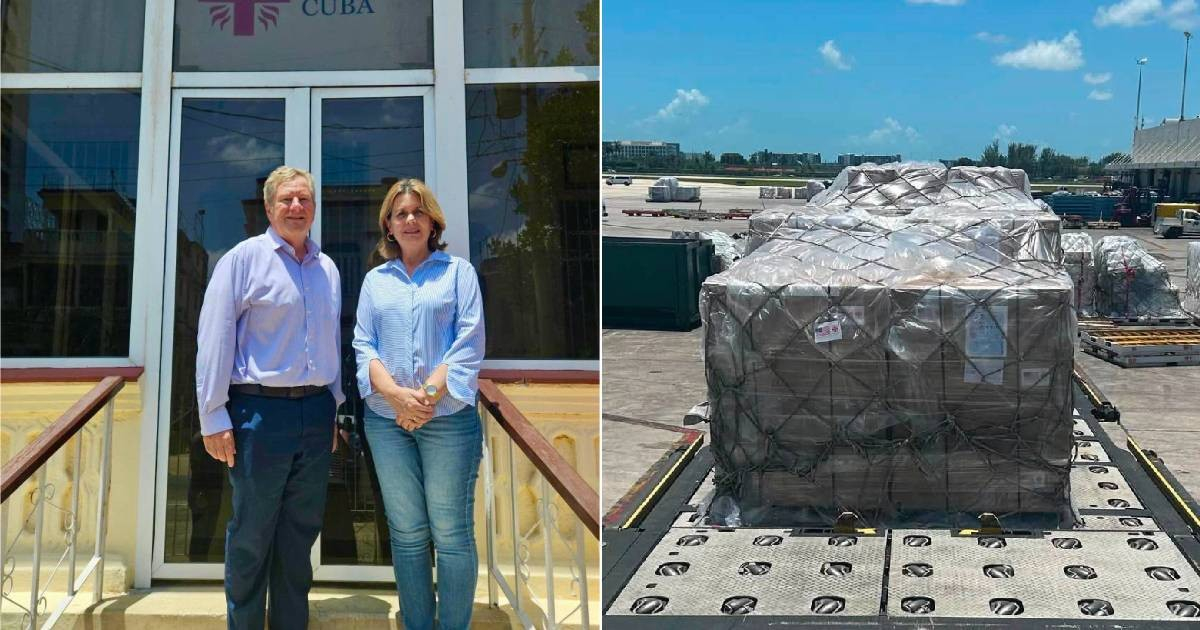
Mike Hammer, the head of mission at the U.S. Embassy in Havana, engaged in discussions with Carmen María Nodal Martínez, the director of Cáritas Cuba, at the organization's Havana headquarters on Wednesday. The focus of their meeting was to plan the delivery of humanitarian aid provided by the Trump administration.
This meeting followed the arrival of the first cargo flight at José Martí International Airport, which delivered 700 food kits and 700 hygiene kits aboard a 7Air Cargo plane from Miami.
The U.S. Embassy shared via social media that Hammer and Nodal Martínez deliberated on the distribution mechanism. This system operates through parishes, ensuring that packages are delivered directly to recipients' homes, bypassing the Cuban regime entirely.
Furthermore, arrangements were made for upcoming visits to Cáritas volunteers and beneficiary families in the municipalities of Bejucal in Mayabeque and Alquízar in Artemisa. Distribution efforts were actively underway in these areas, targeting the most vulnerable individuals as identified by their communities.
The supply boxes prominently display the message, "A donation from the people of the United States of America to the citizens of Cuba," alongside the Cáritas Cuba logo and the American flag.
The food kits include essential items such as white rice, black beans, tuna, sardines, vegetable oil, spaghetti, iodized salt, and brown sugar. Some packages also contain flashlights, buckets, toothpaste, and toothbrushes.
This initial shipment aims to assist 700 families within the archdiocese of Havana, selected based on vulnerability criteria set by their parish communities.
The aid initiative is part of a $100 million humanitarian assistance package announced by Secretary of State Marco Rubio on May 8, following his meeting with Pope Leo XIV at the Vatican, and later formalized by the State Department on May 13.
Out of the total amount, $60 million will be managed by the Catholic Church through Catholic Relief Services and Cáritas Cuba, while $40 million will be administered by independent non-governmental organizations.
The framework is designed to exclude governmental involvement: Catholic Relief Services procures the goods directly from the United States and ships them to the island, with Cáritas Cuba never handling cash transactions.
The Cuban regime's response to the first shipment was typical: the Ministry of Foreign Trade and Foreign Investment (MINCEX) blamed Washington for the island's crisis, although they formally accepted the aid in writing, terming it as "a gesture from the American people."
Deputy Secretary of State Jeremy P. Lewin was forthright, stating, "This is not their aid... They are not in a position to make decisions about this. If they interfere, they will be accountable to their own people and to us."
It is anticipated that the full program, once implemented nationwide, will benefit between 100,000 and 120,000 families across Cuba.
Frequently Asked Questions about U.S. Humanitarian Aid to Cuba
What is the purpose of the humanitarian aid sent to Cuba?
The humanitarian aid aims to provide essential food and hygiene supplies to vulnerable families in Cuba, bypassing the Cuban regime to ensure direct delivery to recipients.
Who is responsible for distributing the aid in Cuba?
The distribution is managed collaboratively by Catholic Relief Services and Cáritas Cuba, utilizing parish networks to reach families in need.
How many families are expected to benefit from the aid?
The complete program is projected to benefit between 100,000 and 120,000 families across the island.