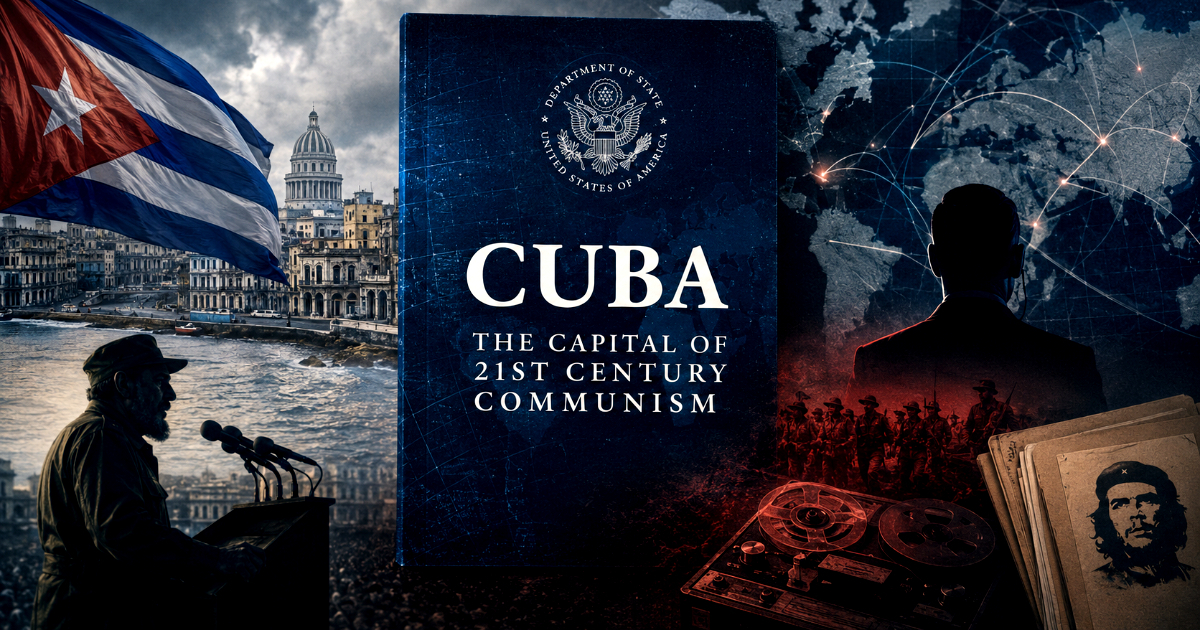
When the State Department released the report titled "Cuba: The Capital of 21st Century Communism," much of the information it contained was already well-known. The document details Cuba's military presence in Africa, support for Latin American revolutionary movements, its close ties with the Soviet Union, alliances with Chavismo, and cooperation with Russia and Iran. These elements have long been subjects of extensive literature and political debate.
However, reducing the report to a mere compilation of historical events would overlook its most intriguing aspect. The document doesn't just recount history; it reorganizes it. Events spanning over sixty years are arranged in a specific order to provide a coherent explanation of Cuba's current global position.
A Structured Argument for Cuba's Role
Unlike many government reports, which typically sort information by thematic areas or geographic regions, "Cuba: The Capital of 21st Century Communism" builds a progressive argument. Each chapter sets the stage for the next, with every historical episode adding to a broader narrative.
The 1959 revolution is depicted as the starting point, with the Soviet alliance offering resources and international visibility. Military campaigns in Africa and support for Latin American guerrillas highlight the regime's intent to export its ideology. The collapse of the Soviet bloc forced a strategic pivot, with Venezuela providing a new regional platform. Relations with Russia, China, and Iran are presented as modern extensions of this ongoing project.
Rethinking the Cuban Revolution's Role
This shift in perspective alters the traditional role of the so-called "Cuban Revolution" in the narrative. Historically viewed as the central event with foreign policy as a consequence, the report partially reverses this relationship. The revolution remains the origin, but its true significance lies in establishing a structure capable of international influence over decades.
Thus, the report focuses less on internal debates about economic models or social transformations within the island. Instead, it concentrates on what it deems enduring: the construction of political influence beyond national borders. Military campaigns, international cooperation, diplomatic alliances, and support for revolutionary movements are not seen as temporary responses to historical moments. Instead, they are woven into a consistent pattern of behavior.
Intelligence: The Unifying Thread
A chapter titled "An Empire of Espionage" places intelligence services at the core of this narrative. The report argues that the Directorate of Intelligence (DI) developed an operational capacity disproportionate to Cuba's size, making it a key tool for the regime's external projection.
The chapter's interest isn't limited to describing espionage operations. Intelligence is portrayed as the element linking all other dimensions analyzed in the document. Diplomacy, international cooperation, academic relations, political training, global solidarity, and ideological influence are integrated into a single network.
The report emphasizes that much of this effectiveness stemmed from the ideological commitment of its agents, characterized as "true believers," more dedicated to serving a political project than a conventional bureaucratic structure.
Networks Over Alliances
Unlike traditional alliances, the report frequently emphasizes the concept of a network. For example, the Cuban Institute of Friendship with the Peoples (ICAP) is described as "the central nexus of Cuba's intelligence and influence network." It is portrayed not just as an international solidarity organization but as a connector of organizations, political leaders, academics, activists, and social movements across countries.
This approach is mirrored in other sections of the report. Universities, exchange programs, solidarity brigades, international meetings, and affiliated organizations are analyzed not for their specific activities but for their roles within a network of relationships built over decades.
From Castroism to the 21st Century
The report's transition from the end of the Cold War to the present is another key focus. Instead of depicting the Soviet Union's dissolution as a definitive break, it views it as a period of adaptation. The alliance with Venezuela is crucial in this historical reconstruction. According to the report, Hugo Chávez's rise to power enabled Havana to regain regional influence and develop new forms of political, economic, and intelligence cooperation.
Subsequently, the narrative includes Russia, China, and Iran as part of a geopolitical configuration where Cuba serves as a connection point between various actors opposed to the United States. The chapter on Iran exemplifies this logic, detailing decades of political, intelligence, and technological collaboration between the two governments.
This continuity supports the report's title. Referring to 'The Capital of 21st Century Communism' doesn't merely assert that Cuba remains a communist state. It suggests that the regime has adapted Cold War-era influence tools for the modern international context, turning them into strategic assets in a new era of great power competition.
A Guiding Document for Interpretation
The report's strength doesn't lie in the indisputability of each argument. Like any strategic document, its interpretations may be debated by historians, intelligence experts, or international relations specialists. Its significance lies elsewhere. The State Department doesn't present a collection of unrelated events. Instead, it weaves them into a cohesive interpretive framework.
Revolution, intelligence, diplomacy, international solidarity, cadre training, and geopolitical alliances are no longer seen as independent phenomena. They are part of a unified narrative about the Cuban regime's international role.
This synthesis exercise explains why the report holds meaningful significance beyond academic or historical circles. Rather than offering a new history of Cuba, it proposes a new way to read it. In international politics, how a government organizes historical facts can be as revealing as the decisions it makes today.
Understanding the State Department's Report on Cuba
What is the main argument of the State Department's report on Cuba?
The report argues that Cuba has maintained a consistent international influence strategy, evolving from Cold War-era tactics to adapt to the modern geopolitical landscape.
How does the report view Cuba's alliances with countries like Russia, China, and Iran?
The report sees these alliances as part of a broader geopolitical network, positioning Cuba as a connection point among nations opposing US influence.
Why does the report emphasize the role of intelligence services?
Intelligence services are highlighted as a crucial component of Cuba's strategy, linking diplomacy, international cooperation, and ideological influence into a cohesive network.