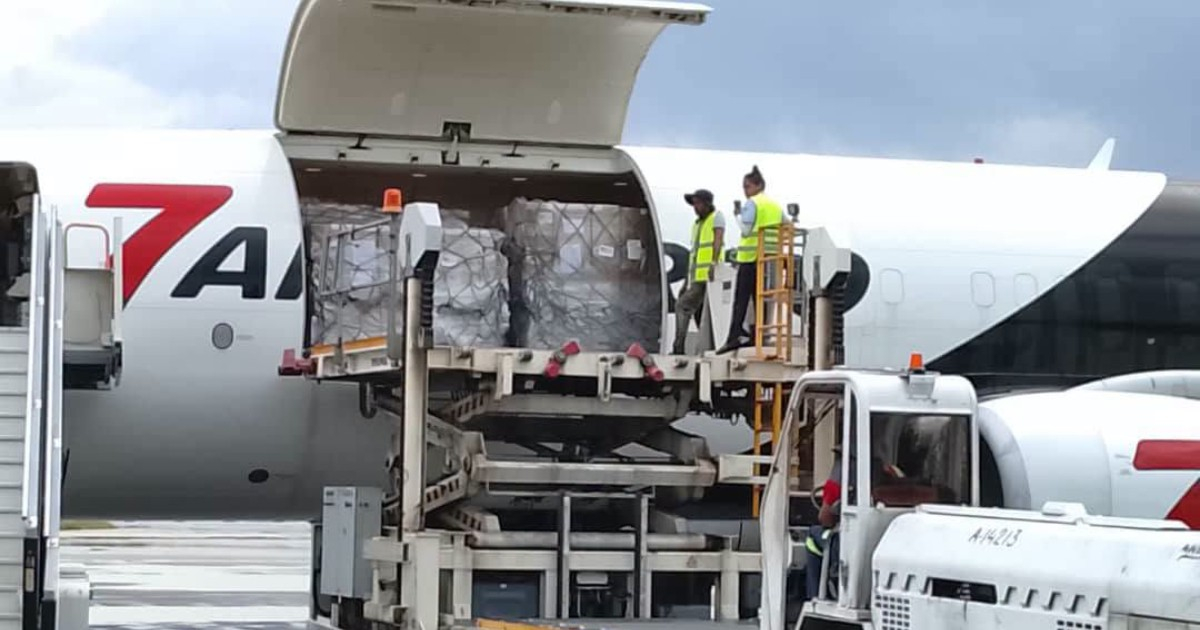
The Ministry of Foreign Trade and Foreign Investment (MINCEX) recently addressed the arrival of the first shipment of a $100 million humanitarian aid package from the United States on Facebook. However, they took the opportunity to once again accuse Washington of being responsible for the crisis currently plaguing Cuba.
A flight operated by 7 Air Cargo from Miami landed at Havana's José Martí International Airport, carrying 700 food kits and 700 hygiene kits intended for an equal number of families in the municipalities of Alquízar, Artemisa, and Bejucal, Mayabeque.
The reception saw the participation of Cardinal Juan de la Caridad García Rodríguez, Archbishop of Havana; Carmen María Nodal Martínez, director of Cáritas Cuba; and Ángel Miguel Gutiérrez Valdivia, director of Cáritas Habana, along with government officials.
The distribution of these packages, which include rice, beans, tuna, and hygiene products, will be managed through local parishes based on vulnerability criteria, with the support of community volunteers.
MINCEX's Narrative and Diplomatic Tensions
In its statement, MINCEX didn't miss the chance to claim that "the aid component contrasts with the reality imposed by the collective punishment applied by the U.S. government against the Cuban people, reinforced by a brutal energy blockade enforced since early this year."
The regime portrayed the assistance not as a gesture from the U.S. government but from the American people: "Cuba does not oppose aid as long as it benefits the people and is not used for political gain; it accepts it as a gesture from the American people, who sustain, through their contributions, the public funds used by their government."
This narrative is part of the regime's strategy to accept the material resources needed by the population while maintaining the embargo narrative as the root of all Cuba's problems.
MINCEX's statement comes amid diplomatic tensions. On Tuesday, Miguel Díaz-Canel lashed out at Secretary of State Marco Rubio, calling him "one of the most corrupt officials of the current administration, with proven ties to drug traffickers and terrorists in Florida," in response to the State Department's report titled "Cuba: the Capital of 21st Century Communism." On Wednesday, Foreign Minister Bruno Rodríguez labeled the same document as a "slanderous pamphlet."
U.S. Aid Strategy: Excluding the Regime
The regime's stance contrasts with warnings from Deputy Secretary of State Jeremy P. Lewin, who was clear in stating that "this is not their aid" and that the Cuban government "is not in a position to make decisions about this."
The $100 million aid package was announced by Rubio in May 2026 from Rome, following a meeting with Pope Leo XIV. It is divided into $60 million for the Catholic Church and $40 million for independent non-governmental organizations. The strategy was designed to bypass the regime: Catholic Relief Services purchases the goods in the U.S. and sends them to Cáritas Cuba, which distributes them without cash transfers and without state mediation.
According to Cáritas Cuba, the complete program could benefit between 100,000 and over 196,000 families across the island, building on the experience of a previous $9 million package distributed after Hurricane Melissa in October 2025.
Frequently Asked Questions About U.S. Aid to Cuba
What does the U.S. aid package to Cuba include?
The aid package includes food kits with rice, beans, tuna, and hygiene kits, intended for vulnerable families in Cuba.
How is the aid being distributed in Cuba?
The distribution is managed through local parishes based on vulnerability criteria, with the support of community volunteers.
What is the Cuban regime's response to the aid?
The Cuban regime has accepted the aid but continues to blame the U.S. embargo for the country's crisis, portraying the assistance as a gesture from the American people rather than the U.S. government.