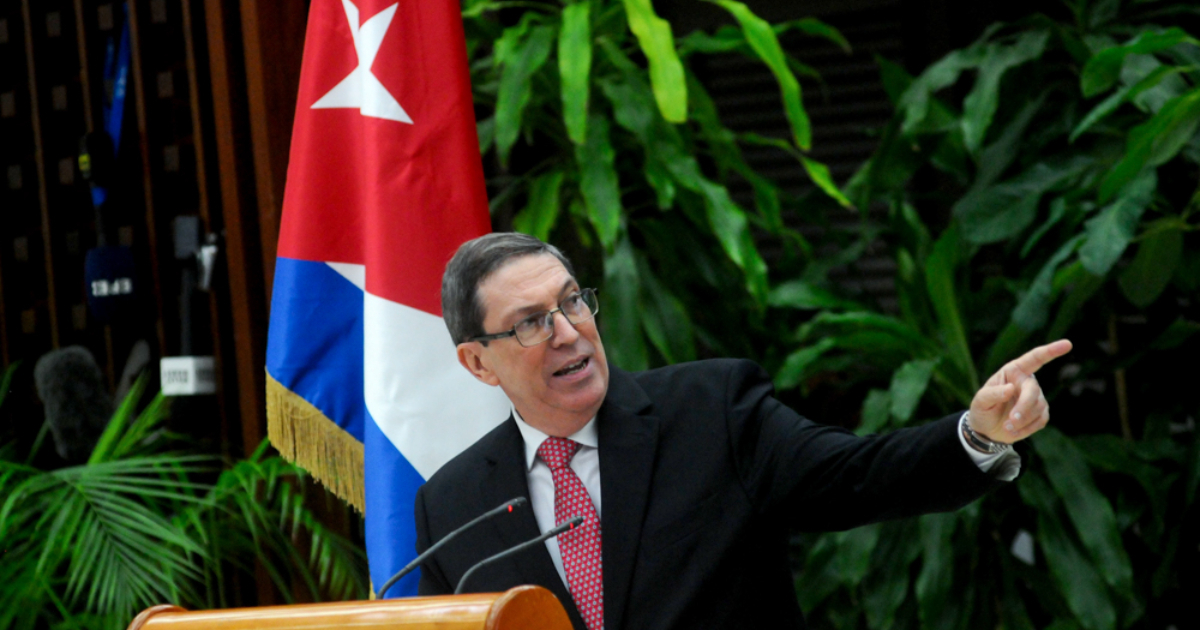
Cuban Foreign Minister Bruno Rodríguez Parrilla lashed out on Tuesday, labeling the State Department's recently released report on Cuba as a "slanderous pamphlet." This statement, shared on his X account, marks his second public rebuttal within 24 hours.
The report, titled "Cuba: The Capital of Communism in the 21st Century," presents the U.S. government's perspective on nearly seventy years of alleged espionage, ideological influence, and subversive activities attributed to Havana.
Rodríguez criticized the report, claiming it aims to "frighten the American public with the supposed threat looming over the world's largest nuclear power." He dismissed it as "a curious exercise blending deceitful fantasy with a touch of admiration."
Furthermore, the foreign minister attributed 3,478 deaths and 2,099 mutilations to acts of violence and terrorism linked to the United States, without providing concrete evidence.
"Solidarity with those fighting for justice against oppression and crime is not a threat," Rodríguez stated, concluding his message with the hashtags "#CubaIsNotAThreat" and "The blockade is."
Previous Reactions and Accusations
This was Rodríguez's second response to the document. On Monday, he had already labeled the report as "false" and accused Senator Rubio of fabricating a pretext to maintain economic pressure and justify potential military aggression against Cuba.
In a follow-up message that same Monday, Rodríguez intensified his rhetoric, condemning what he described as Rubio's "macabre plan," allegedly backed by unspecified individuals or organizations that had previously supported the Secretary of State.
Meanwhile, Cuban leader Miguel Díaz-Canel also chimed in on Monday, labeling Rubio "corrupt" and associating him with drug traffickers, yet he failed to provide evidence to support these allegations.
Allegations of Espionage and Subversive Activities
The report, which has infuriated the ruling elite in Havana, also claims that Cuba hosts facilities linked to Chinese and Russian intelligence operations.
It references cases such as that of Ana Belén Montes, a former top analyst on Cuba for the Defense Intelligence Agency, who was arrested in 2001, and Víctor Manuel Rocha, a former U.S. ambassador who confessed to clandestinely working for Cuban intelligence for decades.
Rocha was apprehended in December 2023 and sentenced to 15 years in prison by April 2024. Subsequent FBI investigations traced his collaboration with Havana back to 1973, highlighting his access to the National Security Council, the White House, and other sensitive U.S. government information.
The report concludes with a stark warning: "Mistaking Cuba's poverty for harmlessness is a complete misunderstanding of the threat. Its power has always been ideological, subversive, and parasitic."
Understanding the U.S. Report on Cuba
What does the U.S. report accuse Cuba of?
The report accuses Cuba of engaging in espionage, ideological influence, and subversive activities over the last seven decades, as well as hosting intelligence operations from China and Russia.
How has Cuba responded to the report?
Cuban officials, including Foreign Minister Bruno Rodríguez and President Miguel Díaz-Canel, have strongly criticized the report, calling it slanderous and accusing U.S. figures like Senator Rubio of ulterior motives without providing evidence.