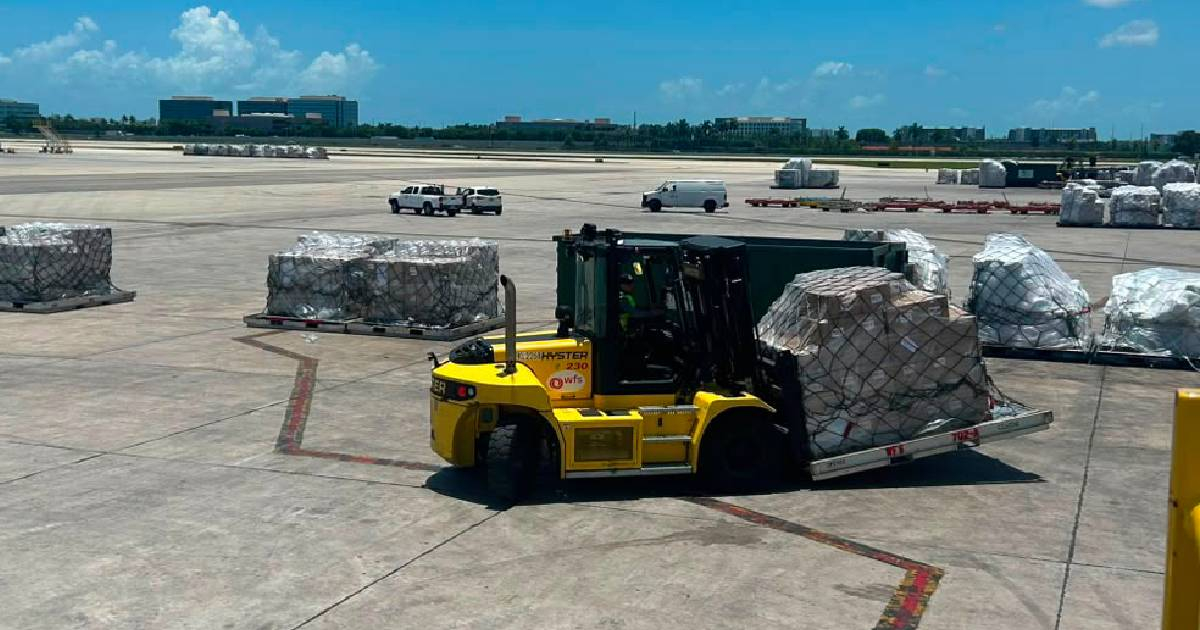
This past Tuesday, the U.S. State Department dispatched the inaugural humanitarian aid flight from Miami, part of a $100 million aid package that Secretary Marco Rubio has pledged to the Cuban people. The Trump administration aims for a "freer and more prosperous future for Cuba" through this initiative.
A cargo plane operated by 7 Air Cargo took off from Miami International Airport bound for Havana, laden with 700 hygiene kits and 700 food items for Cuban families, as confirmed by the State Department.
Overseeing the departure were Jeremy P. Lewin, Acting Undersecretary of State for Foreign Assistance, Humanitarian Affairs, and Religious Freedom, along with Viviana Bovo, Senior Advisor to the Office of Western Hemisphere Affairs.
The aid will be distributed solely through Catholic Relief Services (CRS), Caritas Cuba, and the Catholic Church in Cuba, entirely bypassing the Cuban regime's involvement.
This mechanism ensures the security of the resources: CRS procures the goods directly in the United States and ships them to the island, while Caritas Cuba never handles any cash.
Labels affixed to the packages bear the message "Donation from the People of the United States of America to the Citizens of Cuba," alongside the Caritas Cuba logo and the American flag.
Lewin firmly cautioned the regime against any interference: "This is not your aid... You are not in a position to make decisions about this," adding that any interference by the regime would make them accountable both to their people and to the U.S.
This flight directly opposes statements made by Miguel Díaz-Canel on June 19 to a Dominican television station, where he claimed that aid would not begin until after September and would exclude food and medicine, dismissing the offer as a "joke."
The State Department responded sharply to these claims: "That is completely and utterly false. The shipments do include food, as demonstrated during inspections conducted in the humanitarian aid phases following Hurricane Melissa."
Despite his public derision, Díaz-Canel had formally accepted the aid in writing. On Tuesday, Díaz-Canel reacted to the "Cuba: Capital of 21st Century Communism" report—released Monday by the State Department—by attacking Rubio, calling him "one of the most corrupt officials in the current administration, with proven ties to Florida's drug traffickers and terrorists."
The $100 million package was first announced by Rubio on May 8 from Rome, following his meeting with Pope Leo XIV at the Vatican, and was formalized by the State Department on May 13.
Of the total amount, $60 million will be managed by the Catholic Church and $40 million by highly trusted independent non-governmental organizations.
The entire package is expected to benefit between 100,000 and 120,000 families across the island.
This initial shipment draws on lessons learned from two previous deliveries totaling $9 million, which were routed from January 2026 in response to Hurricane Melissa that struck eastern Cuba on October 29, 2025, impacting over three million people.
Caritas Cuba utilized 82% of those previous funds, aiding approximately 8,800 families in Santiago de Cuba, Holguín, Las Tunas, Bayamo, and Guantánamo, even reaching remote areas via ox carts without state mediation.
Rubio summarized Washington's stance in May: "The Cuban people must know there's $100 million in food and medicine available to them right now, and the only reason they aren't receiving it is the Cuban regime."
Understanding the U.S. Aid Plan for Cuba
What is the purpose of the $100 million aid package to Cuba?
The aid package aims to support Cuban families with essential supplies and promote a "freer and more prosperous" future for Cuba, as part of the U.S. government's initiative.
Who is responsible for distributing the aid in Cuba?
The distribution is managed exclusively by Catholic Relief Services, Caritas Cuba, and the Catholic Church in Cuba, without involvement from the Cuban regime.
How is the aid being delivered to Cuba?
The aid is transported via cargo flights from Miami to Havana, and includes necessary items such as hygiene kits and food supplies.