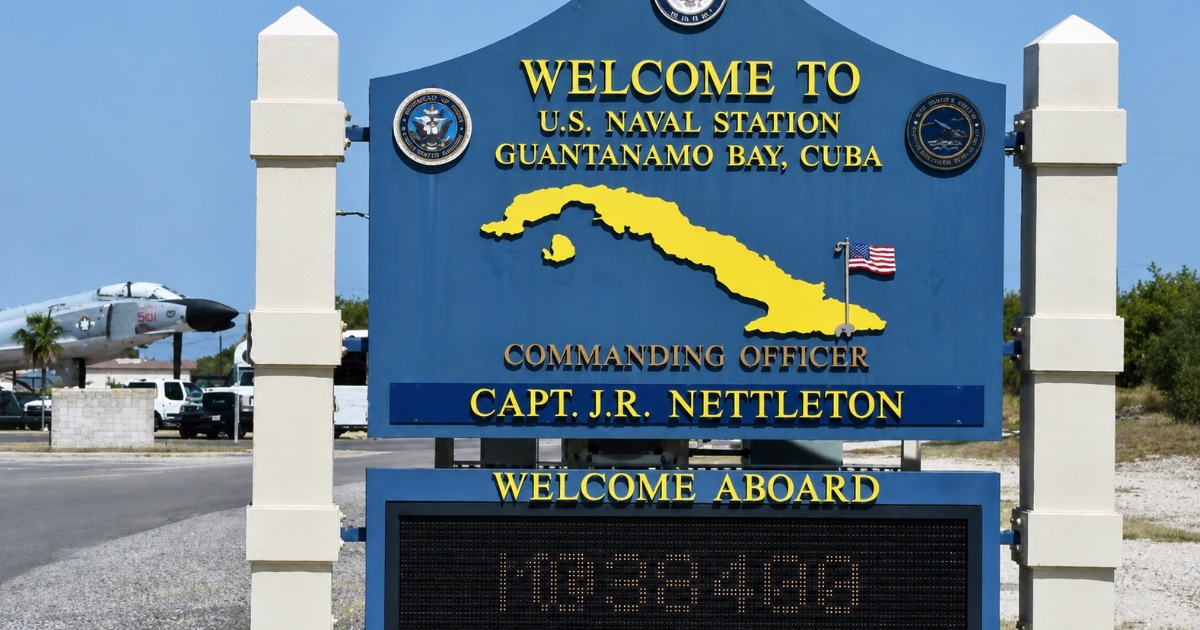
The Trump administration is seeking construction firms to either expand or establish new immigrant detention centers across up to 14 sites within the United States and its territories. This includes the naval base at Guantánamo Bay in Cuba and the U.S. Virgin Islands, as revealed by documents obtained by Time magazine.
On Monday, the formal request for proposals was published on the federal portal sam.gov by the Immigration and Customs Enforcement (ICE). The request highlights the expansion of the Port Isabel facility in Texas, located near the Mexican border, as the initial concrete step in this plan.
The potential locations listed are Miami; Honolulu; Florence, Arizona; Batavia, New York; Broadview, Illinois; Oakdale, Louisiana; El Paso and Huntsville, Texas; Aguadilla, Puerto Rico; St. Thomas in the U.S. Virgin Islands—currently devoid of any ICE centers—and El Centro, California, a closed facility since 2014, which is included in the plan for reopening.
Each expansion unit is designed to be a single-story structure housing 26 detention cells, equipped with security cameras in each cell, and three communal showers for inmates.
The projected cost per unit ranges from $24 million to $40 million, with a total spending cap set at $10 billion. The contract is anticipated to be awarded by the end of September.
Plans also include constructing an entirely new facility at Guantánamo Bay, resurrecting a promise Trump made in January 2025 to provide "30,000 beds" for "the worst illegal immigrant criminals."
However, the reality has been starkly different. CBS News reported in May that the operational cost of Guantánamo's military component amounts to $73 million annually, even though the facility has only about 400 beds, with less than 2% occupancy.
As of May 11, only six detainees, all Haitian nationals, remained at the base.
The expansion effort is a response to the overpopulation crisis in ICE facilities, which currently detain over 60,000 individuals, according to the watchdog group TRAC.
Recently, the Trump administration set a new target of 2,000 daily arrests after failing to meet the previous goal of 3,000 daily arrests.
The path to expansion has been fraught with challenges. ICE had already spent close to $1 billion acquiring nearly a dozen commercial warehouses to convert into detention centers. However, most of these projects have been stalled by legal challenges concerning environmental impact in Maryland, Arizona, New Jersey, and Michigan.
In June, the agency began selling or transferring seven of these warehouses.
Conditions in existing centers have also raised alarms. In 2026, there were reports of a measles outbreak in Arizona, expired food, air conditioning failures, and cases of medical negligence.
The mortality rate in ICE centers has reached 88.9 deaths per 100,000 detainees this year, the highest in 22 years, according to Human Rights Watch.
The ICE document cautions that the construction plan will proceed only "if it is in the government's best interest," a clause that leaves open the possibility that several of the 14 projects may not come to fruition.
Key Aspects of Trump's Detention Center Expansion Plan
What is the purpose of expanding detention centers?
The expansion aims to address the current overpopulation crisis in ICE facilities, which are detaining over 60,000 individuals.
Where are the proposed new detention centers to be located?
Proposed locations include Miami, Honolulu, Florence (Arizona), Batavia (New York), Broadview (Illinois), Oakdale (Louisiana), El Paso and Huntsville (Texas), Aguadilla (Puerto Rico), St. Thomas in the U.S. Virgin Islands, and El Centro, California.
What issues have been reported in existing ICE centers?
Existing centers have faced issues such as a measles outbreak, expired food, air conditioning failures, and cases of medical negligence.