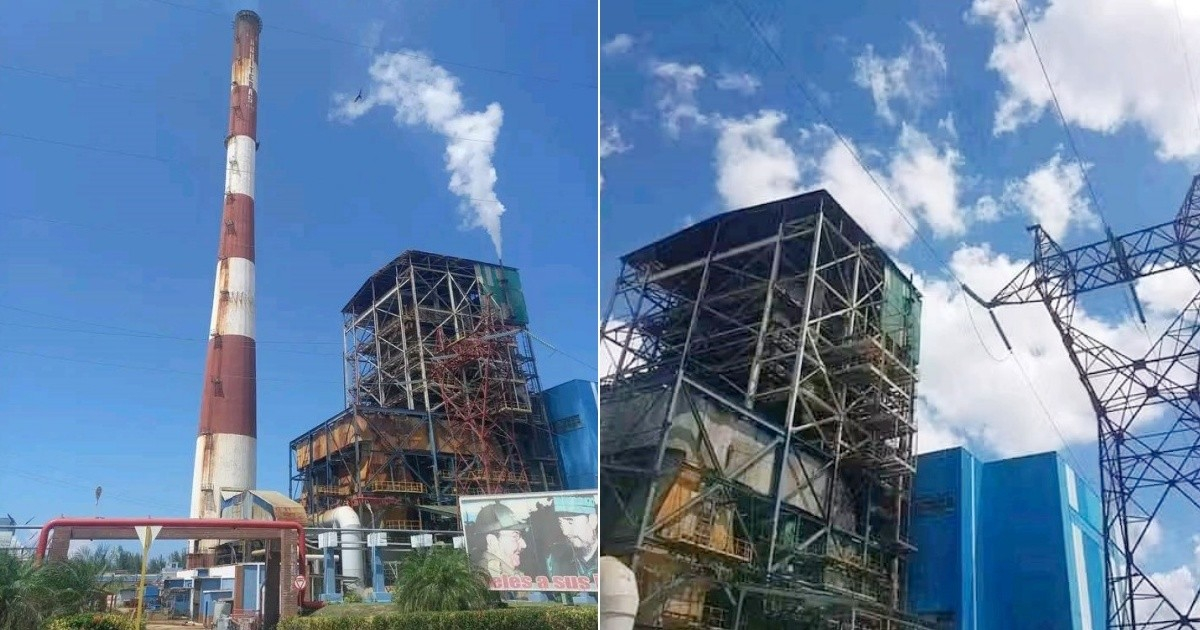
The Antonio Guiteras Thermoelectric Plant, Cuba's largest power generator, announced on Tuesday a fresh withdrawal from the National Electric System (SEN) due to a water loss in its boiler. This update was shared by Matanzas-based journalist José Miguel Solís, who is known for his specialized reporting on the plant.
Just moments before the official announcement, the plant's website indicated that Guiteras was operational yet producing a mere 150 MW, restricted by high water usage—a condition that foreshadowed its imminent disconnection.
This shutdown occurs merely a day after the plant was reconnected to the SEN, highlighting a repeated pattern of outages that continues to exacerbate Cuba's ongoing electricity crisis.
The Chaotic July at Guiteras
July has been particularly turbulent for the Guiteras plant. On July 18, the plant synchronized with the SEN but was disconnected after just 26 minutes due to a boiler leak. It managed to reconnect on July 20, only to fail again on Tuesday.
Thus far in 2026, the plant has experienced at least 17 unscheduled outages, primarily due to economizer faults and water leaks in the boiler, which account for half of these shutdowns.
Structural Issues and Maintenance Neglect
The underlying problems are deeply rooted. Guiteras has been operational for over 38 years without receiving comprehensive maintenance since 2010. This means 16 years have passed without an in-depth overhaul.
In June, a plant engineer confirmed that they lack the necessary parts for extensive repairs. A long-term fix would require replacing around 500 tubes and performing between 1,000 and 1,200 welds, necessitating a 180-day shutdown that authorities have yet to implement.
Widespread Failures Across the Grid
The rest of the thermal system offers little relief: Units 5 and 6 of the Máximo Gómez Thermoelectric Plant (Mariel) are malfunctioning, as is Unit 2 of the Ernesto Guevara Thermoelectric Plant (Santa Cruz) and Unit 3 of the Antonio Maceo Thermoelectric Plant (Renté).
At the Lidio Ramón Pérez Thermoelectric Plant in Felton, Unit 1 has returned to the SEN following urgent repairs, but Unit 2 remains out of service this Tuesday.
Moreover, 106 distributed generation plants are offline due to fuel shortages. Additionally, the barges at Regla and Melones, along with the fuel plants in Mariel and Moa, remain inactive.
Predicted Impact and Insufficient Solar Generation
Tuesday's outlook appears grim according to the Union Eléctrica's report: peak hour availability is projected to reach just 1,080 MW against an anticipated demand of 3,200 MW, with an expected shortfall of 2,150 MW.
On Monday, service disruptions lasted 24 hours, including overnight, with a maximum impact of 2,128 MW at 9:40 PM, affecting all provinces across the country.
The 54 photovoltaic solar parks generated 4,989 MWh on Monday, with a peak capacity of 780 MW. This output is insufficient to offset the deficit that spikes during nighttime when solar generation ceases, and demand peaks.
Understanding Cuba's Electrical Crisis
What is causing the frequent outages at the Guiteras plant?
The frequent outages are mainly due to structural issues such as boiler leaks and economizer faults, compounded by a lack of maintenance and necessary parts for repairs.
How does the situation at Guiteras impact Cuba's overall power system?
Guiteras' instability significantly contributes to Cuba's energy crisis, as its repeated disconnections exacerbate the existing power shortfall across the nation.
What are the challenges faced by other thermoelectric plants in Cuba?
Other plants are also grappling with malfunctions and fuel shortages, limiting their ability to compensate for the deficits left by Guiteras and other offline facilities.