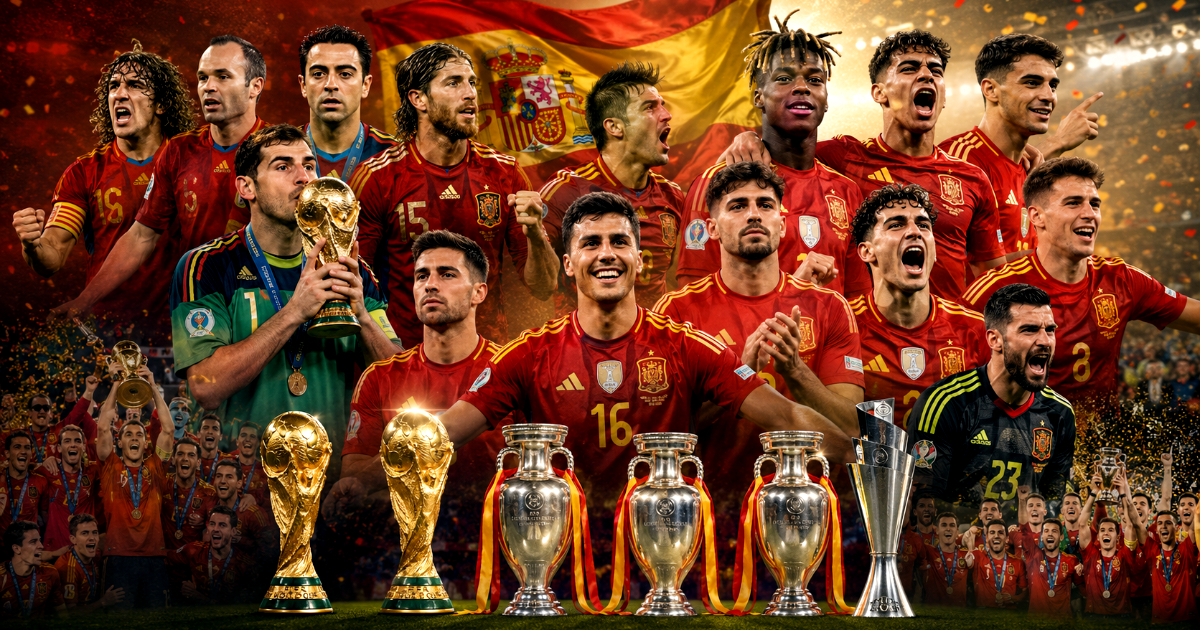
The victory at the 2026 World Cup not only reinstated Spain at the pinnacle of international soccer but also underscored a truth that has been building for nearly two decades: no other national team has assembled such an impressive record in major competitions during the 21st century.
Spain's triumph over Argentina in the final held in the United States allowed the team to secure its second World Cup in just sixteen years. The first was claimed in South Africa in 2010, with the second achieved in North America in 2026. No other nation has managed to win two World Cups since 2000.
However, Spain's success transcends FIFA's premier competition. Since the turn of the century, the national team has also captured three European Championships—2008, 2012, and 2024—and the UEFA Nations League in 2023, accumulating six top-tier official titles.
This achievement becomes even more significant when considering the competitive value of these tournaments. While other nations may boast a greater number of official trophies, none can match the combination of prestigious championships that Spain holds.
Brazil, for instance, secured the 2002 World Cup, three Copa America titles (2004, 2007, and 2019), and three Confederations Cups (2005, 2009, and 2013). Mexico, in the same timeframe, won seven Gold Cups. Yet, the Confederations Cup—discontinued since 2019—and the Gold Cup do not hold the same historical and sporting weight as the World Cup and the European Championship.
The Significance of the European Championship
The European Championship is often regarded by experts as the most challenging continental tournament globally due to the concentration of elite teams. Winning it three times in eighteen years is already an extraordinary feat; achieving this alongside two World Cup victories places Spain in a league of its own.
The dominance began with a generation led by Luis Aragonés and later solidified by Vicente del Bosque. Between 2008 and 2012, Spain clinched the European Championship, World Cup, and another European Championship consecutively, a sequence unmatched in men's soccer history.
A Legacy of Excellence
Rather than remaining a one-time phenomenon, this footballing identity found continuity. After a period of rejuvenation, the 2024 European Championship and the 2026 World Cup demonstrated that Spain had regained its status as a global powerhouse with a new wave of talent.
Examining only the most prestigious titles—World Cups, continental championships, and the Nations League—no other team in the 21st century presents such a robust record.
While Brazil maintains the most historically decorated soccer legacy, Germany and Italy preserve remarkable legacies, and Argentina added a World Cup in 2022, none have managed to pair two World Cups with three continental titles in this era.
The stats, titles, and sustained competitiveness lead to one conclusion: the 21st century has seen several champions, but only one team has built a genuine dynasty. That team is Spain.
Understanding Spain's Football Dominance
What makes Spain's football achievements in the 21st century unique?
Spain's football achievements are unique due to their combination of two World Cups and three European Championships in the 21st century, a feat unmatched by any other national team.
How does Spain's record compare to other countries like Brazil and Argentina?
While Brazil and Argentina have their own impressive records, Spain stands out by winning two World Cups and three European Championships since 2000, a combination of titles that neither Brazil nor Argentina has achieved.