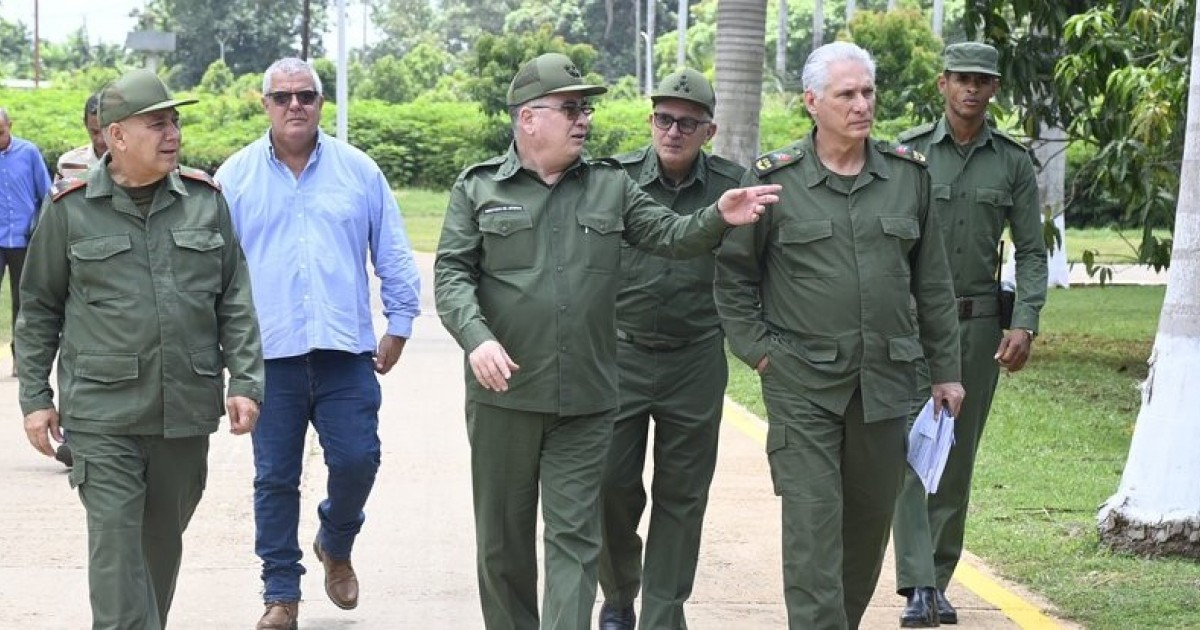
In a recent interview with Russian state media outlet RT, Miguel Díaz-Canel emphasized the Cuban regime's commitment to maintaining open channels of communication with the United States. He warned that an armed conflict would lead to "a bloodbath with dire consequences for both nations."
Defending the continuation of dialogue, Díaz-Canel invoked a historical tradition, a stance that critics argue hinders any substantial progress. "The revolution has always championed resolving bilateral differences between Cuba and the United States through dialogue," he stated, while stipulating that talks must be conducted "on a basis of respect and equality, without preconditions."
He firmly stated that discussions on political systems, self-determination, and independence are "not up for debate."
Díaz-Canel attributed the challenging nature of the dialogue to the United States, saying, "It is very difficult to engage in dialogue under these conditions, when we face a power that consistently plays the role of aggressor" and "has historically failed to honor its commitments."
Nevertheless, he reiterated the regime's dedication to peaceful solutions, citing the teachings of Fidel Castro: "Dialogue is the path to peace, and peace is the cornerstone of stability."
The Cuban leader also dismissed accusations made on July 16 by Secretary of State Marco Rubio, who, during a ministerial conference with representatives from over 70 countries, labeled Cuba as the "world capital of leftist radical terrorism" and accused Havana of supporting a "platform of political terrorism." Díaz-Canel described these claims as a "pretext" fabricated by Washington to justify potential military aggression.
During the same interview, Díaz-Canel accused the United States of waging a "multidimensional aggression" against Cuba, with ideological, cultural, and media components. He accused Washington of promoting a "supremacist, capitalist, and imperial narrative, replete with slander and lies."
The choice of RT as the platform for these statements was deliberate. Díaz-Canel praised the Kremlin-backed channel as a reliable source, asserting that Cuba turns to it "to discern the truth amidst the widespread lies in the world."
These remarks come amid the most severe bilateral crisis between Cuba and the United States in decades, exacerbated by more than 240 sanctions imposed by the Trump administration since January and an energy blockade that has left the island virtually fuel-starved for six months.
Foreign Minister Bruno Rodríguez had already warned on June 30 that bilateral talks "show no progress" and accused Washington of mixing dialogue with threats and coercive measures.
The regime also disclosed the extent of the energy crisis affecting the Cuban population. "No fuel shipments have arrived in six months, except for one Russian vessel," Díaz-Canel admitted, a confession that contrasts with the official narrative of heroic resistance and highlights the direct impact of sanctions on ordinary Cubans, who endure power outages lasting over 24 hours.
The leader also promised that by the end of July, the government would be prepared to implement 121 of the 176 approved economic measures, starting with those aimed at retirees and low-income individuals. However, he offered no concrete assurances that these measures would alleviate the structural crisis plaguing the island after 67 years of dictatorship.
Understanding the Cuban-American Diplomatic Standoff
Why is Díaz-Canel advocating for dialogue with the United States?
Díaz-Canel believes that maintaining dialogue is essential to resolving bilateral differences peacefully, emphasizing a historical tradition of seeking solutions through communication rather than conflict.
What are the main obstacles to Cuban-American dialogue?
The main obstacles include the United States' aggressive stance, historical non-compliance with commitments, and the imposition of over 240 sanctions by the Trump administration, which complicate diplomatic progress.
How has the energy crisis affected Cuba?
The energy crisis, exacerbated by an energy blockade, has resulted in significant fuel shortages, leading to prolonged power outages that severely impact daily life for the Cuban population.