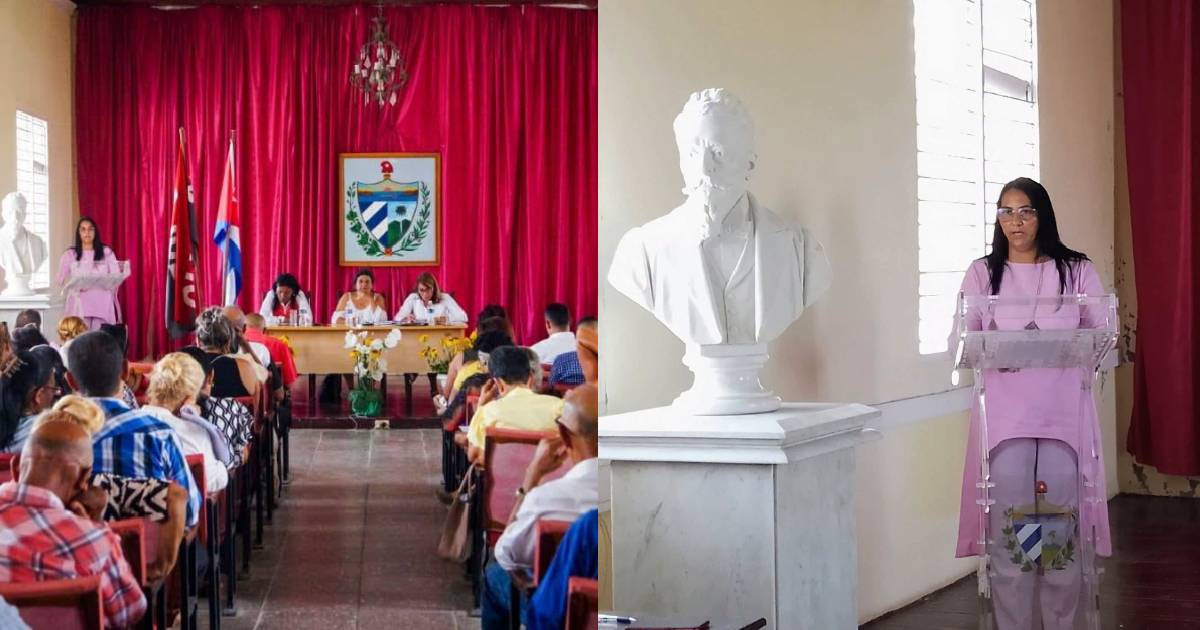
Yudelkis Ortiz Barceló, the head of the Communist Party of Cuba (PCC) in Granma and a national assembly representative for Manzanillo, appeared before the Municipal Assembly of People's Power in the city of Guacanayabo on Saturday. Her purpose was to report on her two-year term, but her speech was filled with emotional rhetoric rather than concrete management data.
This session was part of the 18th mandate period of the local government body and also included other representatives from the region. Delegates from Cayo Espino, San Francisco, Caymari, Pedro Soto, Las Novillas, and Carlos Coello presented their reports, according to CMKX Radio Bayamo.
Ortiz Barceló described the event as "a great honor" and "a significant and beautiful moment" in her life, calling Manzanillo a "city that inspires." However, while addressing the province's challenges, she only mentioned the "difficult aggressive context of the empire" without offering any statistics, verifiable plans, or measurable outcomes.
Focus on Personal Growth
The leader emphasized her personal development gained from the role: "I have learned to appreciate issues with a more comprehensive view and greater sensitivity," she stated. She added that being a representative "has compelled me to improve myself and study."
She concluded with a vague promise: "There is no greater greatness in my commitment to serve... to be useful, than to honor your trust every day. And to act."
Citizen Reactions
Social media reactions were swift and critical. Many users asked bluntly, "What management was done?" or "Can someone explain the achievements and successes?"
One extensive comment captured the general sentiment: "Two years of reporting on paper, but where are the real results for Granma? Where are the functioning power plants, repaired streets, transportation, hospitals with resources, stable water supply, and food accessible to the people? True accountability is not measured by speeches or social media posts but by the quality of life of the people."
Another citizen was more direct: "Can you name five achievements? Can we fish from the malecón? Or is the malecón owned by Trump and Marco Rubio?"
A third comment criticized the state-run radio station: "Journalists from Radio Bayamo, read, quantify, and comment on the people's feedback to your publication. You might say you think the same, but you can't express it."
Lack of Concrete Results
The question citizens keep asking, which Saturday's session did not answer, remains: where are the results?
Ortiz's empty and propagandistic speeches are well-documented. Days earlier, she praised the fact that Granma residents watched the World Cup on TVs placed on wooden boxes as a sign of "creativity," even while the province suffered its third massive blackout in eight days.
In June, she touted as "humanitarian" the fact that neighbors cooked tamales in the street during nearly 48-hour blackouts in Bayamo. A month earlier, she attended a spiritual cordon to "ward off threats from the United States" and declared that "we will continue riding with Fidel and Raúl."
Meanwhile, Granma faces a dire crisis, with over 67,000 residents without access to water through the network. Moreover, the eastern province was completely disconnected from the National Electric Grid on July 4 and 7, with power outages lasting up to 72 consecutive hours in some areas.
Granma's Challenges and Accountability
What were the main criticisms of Ortiz Barceló's report?
Critics pointed out the lack of concrete results and measurable achievements in her report, questioning the practical impact of her leadership on the quality of life in Granma.
How did Ortiz Barceló describe her personal growth from the role?
She mentioned gaining a more holistic perspective and increased sensitivity, emphasizing self-improvement and study as part of her experience.
What were some of the ongoing issues in Granma mentioned?
Granma continues to suffer from severe problems, including widespread water shortages affecting over 67,000 people and frequent, prolonged power outages.