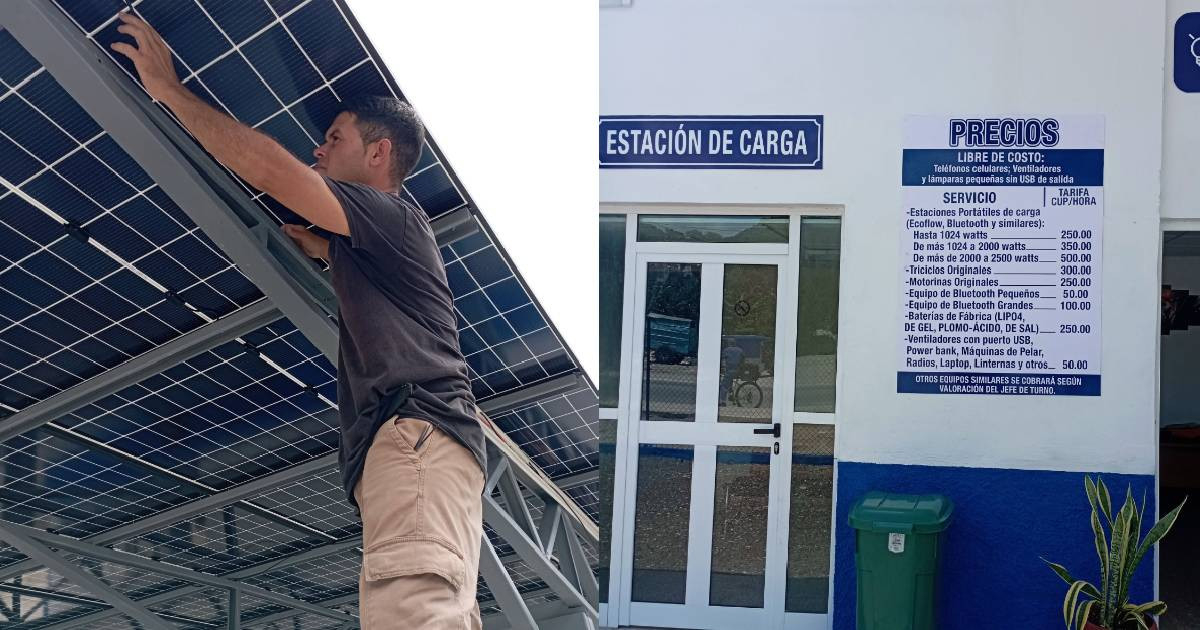
The official pricing list for El Girasol, Holguín's inaugural solar charging station, has sparked a heated discussion on social media this Saturday. Supporters defend the rates, while critics label them as exorbitant compared to the average state salary.
Displayed on an acrylic sign at the facility on the road to Gibara and Luz Street, the rates range from 50 CUP per hour for small Bluetooth devices to 500 CUP per hour for portable stations exceeding 2,000 watts.
Notably, charging for cell phones, rechargeable fans, and small lamps without USB outlets is offered free of charge.
Original tricycles are charged at 300 CUP per hour, and scooters at 250 CUP per hour. Acknowledging the free charging for smaller devices, some still question the overall pricing strategy.
Juan López, a commercial technician from the private Holguín-based microenterprise Frenas Conmigo S.U.R.L., which manages the facility, addressed the controversy on Facebook, stating he released the prices to "clear up doubts and misinterpretations."
He also hinted at unconfirmed reports of two additional charging stations being established by other companies in the province.
The debate underscores the clash between market dynamics and the purchasing power of state workers, whose average monthly salary is around 6,930 CUP, or about 230 CUP daily. Consequently, an hour of charging for a large portable station equates to more than two days' wages.
"I'm wondering if it's a solar or nuclear power station because, with these prices, solar seems costlier than oil or uranium," quipped one citizen. Another bluntly remarked, "200 [CUP] per hour, more than what a worker earns."
Defenders of the pricing point to the significant investment required. "Setting up such a business costs thousands of dollars. At these rates, it will take at least five years to break even, not counting wages or battery degradation," argued one user.
Others contextualized the prices based on practical use: "Considering nearly a thousand pesos are charged per kilometer traveled, 2,500 for a charge isn't excessive," commented another, referring to scooters and tricycles.
A technical critique focused on the hourly charge instead of energy consumed. "A modern device with fast charging completes in 45 minutes or an hour; a device lacking this feature takes five to eight times longer to charge the same energy. That's the flaw with this tariff," explained a user.
Despite the debate, demand is evident. A witness noted, "There are always several people waiting to charge their devices" at the station.
The lack of competition exacerbates the perception of high prices. One commenter warned, "Only one [company] will control the two stations planned for now," dismissing the chance of competitive pricing pressure in the near term.
El Girasol, operated by the private microenterprise Frenas Conmigo, opened on June 15 with 30 kilowatts in inverters and 60 in batteries, operating 12 hours daily and creating 10 jobs. Its emergence is a response to an unprecedented crisis: Holguín operates with just 70 MW against a demand of 225 to 240 MW, with blackouts lasting up to 51 hours in some neighborhoods.
This phenomenon is widespread across the island. Cuba's first solar charging station opened in Santa Clara in April, and by May, Matanzas announced plans for nine solar charging points.
"I don't see anything wrong with the prices; the real issue is that poverty is creating these business opportunities. In Cuba, it's precisely poverty that has generated the greatest wealth," summarized one user, capturing the paradox of this new Cuban energy market.
Understanding the Controversy Over Solar Charging Rates in Cuba
What are the rates at Holguín's solar charging station?
Rates range from 50 CUP per hour for small devices to 500 CUP per hour for larger portable stations. Charging for cell phones, rechargeable fans, and small lamps without USB outlets is free.
Why is there a debate over the pricing at El Girasol?
The debate arises from the discrepancy between the rates and the average state salary, leading some to view the prices as excessive, while others justify them based on investment costs.
How does the charging station impact the local energy crisis?
El Girasol helps address Holguín's severe energy shortage, where the demand far exceeds the supply, resulting in prolonged blackouts.