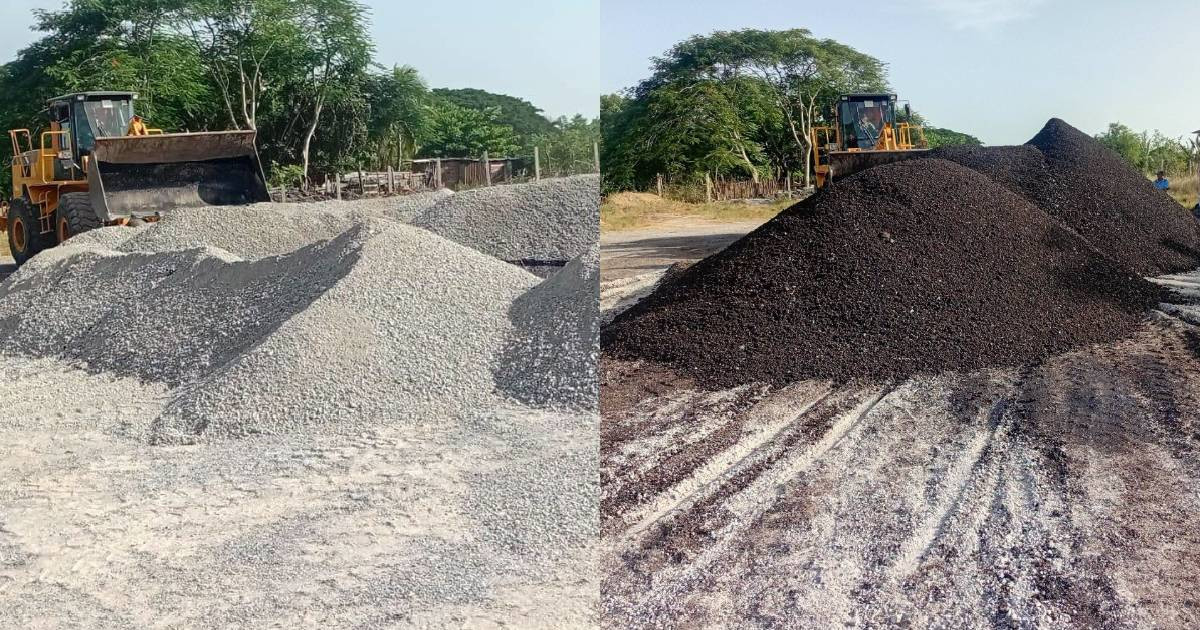
The state-owned Construction and Assembly Company of Las Tunas, known as Conalza, has recently entered into cooperative production agreements with two private small and medium-sized enterprises (SMEs) to manufacture cold asphalt and vinyl paint. These products are in high demand in Las Tunas due to a severe shortage of construction materials.
The first partnership is with the trading company AsfalTunas, with which Conalza will begin producing the initial 100 tons of cold asphalt. The second agreement is with the SME Construnes Tristá, for the future production of vinyl paint. This collaboration was highlighted by the company on July 12 through its Facebook profile.
Collaborative Production Efforts
Under the agreed framework, both parties will exchange financing, construction equipment, infrastructure, and skilled personnel, while jointly managing the necessary raw materials.
The company acknowledged that this partnership is a response to a critical situation. "These SMEs are initiating a cooperative relationship to produce asphalt and paints at a time when the lack of construction materials has hindered the fulfillment of production plans," the company emphasized.
Meeting Urgent Needs
The products from these partnerships will be used for road repairs, maintenance, and housing construction in Las Tunas, areas severely affected by shortages.
Conalza described this venture as a "gradual adaptation to new realities," embracing a hybrid model between the state and private sectors, a solution promoted by the regime due to the state company's inability to operate independently.
Legal and Economic Framework
This type of agreement is facilitated by Decree-Law 114/2025, which allows partnerships between state companies and non-state actors through economic association contracts, effective since April 2.
In June, the government also approved a set of 176 measures, removing the cap of 100 workers for SMEs and the restriction of owning only one business, thereby expanding the private sector's operational scope.
Government Acknowledgment
Cuban authorities have acknowledged that SMEs are rescuing portions of national production. Statistics support this claim, showing that partnerships with private companies increased raw material transformation by 19% in the first quarter of 2026, yielding 9,000 tons of finished products.
Conalza's shift toward this hybrid model is driven by an accumulated collapse. Seventy-five percent of Cuban roads are in fair or poor condition, and in 2024, only 22.3% of planned pothole repairs were executed, with 12 out of 25 asphalt plants halted due to mechanical failures.
The housing sector faces a similarly dire situation. The 2025 housing construction plan reached only 22% of its target, with a housing deficit exceeding 900,000 units, according to estimates.
In January 2025, Minister of Transportation Eduardo Rodríguez Dávila admitted that "the poor condition of many of our roads directly contributes to accidents and vehicle deterioration," highlighting the accumulated failure of state management in infrastructure.
Understanding the Hybrid Production Model in Cuba
What prompted Conalza to partner with private SMEs?
Conalza partnered with private SMEs in response to severe shortages of construction materials, which have hindered their ability to meet production plans.
How will the products from these partnerships be used?
The jointly produced asphalt and paint will be used for road repairs, maintenance, and housing construction in Las Tunas.
What legal framework supports these agreements?
These partnerships are supported by Decree-Law 114/2025, which allows economic association contracts between state and non-state actors.