The state-run outlet Cubadebate recently highlighted a piece criticizing the labor conditions in the United States, arguing that American workers lack guaranteed sick leave. The article cleverly uses the hospitalization of Republican Senator Mitch McConnell as a springboard to critique the U.S. labor system.
Originally published by the progressive U.S. platform Truthout and authored by Sharon Zhang, the article notes that McConnell has been hospitalized since June 14 due to a fall resulting in a brief loss of consciousness and mild pneumonia. His absence from the Senate wasn't clarified until July 12.
The irony emphasized in the article is striking: the Kentucky senator enjoyed weeks of paid leave while having blocked legislation for years that would extend similar benefits to ordinary workers.
Hypocrisy in Cuban Critique
As Senate Majority Leader in 2020, McConnell thwarted the inclusion of expanded federal family and sick leave benefits in the second COVID-19 relief package. In 2022, he opposed granting seven days of sick leave to railroad workers amid a national strike threat between freight companies and unions.
The article points out that the U.S. stands alone among wealthy nations in not federally guaranteeing paid sick leave for all workers, a well-documented shortfall.
The Cuban Reality
Yet, the Cuban regime sidesteps a critical question: What rights do Cuban workers possess?
The answer is stark. The new Cuban Labor Code, introduced in June 2026, fails to recognize the right to strike or allow independent unions, maintaining the monopoly of labor representation with the Central de Trabajadores de Cuba (CTC), a compliant arm of the Communist Party since 1961.
This is not the first instance of Cubadebate using such tactics. In May, the outlet and the TV program Mesa Redonda aired a documentary on poor U.S. workers, sparking ridicule and criticism from Cubans, both within and outside the island, who are weary of the regime's hypocrisy.
Economic Disparities in Cuba
While Cubadebate points fingers at Washington, Cuba's minimum wage is 3,210 pesos monthly, less than four percent of the 96,000 pesos independent economists deem necessary for basic needs.
The average state salary is around 6,930 pesos, roughly $13 at the informal exchange rate, with 89% of Cubans living in extreme poverty, based on independent studies.
The U.S. government has also criticized Cuba's medical brigade program, labeling it a "form of human trafficking."
Allegations of Exploitation in Cuba's Medical Brigades
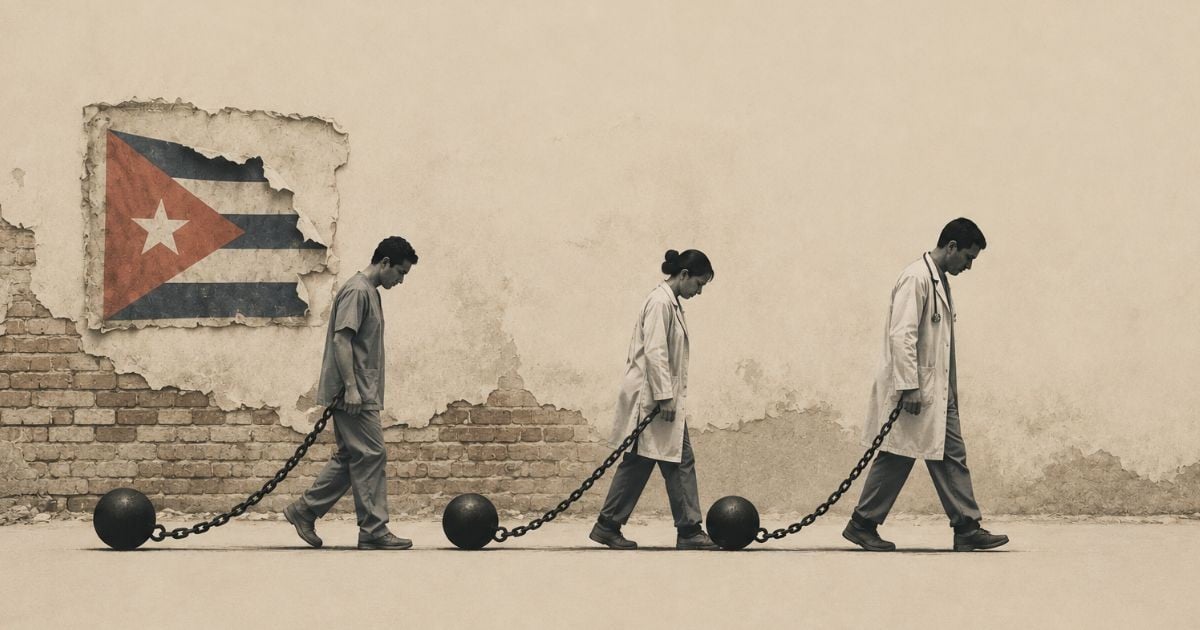
On April 7, the Inter-American Commission on Human Rights (IACHR) released a 199-page report indicating the program's serious signs of forced labor, human trafficking, and modern slavery, recommending all continental countries withdraw from it.
Based on testimonies from 71 mission professionals in 109 countries, the report documented that the Cuban state withholds 60% to 97.5% of salaries paid by host countries: in Mexico, the government paid around $3,750 monthly per Cuban doctor, while the professional received just $200.
This wage retention is compounded by passport and academic document confiscation, political monitoring, and reprisals against those who abandon the mission.
Article 135 of the Cuban Penal Code punishes desertion with three to eight years in prison, and Decree-Law 306 of 2012 enforces an eight-year ban on returning to Cuba.
In September 2025, Cuban doctors who broke away from the mission in Italy described the situation succinctly: "They blackmail you with your titles."
In 2019, deserter doctors had already told AFP that the program amounted to a "modern slavery system." One, Orazal Sánchez, plainly stated: "The sad truth is we remain slaves. We think we are free, but as long as we have family in Cuba, we continue working for that system."
In April 2025, the European Parliament passed Amendment 311, branding Cuban medical brigades as "modern slavery" and "forced labor" in the central document of European foreign policy.
FAQs on Cuban Worker Rights and Medical Brigades
What are the main criticisms of Cuba's labor rights?
Cuba's labor rights are heavily criticized for not recognizing the right to strike and not allowing independent unions, keeping labor representation under the Central de Trabajadores de Cuba, which is aligned with the Communist Party.
Why is Cuba's medical brigade program controversial?
The program is controversial due to allegations of forced labor, human trafficking, and modern slavery, as the Cuban government withholds a large portion of the salaries paid by host countries to its medical professionals.
How does Cuba's economic situation compare to its criticism of the US?
Cuba criticizes the U.S. worker rights while facing severe economic hardships at home, with extremely low wages and widespread poverty affecting the majority of its population.