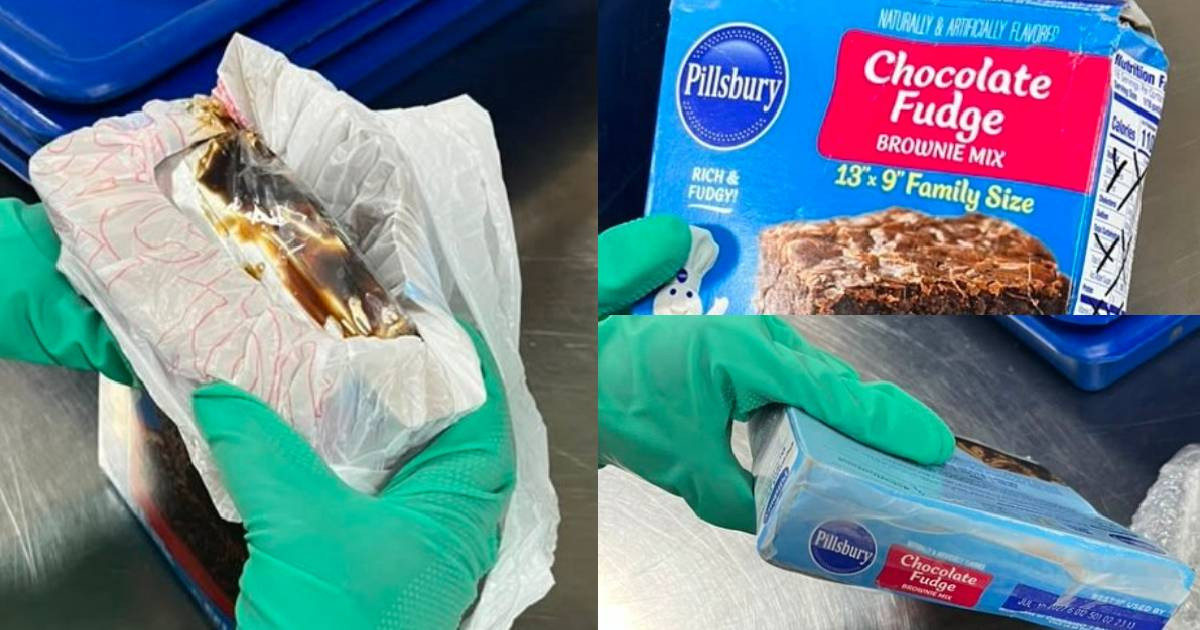
Cuban Customs recently intercepted synthetic cannabinoids, known colloquially as "químico," concealed within two food packages originating from the United States at Havana's José Martí International Airport. This announcement was made on Friday by Wiliam Pérez González, the first deputy chief of the General Customs of the Republic.
Images shared by the official on his social media account depicted inspectors wearing green latex gloves as they handled the suspicious packages on a metallic surface.
One of the packages used for concealment was a 521-gram family-sized Pillsbury brownie mix, a seemingly ordinary food item shipped from the U.S.
The operation, a collaboration between Customs and the Ministry of the Interior's anti-drug unit, was part of an ongoing border surveillance initiative at the nation's primary airport, Pérez González noted.
In another recent operation, Customs unearthed over 12 kilograms of gold, valued at more than $1,589,160, hidden in nine black-painted artisanal figures. Two passengers were attempting to smuggle them through the airport, leading to a report filed with the Revolutionary National Police.
Earlier in April, the joint Customs and anti-drug team discovered 19 sheets laced with "químico" within a Cocoa Puffs cereal box sent from the United States, a shipment capable of distributing 22,800 doses.
Previously in May, methamphetamine was found disguised in popcorn packages, and in January, marijuana was detected hidden in cereal and instant drink mixes, all originating from the U.S.
The substance "químico," also referred to as "papelillo" or "kimiko," is a synthetic cannabinoid that is 50 to 100 times more potent than marijuana. Since May 2025, a more lethal version containing fentanyl, formaldehyde, benzodiazepines, phenobarbital, and veterinary anesthetics has circulated in Cuba.
There are at least 40 variants of synthetic cannabinoids in Cuba, with the highest prevalence in Holguín and Havana. According to official Cuban sources, 90% of users become addicted.
The ease of concealment contributes to its widespread distribution: a piece of paper the size of an ID card can yield up to 300 doses, with each dose costing between 150 and 300 Cuban pesos, making it one of the most affordable substances on the illegal market.
In response to the surge in synthetic drug trafficking, the Supreme People's Court approved Ruling 476 in August 2025, implementing harsher penalties.
In March, two individuals received 15-year prison sentences for trafficking a mere 1.74 grams of synthetic cannabinoid in the Artemisa province.
Understanding Synthetic Drug Trafficking in Cuba
What is the "químico" found in Cuba?
"Químico" is a synthetic cannabinoid that is significantly more potent than traditional marijuana, with some variants being 50 to 100 times stronger.
How are synthetic drugs smuggled into Cuba?
Synthetic drugs are often hidden in everyday items like food packages, making them difficult to detect and allowing for widespread distribution.
What measures is Cuba taking against drug trafficking?
Cuba has intensified its border surveillance and has enacted stricter legal penalties for those caught trafficking synthetic drugs.