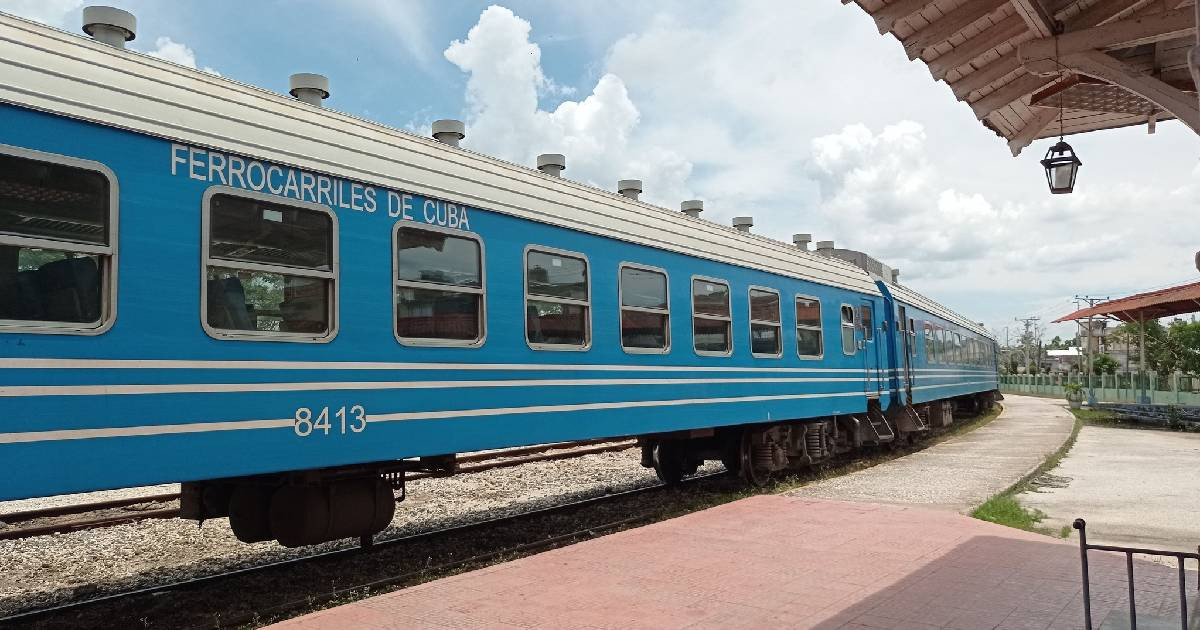
The Cuban National Passenger Train Company is currently operating a mere 16 trains each month, a stark contrast to the 62 trains it ran during its peak times. This 74% reduction was acknowledged by the company's general director while commemorating the entity's seventh anniversary, as noted in statements shared on social media by the company.
Engineer Jorge Oliva Yero acknowledged this operational decline during preparations to celebrate the anniversary of the first trip, which took place on July 19, 2019.
The fuel crisis gripping Cuba since late 2025—exacerbated by the halt of Venezuelan supplies, the suspension of Pemex exports, and secondary sanctions imposed by the Trump administration—has severely impacted the railway system.
Impact on Passenger Transportation
At its height, the company transported between 58,000 and 64,000 passengers every month, with annual figures nearing 900,000 travelers. Today, those numbers have dwindled significantly, and the toll is particularly harsh on communities in the interior of the country.
"In places like Jobabo, Santa Lucía, Guáimaro, or Río Cauto, trains are the only means for national passenger transport," Oliva Yero highlighted, emphasizing the railway's role as the sole link for these areas.
Adaptive Measures for Survival
To remain economically viable, the company has had to adapt: it utilizes its workshop machinery to manufacture parts and provides transportation services to the non-state sector.
The company also entered into an agreement with the Center for Molecular Immunology to transport raw materials for cancer medications to the eastern region and return with vaccines and serums to Havana.
"We will transport the raw materials for cancer medicine production to the eastern region, and once produced, we will bring back vaccines and serums from the East to Havana," Oliva Yero confirmed.
Future Prospects Amid Current Challenges
Among the most ambitious announcements is a proposed high-speed train project between Havana and Santiago de Cuba, which would cover the distance in 17 hours and 20 minutes at a commercial speed of 55 kilometers per hour, with just three intermediate stops: Matanzas, Villa Clara, and Camagüey. This proposal starkly contrasts with the current reality, where travel times often double or triple those predicted.
The decline is not a recent development. In February 2026, the Ministry of Transport declared "emergency mode," reducing the frequency of eastern trains to once every eight days.
In June, a more severe cutback was implemented: services to Santiago de Cuba, Guantánamo, Holguín, and Bayamo-Manzanillo now operate once every 16 days, the open sale of tickets was abolished, and the APK Viajando app was suspended.
The impact is evident nationwide. In Camagüey, state transportation collapsed from 350,000 daily passengers to merely 15,000 following the June cutback.
In May, a trip from Holguín to Havana took 27 hours, nearly double the estimated time, and in February, passengers were stranded for hours due to malfunctioning locomotives in Camagüey.
The railway collapse is part of a long-standing decline: the number of train passengers in Cuba fell from 33 million in 1992 to 7.8 million in 2016, and to just four million in 2023. Only 12 large locomotives out of the 34 required are operational, and 67% of the tracks need maintenance, according to Cuban railway system data.
The Impact of Cuba's Train Service Reduction
Why has Cuba reduced its train operations so drastically?
The reduction in train operations is largely due to a severe fuel crisis exacerbated by geopolitical issues, including the cessation of Venezuelan fuel supplies, the suspension of Pemex exports, and sanctions imposed by the Trump administration.
How has the decline in train services affected Cuban communities?
The decline has hit rural communities particularly hard, as trains are often the sole means of national passenger transport available to them, cutting off vital connections and making travel significantly more difficult.