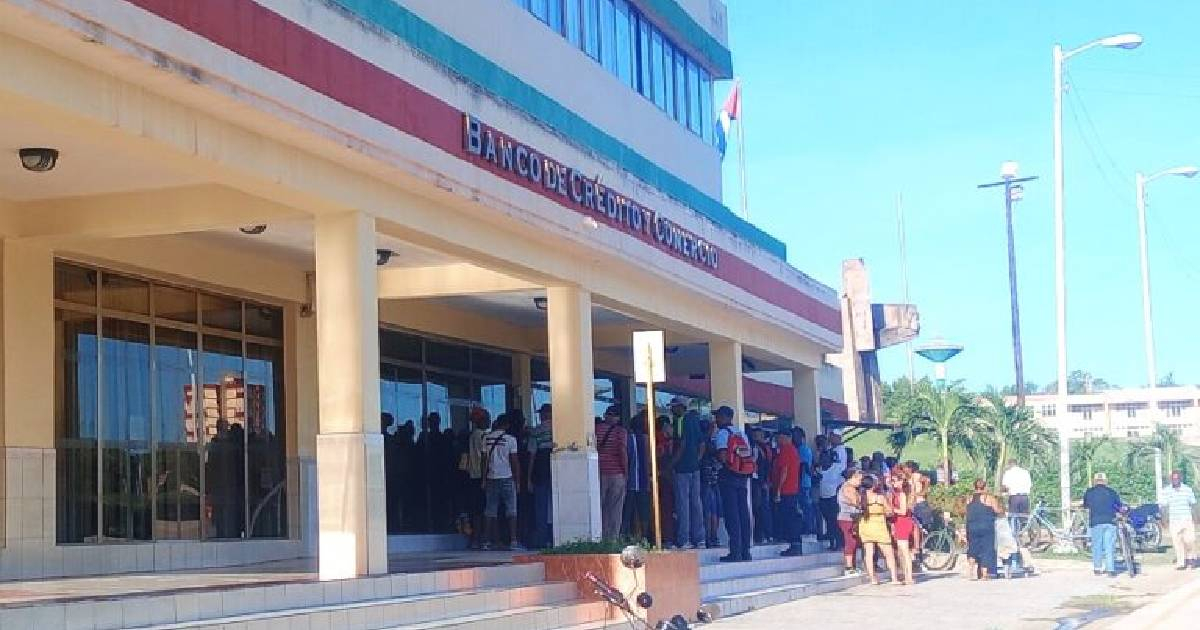
In Cuba, accessing 2,000 pesos in cash requires a hefty 2,800-peso bank transfer. A middleman, stationed outside the bank, pockets 800 pesos — a staggering 40% of the amount.
This is the price thousands of Cubans pay to access their own wages, as highlighted in a Facebook post by Mary Elena Hernández Rodríguez. She describes this practice as a "silent embezzlement," revealing the severe distortion in what was once thought to be progress.
As the end of each month approaches, the same scenario unfolds across the island. While salaries appear as mere numbers on a bank card, converting them into physical cash has become an arduous task: ATMs are empty, networks are unreliable, and withdrawal limits fall short of basic needs.
The Rise of "Liquidity Managers"
"Getting up at dawn and enduring endless lines has turned into an unpaid second job," writes Hernández Rodríguez. In this void, the so-called "liquidity managers" have emerged, offering cash for card transfers while charging commissions ranging from 30% to 45%.
These brokers don't operate in secrecy. They set up shop right outside bank branches.
Impact Beyond Economics
Beyond the financial strain, there's an emotional toll. "High blood pressure and anxiety have become constant companions for workers whose hard-earned money is trapped on a card that, instead of providing joy, breeds frustration and despair," Hernández Rodríguez explains.
"As long as access to one's own money depends on the luck of finding an ATM or a middleman, the banking system will remain an adversary, not an ally, to family economies," she concludes.
Testimonies of Abuse
The phenomenon was also reported by poet and doctor Ericka Castellanos Abad. She documented that near the BANDEC on Victoriano Garzón Avenue in Santiago de Cuba — just blocks from the Communist Party's Provincial Committee — transferring 1,000 pesos yields only 600 in cash. "Transferring 1,000 Cuban pesos to receive just 600 is the height of exploitation," she wrote.
Commissions have steadily climbed. In September, the National Revolutionary Police arrested two men in Santiago de Cuba who were charging a 15% fee near the same ATM, confiscating over 250,000 pesos from them.
Yet, by May, further arrests at the Santiago train station revealed fees ranging from 35% to 50%. These arrests have not eradicated the business.
Structural Problems at the Core
The root of the issue is systemic. The mandatory banking measures imposed by the government in August 2023 required transactions over 5,000 pesos to be conducted digitally, without ensuring cash availability in the system.
Three years later, only 3.77% of transactions in Cuba are digital, and less than 10% of private businesses regularly accept transfers.
The cash shortage exacerbates the vicious cycle. In May, over half of the Metropolitan Bank's ATMs in Havana were non-operational.
Similarly, in June, that bank lowered the withdrawal limit from 5,000 to 3,000 pesos per transaction, while in Sancti Spíritus, the People's Savings Bank set caps as low as 500 pesos.
People reported waiting up to three days to access a working ATM, only to withdraw a mere 40% of their salary.
However, the Central Bank of Cuba announced on Friday a set of emergency measures, including the issuance of 2,000 and 5,000-peso bills, lifting the 5,000-peso cash payment limit among economic actors — as per Resolution 74/2026, effective from July 20 — and reducing online payment fees for businesses.
Understanding Cuba's Financial Crisis
Why are Cubans facing cash shortages?
Cubans are experiencing cash shortages due to systemic banking issues and mandatory digital transaction policies that were implemented without ensuring enough cash flow in the system.
What are "liquidity managers" in Cuba?
"Liquidity managers" in Cuba are individuals who provide cash in exchange for bank card transfers, charging high commissions, often ranging from 30% to 45% of the amount.