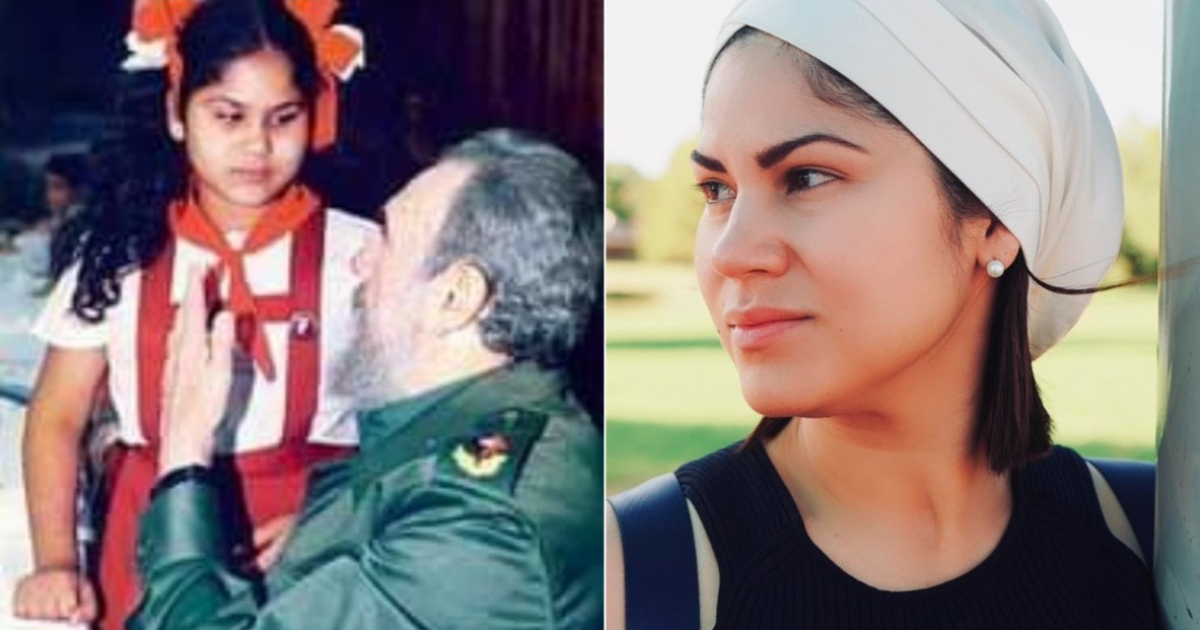
Jenny Sotolongo, the Cuban singer famously known as "the girl of the rallies" from her childhood, recently shared a personal statement on her social media. She addressed a childhood photograph featuring Fidel Castro that some have used to define her.
In her Facebook post, Sotolongo was upfront: "I sang for Fidel Castro. It wasn't a political choice made by an adult; it was simply part of the life I experienced in Cuba."
Now residing in the United States, the singer explained that she was around nine or ten years old when she participated in the massive Open Tribunes events. These events were organized by the Cuban regime between 1999 and 2000 to demand the return of Elián González.
The Early Days of Public Performance
During these propaganda events, Fidel Castro recognized her talent and included her in his ideological machine. Sotolongo performed for the first time in December 1999 outside the United States Interests Section in Havana, singing songs like "Que canten los niños" and Silvio Rodríguez's "La Maza."
She never received any payment for her performances, which she describes as driven by artistic ambition and childhood innocence.
Defining Her Identity Beyond a Photograph
"Many have tried to define who I am based on a single photograph. But a picture never tells the whole story of a person," she wrote in her post.
The artist acknowledges her past while refusing to be confined by it: "I don't deny my past, because it's part of my history. However, I don't allow that past to dictate who I am today."
Sotolongo described a personal transformation that evolved over time as she encountered different realities beyond Cuba.
"Over time, I grew up, discovered other realities, and lived experiences that reshaped my worldview. Like any human being, I evolved," she expressed.
Embracing Change and Looking Forward
Sotolongo concluded her post with a sentence that encapsulates the full arc of her journey: "This photo doesn't define who I am today. It speaks of where I come from. And knowing where we come from also explains why we value where we want to go."
In earlier statements to Telemundo 51, the singer elaborated on this process: "I was a child, living a reality that was completely normal to me, because it was the only one I knew."
She added, "I don't like to judge the child I was; I look at her with compassion because she was growing up in a very unique context."
This statement is the latest step in Sotolongo's public distancing from the regime, a process she has been building for years.
In October 2023, she announced plans to write a song about the Cuban crisis, spurred by her followers, stating she was "profoundly shaken by the tragedy that we Cubans have endured for so many years."
On June 1, 2026, she released "La voz que me prestaron," a song symbolizing her break from that past: "I am no longer the voice they lent me, / nor the reflection of what they wanted to see."
Understanding Jenny Sotolongo's Journey
Why did Jenny Sotolongo sing for Fidel Castro?
Sotolongo sang for Fidel Castro as part of the life she led in Cuba at a young age, not as a political choice made by an adult.
How does Jenny Sotolongo view her past performances?
She sees her past performances as driven by artistic ambition and childhood innocence, acknowledging that they are a part of her history.
What message does Jenny Sotolongo want to convey about her past?
Sotolongo wants to convey that her past is part of her story, but it doesn't define who she is today. She values the journey that has reshaped her worldview.