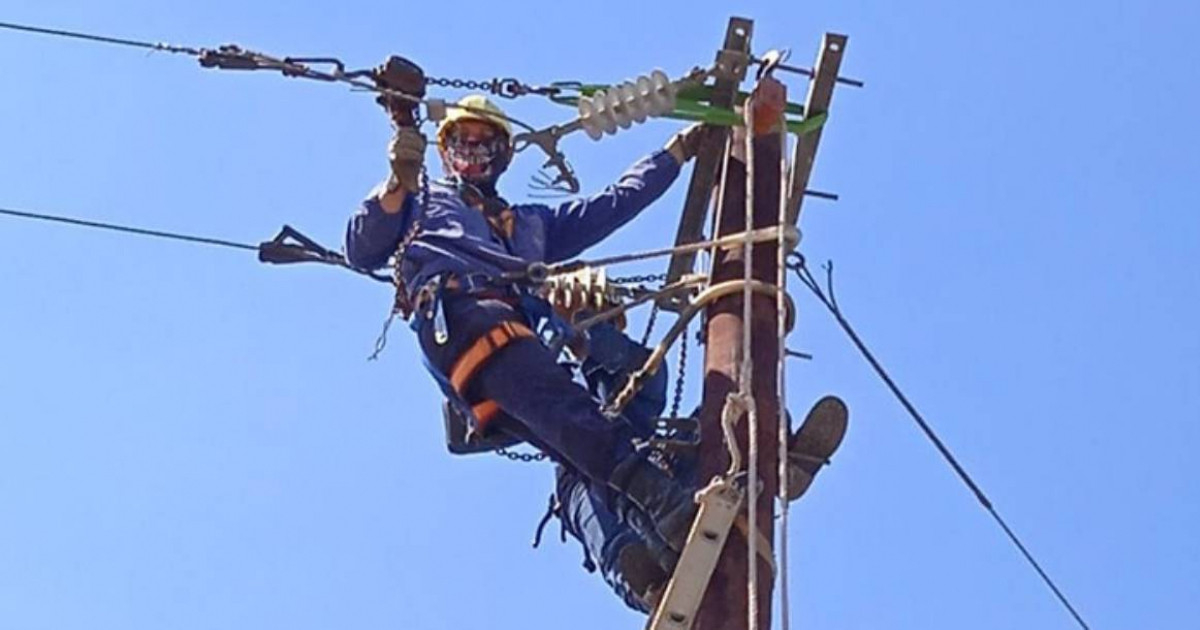
The Electric Union (UNE) has acknowledged an incident involving its linemen in Calabazar, a neighborhood in Boyeros, Havana, through an official statement posted on Facebook this past Friday. The linemen were caught by local residents engaging in the illegal sale of electricity to the neighborhood in exchange for cash.
Eyewitness accounts from residents revealed that the workers were found intoxicated, with bundles of cash and beer cases in their service vehicle. They were reportedly prioritizing power supply to small businesses and private enterprises while leaving the residential area in darkness for most of the day. The local community detained the linemen until the authorities arrived to arrest them.
UNE's Statement and Reactions
In its statement, the state-run company emphasized, "We affirm that such behavior does not align with the conduct, ethics, and values that characterize our employees, who work tirelessly to deliver electricity to every Cuban home."
Regarding the repercussions for those involved, UNE was brief but firm: "The authorities are currently investigating the matter, and appropriate measures will be taken in accordance with the law and established procedures."
The company also expressed deep regret that such "reprehensible actions overshadow the efforts of the vast majority of our workforce" and extended solidarity to those affected.
Public Outcry and Broader Implications
The incident was brought to light on Facebook by a local resident, Isol G, whose description of the situation went viral: "They provide it to those who pay." Her posting sparked a neighborhood response that resulted in the linemen's detention. Simultaneously, other Calabazar residents gathered outside the municipal government office demanding answers for prolonged blackouts, with security forces present.
The UNE's statement ignited a wave of reactions on social media, with many users dismissing the notion that the incident was isolated. "Similar events will occur again. This isn't just happening in Calabazar. Save this statement so you don't have to write it again—just change the location's name," commented one user. Another remarked, "It's not just two individuals. Those were merely the ones caught... but many more exist, and at higher levels. So, start investigating."
Several comments highlighted that corruption within the electrical system is widespread across the island. "Seriously? This happens from Cabo San Antonio to Punta de Maisí, stop joking," one user wrote. Another pointed out, "This happens all over Cuba; they prioritize business areas." A third comment summed up the general sentiment: "Don't worry, in Cuba, corruption doesn't start at the bottom, it ends there."
Wider Context of the Electrical Crisis
Netizens also cited similar incidents in Cojímar, Villa Clara, Cárdenas, San Antonio, and Gibara, Holguín, reinforcing the belief that the issue extends beyond Calabazar. "Dear UNE, know that in our declining country, to receive quality service from your workers, one must pay to expedite the process... But this isn't an isolated incident; it happens nationwide. Don't try to hide the truth," wrote another user.
This episode unfolds amid Cuba's worst electrical crisis in recent history: by 2026, the National Electric System has collapsed at least five times, blackouts in Havana average between 20 to 24 hours a day, and the generation deficit has frequently exceeded 2,100 MW, leaving 70% of the country without power simultaneously. In May 2026, the Cuban Conflict Observatory recorded 1,311 protests, the highest number since July 11, 2021.
Similar cases of illegal electricity sales by UNE workers have been documented in Mantilla—where electricity was offered for $200—and in Guantánamo and Sancti Spíritus, where unauthorized private businesses connected to prioritized circuits have surged.
Key Questions About Cuba's Electrical Crisis
What sparked the incident involving UNE linemen in Calabazar?
The incident was triggered when two UNE linemen were caught selling electricity illegally to the neighborhood in exchange for money, leading to their detention by local residents.
How has the Cuban public responded to the UNE statement?
The Cuban public reacted strongly on social media, with many expressing skepticism about the incident being isolated and highlighting widespread corruption within the electrical system across the island.
What is the broader context of the electrical crisis in Cuba?
Cuba is experiencing one of its worst electrical crises, marked by frequent system collapses, extended blackouts in Havana, and a significant generation deficit, affecting a large portion of the country.