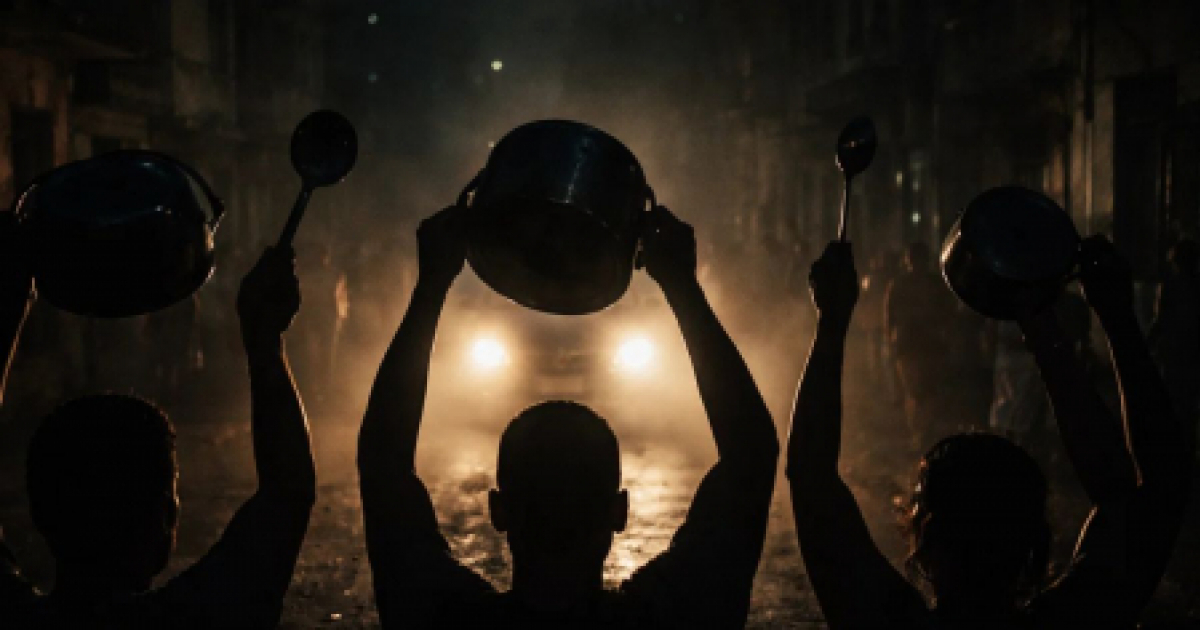
On Thursday, the Cuban government mobilized activists and members of the Rapid Response Brigades at the Communist Party of Cuba (PCC) headquarters in Playa municipality. This deployment was a preemptive measure anticipating potential unrest as pots and pans clanged in El Vedado after over 30 hours without electricity.
Activist and writer Yania Suárez documented the events on Facebook after walking through the neighborhood that night.
"Last night, Thursday, July 16, I walked through El Vedado in the dark. Everything was pitch black. The sound of metal was everywhere. I also saw individuals lurking on Línea Street, seemingly waiting for a couple of Black Beret patrols," she reported.
As Suárez passed the PCC headquarters in Playa, she noticed an unusual gathering of people. She later learned that militants and leaders from the Rapid Response Brigades had been mobilized, anticipating potential disturbances. "I haven't verified if anything happened... Maybe it's something they foresee," she speculated.
In addition to this paramilitary presence, Suárez observed "black beret" posts—members of the National Special Brigade of MININT—stationed on Línea Street, monitoring the nighttime activities.
Commentator Boris González Arenas corroborated this pattern from his own observations: "Every afternoon at the party headquarters in Playa, a group of people gathers, filling the parking lot with modern company cars. Initially, it caught my attention until I realized they are 'battle-hardened people' ready for confrontation."
Dissent in a Politically Significant Neighborhood
What makes this episode particularly noteworthy is the location where it unfolded. Suárez emphasized that it was "the first time" the sound of banging pots was heard in El Vedado, a neighborhood historically linked to the regime's political elite.
"We've had little to no electricity for several days (just 1 or 2 hours), and now even Miramar is running out of water. For the first time, the metal was heard in this area of the wealthy and children of leaders," she wrote.
El Vedado's proximity to the Palace of the Revolution and the PCC's Central Committee makes any protest there a significant political statement. The neighborhood had already witnessed similar protests in broad daylight on July 12, just a few days earlier.
Government's Preemptive Measures Amid Energy Crisis
This preventive mobilization by the government occurs amid an escalating crackdown. On July 13, the U.S. Office of Foreign Assets Control (OFAC) sanctioned the Rapid Response Brigades along with nine other Cuban state organizations and companies, as part of the sixth round of measures under Executive Order 14404 signed by former President Donald Trump.
The ongoing energy crisis fueling these protests shows no signs of abating. The national electricity deficit hit a record 2,208 MW on June 25, 2026, affecting approximately 69% of the country.
In June, 107 street protests were documented in Cuba, nearly double the previous high, with Havana being the most active province. In response, the regime took 135 repressive actions.
Suárez concluded her account with a phrase encapsulating the spirit of those resisting from within: "Hopefully, this ordeal will serve a purpose. May the night not be eternal!"
Understanding the Protests in El Vedado
Why were militants mobilized in El Vedado?
The Cuban government mobilized militants in El Vedado anticipating potential unrest due to ongoing protests sparked by prolonged power outages.
What significance does El Vedado hold in Cuban politics?
El Vedado is historically associated with the political elite of Cuba, making any protest in this neighborhood a highly symbolic political challenge.
What are the Rapid Response Brigades?
The Rapid Response Brigades are paramilitary groups in Cuba, often deployed by the government to suppress dissent and maintain order during protests.