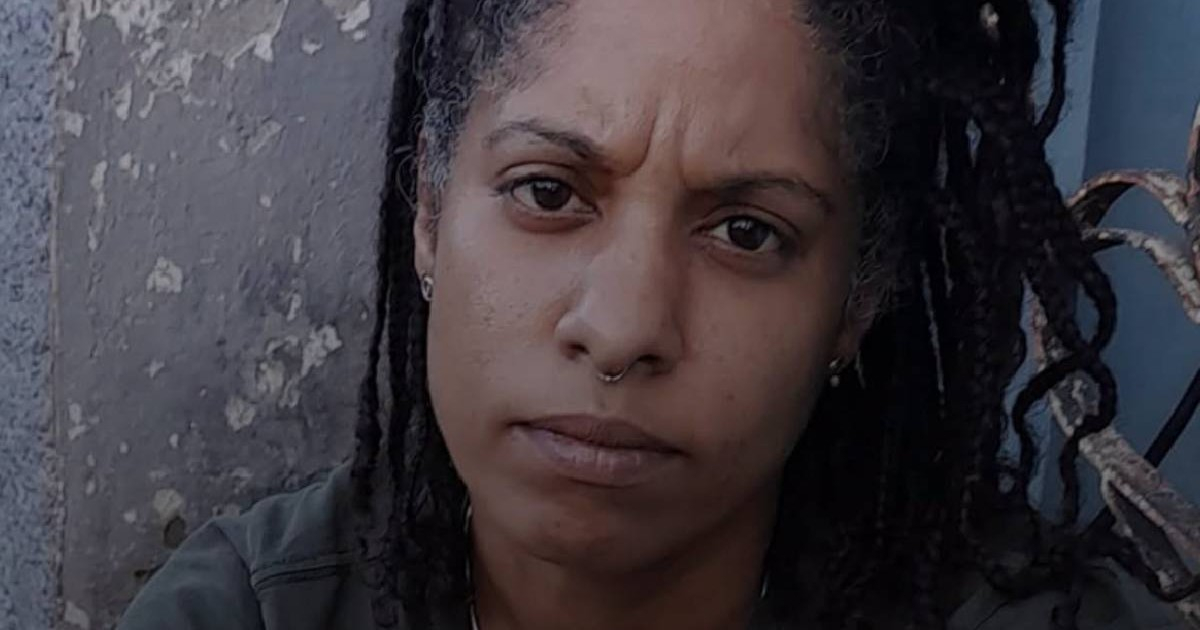
The organization Cubalex has raised an alert regarding the recent interrogation of activist Gisselle "Zea" (Gisselle Ordóñez Milián), a resident and mother from the Zamora neighborhood in Marianao, Havana. On July 16, State Security officials subjected her to a lengthy questioning, employing threats and intimidation tactics, while using her young son as a coercive tool.
According to Cubalex's report, Gisselle received a summons from the Ministry of the Interior (MININT) on July 15, giving her less than a day’s notice to appear at the 6th Unit of the Revolutionary National Police in Marianao.
Despite the summons indicating an interview with the sector chief, she was instead interrogated by two State Security agents identified as "Antonio" and "Luisito," alongside penal instructor "Andy."
During the session, the agents probed her political stance and inquired about her involvement in protests, including pot-banging demonstrations in her neighborhood. They asserted that participating in such actions constituted a "crime" and labeled her a "community leader" due to her social media posts, photographs of police operations during protests, and her community involvement.
Pressure Tactics and Allegations
The officers also attempted to link her to a sign appearing in her neighborhood against ruler Miguel Díaz-Canel, requesting she write the alphabet for handwriting comparison. Gisselle refused, fearing it could be used against her.
Furthermore, they warned of potential charges related to foreign funding and held her accountable for the reproduction of her posts in independent media.
One of the most serious moments came when the officials hinted at possible actions concerning the custody of her minor son, leveraging this as a pressure point.
After the interrogation, she was forced to sign a warning statement and informed she would be summoned again, this time to Villa Marista, the main headquarters of the State Security Department in Havana, with a stark warning that "the procedure there would be different."
Ongoing Resistance and Broader Implications
Gisselle has been actively documenting and publicly denouncing the basic services crisis in her community. On July 6, she reported 38 consecutive hours without electricity and a week without potable water in Zamora, participating in pot-banging protests in the neighborhood since at least March 2026.
This incident is not isolated. Just days prior, activist Edel Carrero was summoned by State Security to Villa Marista during the fifth anniversary of the July 11 protests.
Cubalex warns that Gisselle’s case "illustrates a documented pattern of arbitrary summonses, intimidating interrogations, threats, attempts to link critics to alleged criminal activities, and the use of family members, including minors, as a pressure mechanism to discourage freedom of expression, civic participation, and human rights advocacy."
This pattern is backed by statistics: in June 2026, Cubalex recorded 319 repressive events and 608 harassment incidents nationwide, with at least 40 minors imprisoned in Cuba.
Understanding State Security Tactics in Cuba
What is the role of Cubalex in Cuba?
Cubalex is an organization that monitors and reports human rights violations in Cuba, providing support and raising awareness about cases of repression and intimidation against activists and citizens.
What tactics are used by State Security to intimidate activists?
State Security often employs threats, arbitrary summonses, and intimidation during interrogations. They may also use family members, including minors, as leverage to pressure activists into compliance.
How does the Cuban government view participation in protests?
The Cuban government tends to view participation in protests as a criminal activity, often labeling protesters as community leaders or instigators, which can lead to further targeting and surveillance.