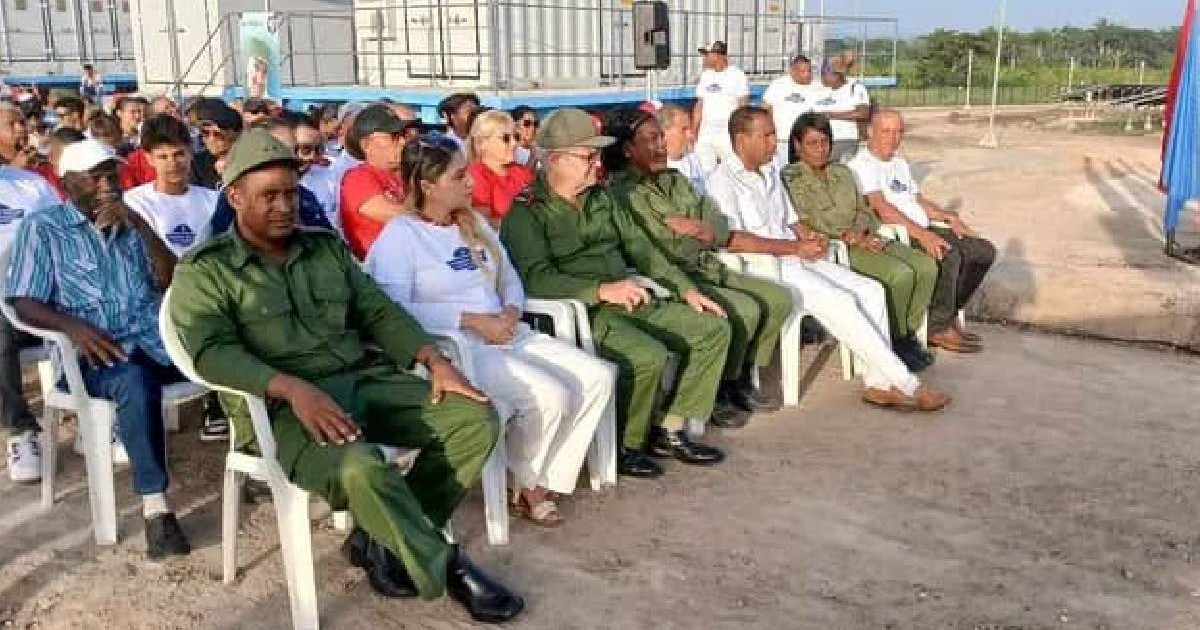
Skepticism ran high among Cubans on Friday as the first solar park with energy storage capabilities was unveiled in Santiago de Cuba. This feature sets it apart from the previous two parks built in the province, theoretically allowing it to function beyond daylight hours.
Overwhelmed by the island's ongoing energy crisis, residents questioned, "What does that translate to?" The inauguration was attended by Beatriz Johnson Urrutia, the first secretary of the Provincial Committee of the Communist Party in the region.
The state-run newspaper Sierra Maestra heralded the event as "Another Victory for the People of Santiago," noting it was a Chinese donation, consistent with the investment and technology patterns seen in all solar parks established in Cuba in recent years.
Images from the event displayed a weather monitoring station equipped with Chinese-manufactured instruments. The control box was labeled in Mandarin as an "Environmental Monitoring Instrument for Photovoltaic Power Plant," with rows of solar panels visible in the background.
This outdoor ceremony brought together civil and military officials from the Revolutionary Armed Forces, adhering to the usual protocol for high-profile political events in the province.
Progress and Limitations of Solar Energy Initiatives
Villa Victoria is the third of four planned solar parks in Santiago de Cuba. The first, Las Guásimas in Contramaestre, offers 21.8 megawatts with over 45,000 panels, connecting to the national grid since April 2025.
The second, Rafael Reyes in San Luis, also boasting 21.8 megawatts, began operations in January of this year. Neither includes battery systems, confining their power generation to daylight hours.
The fourth planned park, Anacaguita in Contramaestre, has yet to be inaugurated. Together, these parks aim for a combined capacity of roughly 80 megawatts.
Challenges Amid an Ongoing Energy Crisis
This announcement comes amidst an unrelenting energy crisis in Santiago, a province home to over a million residents enduring years of extended blackouts. Despite repeated promises of progress, the government has yet to resolve these outages.
In June, officials vowed to restore electricity to neighborhoods still lacking stable service. By October 2025, Johnson Urrutia had mentioned solar pumping as a potential remedy for the water crisis affecting nearly 400,000 people in the province.
While the new park's five-megawatt capacity is modest compared to provincial demand, public skepticism remains strong. The question in the headline—"What does that translate to?"—captures the disconnect between the regime's proclaimed achievements and the everyday reality of power cuts and shortages.
The Cuban government aims for 24% of its electricity generation to come from renewable sources by 2030, as part of a national plan encompassing 55 solar parks. However, none of the Santiago parks have yet alleviated the region's persistent blackouts.
Understanding Cuba's Solar Energy Endeavors
What is unique about the new solar park in Santiago de Cuba?
The new solar park in Santiago de Cuba is the first in the province to feature energy storage capabilities, allowing it to potentially operate beyond daylight hours, unlike the previous parks.
How does public perception reflect the energy situation in Santiago de Cuba?
Despite the inauguration of new solar parks, public skepticism remains due to the ongoing energy crisis and frequent blackouts, which the government has been unable to resolve.
What are the Cuban government's renewable energy goals?
The Cuban government aims for 24% of its electricity to be generated from renewable sources by 2030, which includes the development of 55 solar parks nationwide.