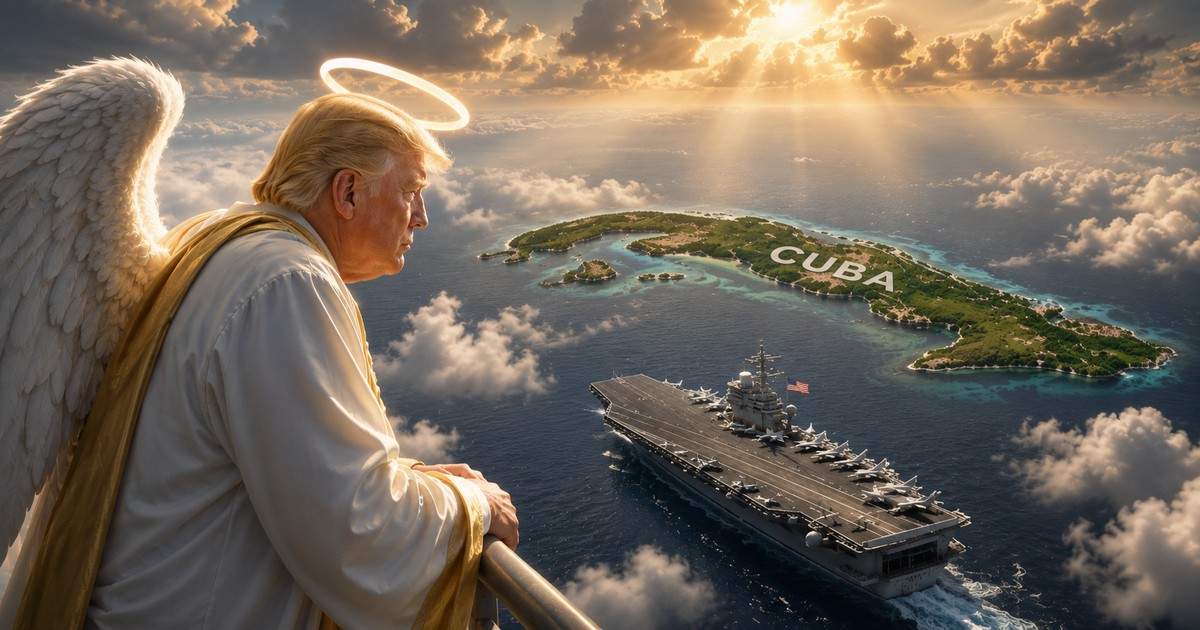
In a recent conversation with Fox News correspondent Trey Yingst, former President Donald Trump declared, "I'm keeping an eye on Cuba. Significant developments are expected there, potentially within the next couple of months, but it won't be like Venezuela."
When queried about potential military intervention, Trump responded, "We could certainly address issues in Cuba. It wouldn't be challenging for us. Venezuela is significantly larger than Cuba, with its vast reserves of gold and oil. It likely possesses some of the world's most valuable lands in terms of gold and rubies..."
These remarks sparked a heated discussion across social media platforms. Many argue that without substantial oil or gold reserves, Trump lacks genuine interest in fulfilling the aspiration of many Cubans: ending the oppressive regime and ushering in true democratic reform.
Nonetheless, the reality might be more complex. On January 29, Trump signed Executive Order 14380, titled "Addressing Threats to the United States by the Government of Cuba," which underscored his awareness of the severe threat the Castro regime poses to U.S. national security and the broader aspirations for freedom and democracy in the region.
The Strategic Advantage of Liberating Cuba
Freeing Cuba is not merely a moral obligation; it represents a strategic advantage. For decades, the conflict with Cuba's dictatorship has been viewed primarily through political, Cold War, or human rights lenses. Rarely has the actual cost of a communist regime just 90 miles from U.S. shores been fully assessed.
The Cuban dictatorship has been one of the most burdensome strategic liabilities for Washington over the past 70 years. It began with the kidnapping of American citizens and the sabotage of properties by Fidel Castro's guerrillas. After seizing power, massive uncompensated confiscations followed, with hundreds of businesses, industries, banks, sugar mills, and hotels nationalized. The U.S. Foreign Claims Settlement Commission certified thousands of claims originally valued at approximately $1.9 billion at the time. With decades of accumulated interest, the current amount is estimated in the tens of billions of dollars.
But the economic damage was just the start. The alliance with the Soviet Union transformed Cuba into Moscow's primary geopolitical platform in the Americas. This compelled the United States to reassess its military strategy in the Caribbean, bolster its naval and aerial presence, increase intelligence expenditures, and maintain constant surveillance over the island.
Long-Lasting Geopolitical Ramifications
The 1962 Cuban Missile Crisis brought the world to the brink of nuclear war. The extensive military buildup and subsequent defense investments significantly influenced U.S. strategic planning for decades.
Meanwhile, Cuba's regime was busy exporting its revolution, training thousands of guerrillas, and supporting insurgent movements throughout Latin America. Washington allocated billions to security and counterinsurgency programs to contain this expansion, which was centered in Havana.
Castro's influence extended beyond the continent. Military interventions in Angola and Ethiopia solidified Soviet presence in Africa, necessitating increased U.S. diplomatic and military efforts.
Post-Cold War, this influence evolved. The Cuban regime played a key role in fostering and strengthening the extreme left in the U.S. and the hemisphere. As Secretary of State Marco Rubio pointed out, the dictatorship has infiltrated American institutions and has been linked to drug trafficking into the U.S.
Without Castroism, Chavismo might not have thrived. Venezuelan oil economically sustained the Cuban regime while Havana exported intelligence, social control, and political operatives, solidifying the Chavista project. This alliance gave birth to ALBA, Petrocaribe, and strengthened the São Paulo Forum, complicating U.S. initiatives like the FTAA and diminishing Washington's influence in the region.
Additionally, Havana's current strategic partnerships with Russia, China, Iran, and North Korea present ongoing threats. Cuba remains a hostile platform close to U.S. shores, requiring continuous vigilance, intelligence, and military capabilities to counter this axis, incurring permanent costs as long as the current system persists.
The Ultimate Strategic Gain
For these reasons, the most advantageous move Donald Trump could make is to dismantle the Castro regime as soon as possible and support Cubans in a structured democratic transition. This is not just a moral imperative to free millions; it's a decision with immense strategic payoff.
A democratic Cuba would:
- Eliminate a hostile platform close to U.S. shores.
- Open investment opportunities for American companies.
- Reduce security risks.
- Weaken the presence of Russia, China, and Iran in the Caribbean.
- Promote regional stability and foster economic relationships through trade, tourism, and investment.
Ending Cuban communism would prove more beneficial to the U.S. than deals involving Venezuelan and Saudi oil combined with Australian and South African gold. Reviewing history and calculating costs clearly shows this assertion's truth. José Daniel Ferrer was indeed modest in his assessment.
Noriega and Maduro were less dangerous and were captured. The Castros have committed—and continue to commit—far worse acts for over six decades.
Freeing Cuba would secure Donald Trump a place in history more valuable than winning six Nobel Prizes annually. The only more significant achievement—democratizing China—remains beyond reach for now.
Understanding the Implications of U.S. Involvement in Cuba
Why is Cuba considered a strategic threat to the United States?
Cuba's alliance with adversarial powers such as Russia, China, Iran, and North Korea, coupled with its proximity to U.S. shores, makes it a strategic threat. It serves as a platform for geopolitical influence and necessitates continuous U.S. military and intelligence attention.
How could a democratic transition in Cuba benefit the United States?
A democratic Cuba would eliminate a nearby hostile regime, open avenues for U.S. investment, reduce security threats, and weaken the influence of adversarial nations in the Caribbean, thus fostering regional stability and economic growth.
What historical costs has the U.S. incurred due to the Cuban regime?
The U.S. has faced economic losses from uncompensated nationalizations of American assets, increased military expenditures for regional security, and strategic disadvantages from Cuba's alliances, costing tens of billions over decades.