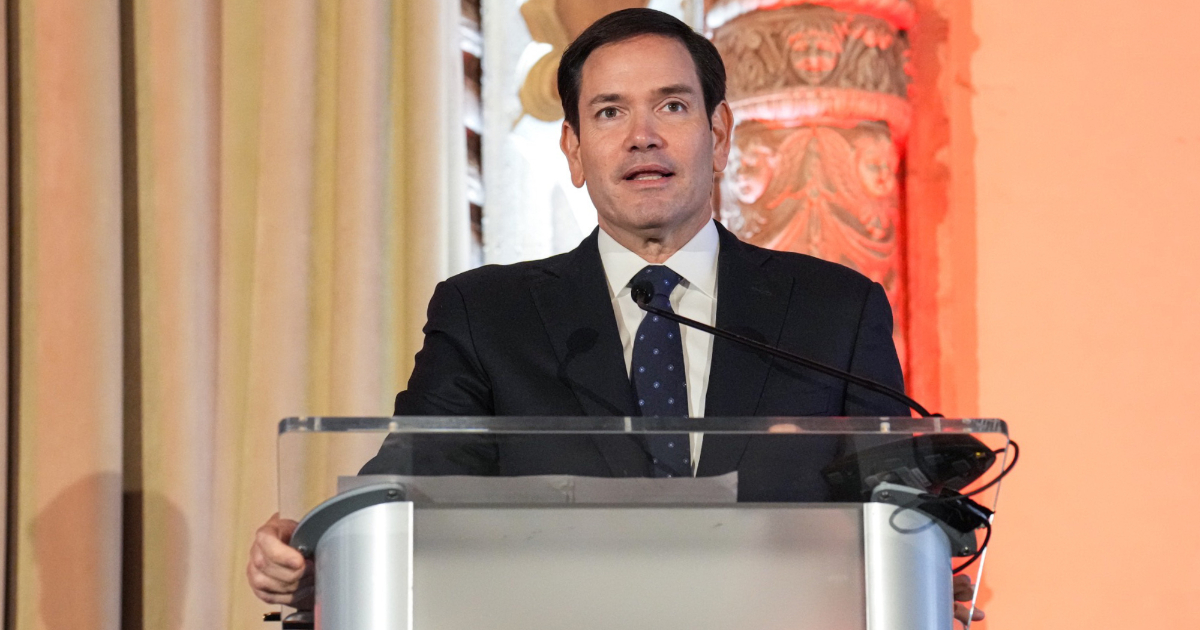
U.S. Secretary of State Marco Rubio announced on Friday a series of new visa restrictions targeting members of radical left-wing groups, labeling those who fund or support them as "adversaries of our civilization" who are unwelcome on American soil.
The announcement came from the official State Department account on X, following Rubio's leadership at the "Ministerial Meeting on the Resurgence of Political Terrorism" in Washington, attended by representatives from between 65 and 70 countries.
In alignment with the Trump administration's stance against the regimes, Cuba, Nicaragua, and Venezuela were explicitly excluded from the gathering.
During Thursday's summit, Rubio stated, "Foreign nationals who finance, incite, or collaborate with left-wing extremists are adversaries of our civilization and are not welcome in the United States."
He described leftist extremism as "a toxic resentment masquerading as equality language" and criticized the U.S. counter-terrorism doctrine for overlooking this "blind spot" for too long.
The new restrictions are backed by Section 212(a)(3)(C) of the Immigration and Nationality Act and National Security Presidential Memorandum-7, applying to individuals who have supported or incited acts of terrorism, engaged in economic sabotage, financed violent networks, or facilitated the convergence of extremist groups.
Rubio also revealed that the administration will offer up to $10 million through the "Rewards for Justice" program for information that leads to the dismantling of these groups’ financial networks.
State Department spokesperson Tommy Pigott described the threat as "an old menace re-emerging with strong transnational links."
Cuban Foreign Minister Bruno Rodríguez accused Rubio of trying to "reinstate political persecution and repression" in the U.S., dismissing the claims as "McCarthyist."
This initiative has not been without its tensions among allies. Spain participated in the summit only at the embassy level, showing reservations about the approach that treats Antifa as a structured organization, a notion several critics challenge.
"Under President Trump's leadership, for the first time, the United States is building the infrastructure, alliances, and strategy necessary to defeat the scourge of left-wing terrorism," Rubio declared to the delegations gathered in Washington.
This measure is part of a sustained escalation. In November 2025, the State Department had already designated four European left-wing groups as Foreign Terrorist Organizations: Antifa Ost (Germany), FAI/FRI (Italy), Armed Proletarian Justice, and Revolutionary Class Self-Defense (both from Greece).
Cuba plays a central role in this agenda. In June 2026, Rubio described the island before the U.S. Senate as "the global capital of radical left-wing terrorism" and sanctioned five Cuban entities, including the Ministry of the Revolutionary Armed Forces (MINFAR) and the Committees for the Defense of the Revolution (CDR), accusing them of funding subversive operations.
Understanding the New U.S. Visa Restrictions
What are the new visa restrictions announced by Marco Rubio?
The new visa restrictions target members of radical left-wing groups who support or finance extremist activities. These individuals are labeled as adversaries of civilization and are barred from entering the United States.
Why were Cuba, Nicaragua, and Venezuela excluded from the summit?
Cuba, Nicaragua, and Venezuela were excluded due to the Trump administration's stance against their regimes, which are viewed as hostile to U.S. interests and aligned with extremist ideologies.
How does the "Rewards for Justice" program contribute to this initiative?
The "Rewards for Justice" program offers up to $10 million for information leading to the dismantling of financial networks of radical left-wing groups, thereby supporting efforts to curb extremism.