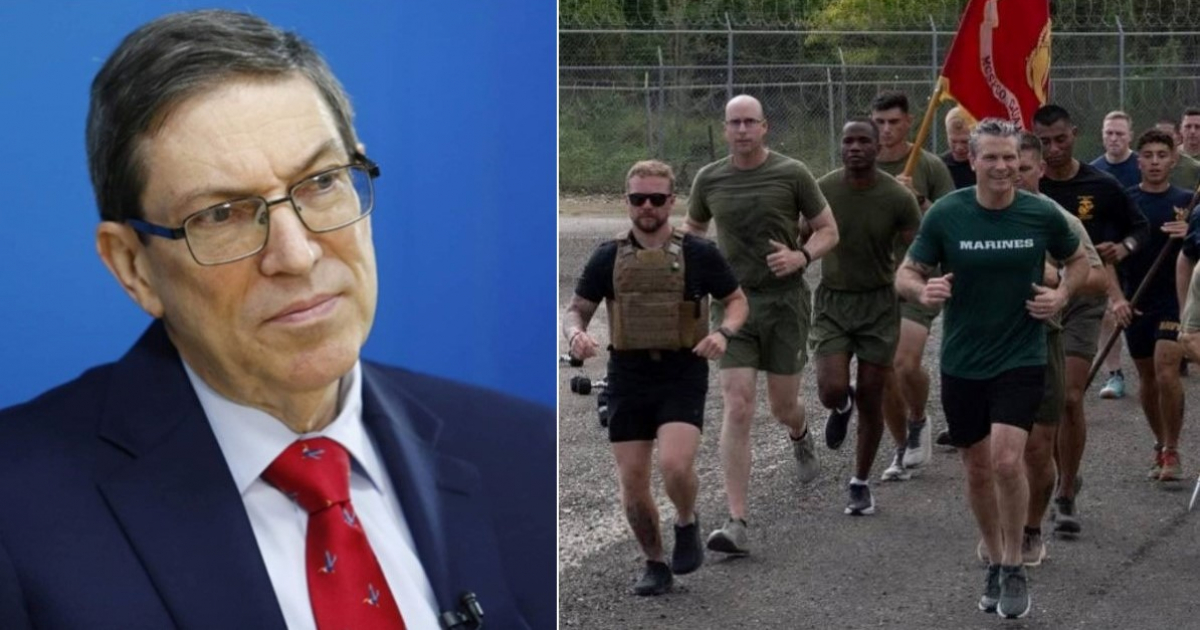
The Cuban Foreign Minister, Bruno Rodríguez Parrilla, launched a scathing critique on Friday against U.S. Secretary of Defense Pete Hegseth. Rodríguez questioned Hegseth's authority to enforce physical and hormonal standards on soldiers while implying that the American official struggles to keep pace with the Marines.
In a statement on X, Rodríguez pointed out what he perceives as Hegseth's hypocrisy. "While the U.S. Secretary of Defense lobbies for increased military budgets that fuel the arms race and ignite global tensions, he unwaveringly supports wars in the Middle East and Europe, issues threats against various countries, and dismisses his most seasoned and recognized generals. Yet, he distrusts the physical strength and preparedness of his soldiers," he wrote.
The criticism was triggered by Hegseth's July 15 announcement to implement mandatory annual testosterone tests for all military personnel over 30 as part of their routine medical evaluation.
Contradiction in Leadership
Rodríguez didn't miss the opportunity to highlight an episode that, according to him, contradicts Hegseth's rhetoric: "He was seen dizzy after attempting to keep up with a Marine physical routine not long ago," referring to Hegseth's training sessions with his subordinates at the Guantanamo Naval Base.
"Now he says he will conduct testosterone tests on his military personnel to determine whether they are fit for duty and capable of withstanding the demands of combat. If he doesn't meet the standards, what will he do?" Rodríguez mocked.
During his June visit to the base, Hegseth was seen working out with Marines and sailors, running in formation, performing leg exercises, and lifting weights. Despite Rodríguez's comments, images of the U.S. Secretary of Defense in athletic attire sparked humorous remarks from Cubans who set politics aside to admire his physical appearance.
High-T Program Controversy
Hegseth has stirred controversy again with his new program, coined "High-T" after a social media trend that promotes high testosterone levels as a symbol of masculinity. "I authorize a new program to screen for testosterone deficiency among our service members, ensuring they have the necessary testosterone levels to perform at their highest capability," he announced in a video on X.
He justified the measure by stating it is about "restoring and optimizing their natural capabilities, protecting their longevity, and ensuring they have the biological foundation needed for sustained combat."
Backlash from Lawmakers and Experts
In the U.S., the initiative has faced backlash. Democratic Representative Chrissy Houlahan, an Air Force veteran, labeled the program a "cultural war obsession," asserting that "the announcement proves Secretary Hegseth is following instructions from the fringes of the manosphere."
Houlahan opposed granting $150 billion to the Department of Defense, calling Hegseth "reckless, incompetent, and unapologetic."
Medical experts from the Endocrine Society and the American Urological Association have also questioned the measure, warning that no established correlation exists between baseline testosterone levels and physical or military readiness, and that mass testing contradicts current clinical guidelines.
The Department of Defense did not specify which studies support the measure or clarify whether female military personnel—who make up 17% of active-duty members—would be evaluated for equivalent hormonal deficiencies.
Understanding the Impact of Testosterone Testing in the Military
What prompted Bruno Rodríguez's criticism of Pete Hegseth?
Bruno Rodríguez criticized Pete Hegseth following the announcement of mandatory annual testosterone tests for military personnel over 30, questioning the credibility and consistency in Hegseth's leadership.
What is the "High-T" program?
The "High-T" program is an initiative authorized by Pete Hegseth to screen military personnel for testosterone deficiency, aiming to ensure they have the testosterone levels necessary for optimal performance.
What are the criticisms against the testosterone testing initiative?
Critics, including lawmakers and medical experts, argue that the initiative lacks scientific backing, does not align with current clinical guidelines, and is influenced by cultural obsessions with masculinity.